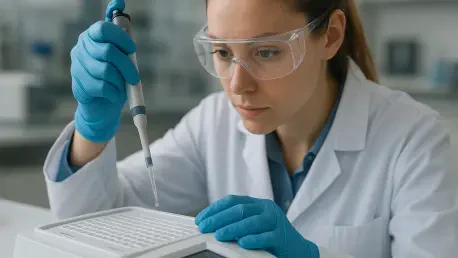

Facility-0 utilizes reverse-engineered software drivers and custom hardware adapters to bridge the functional gap between digital intelligence and physical laboratory equipment. This San Francisco-based initiative marks a definitive transition from generative models that merely process text to

Systemic administration of high-dose antibiotics often causes severe collateral damage to the gut microbiome and vital organs like the kidneys before reaching the lungs. This fundamental limitation of traditional pharmacology has reached a critical tipping point as global healthcare systems

The ability to produce deciliter-scale volumes of organized synthetic tissue within minutes represents a major breakthrough in materials science scalability. This advancement is driven by the development of Jammed Interconnected Bilayer Emulsions, commonly known as JIBEs, which mark a significant

For Tim Andrews, a 66-year-old patient with Type O blood, the experiment served as a vital bridge to a human transplant after two years of exhaustive waiting. This milestone, achieved through the collaboration of researchers and surgeons at Massachusetts General Hospital, signals a pivotal shift in

Scaling up carbon removal requires a transparent monitoring framework, which is provided by the predictable stoichiometric ratios of mineral-based alkalinity generation. As the world moves through 2026, the urgency of the climate crisis has shifted the global conversation from simple emissions

The inherent swarming motility of bacterial colonies provides a unique medium for storing information that can be analyzed using standard optical scanning rather than genomic sequencing. This technological leap, spearheaded by researchers at Columbia University, represents a shift from observing