
The frontier of synthetic biology has moved beyond the mere editing of existing organisms toward the radical construction of entirely new life forms from inanimate chemical components. For decades, the primary strategy involved stripping genetic material from bacteria until only the essentials remained, yet the SpudCell project at the University of Minnesota has fundamentally disrupted this paradigm through a bottom-up methodology. By assembling a functional cellular chassis from non-living parts, researchers have established a clear roadmap for the absolute minimum machinery required to sustain a biological life cycle. This achievement identifies the critical transition points where a collection of chemicals becomes an active, reproducing system capable of gathering resources and following genetic instructions. Instead of relying on nature’s complex templates, this model offers a unique perspective on how fundamental building blocks can be organized to maintain vitality.
The Core Subsystems of the Synthetic Chassis
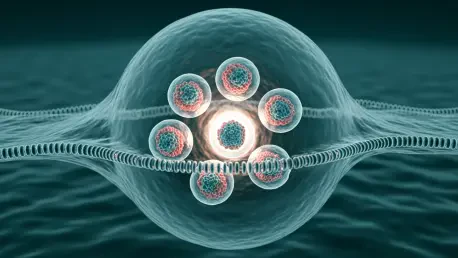
The structural foundation of the SpudCell architecture rests upon a sophisticated boundary layer comprised of a self-assembled lipid membrane that mimics natural barriers. This protective shell acts as a precise filter, ensuring that delicate internal tools remain concentrated while allowing essential energy molecules to permeate from the external environment. Within this boundary, the modular information store functions as the genetic blueprint, but it diverges significantly from the massive genomes seen in traditional organisms. Rather than a single massive chromosome, the system utilizes a compact code of only ninety kilobase pairs distributed across seven distinct DNA circles known as plasmids. This modularity is a deliberate engineering choice, allowing scientists to fine-tune specific cellular functions or swap out information blocks without compromising the structural integrity of the entire system, providing a degree of control that is impossible with natural biology.
Powering the internal operations of the chassis is an energy and translation engine that functions as a highly specialized molecular factory. Because the synthetic design is currently too simple to synthesize its own energy from raw environmental materials, it is pre-loaded with a critical mixture of ribosomes and enzymes harvested from bacterial sources. This internal machinery is responsible for reading the synthetic genetic code and synthesizing the specific proteins required for the cell to maintain its structural state and perform work. This hybrid approach, combining synthetic information with biological hardware, creates a bridge between pure chemistry and functional life. By isolating the translation process within the lipid membrane, researchers have successfully demonstrated that the most basic unit of biological activity can be sustained as long as the necessary catalytic components are present, effectively acting as a programmable engine for biochemical production.
Mechanical Solutions for Cell Division: Harnessing Physical Stress
Achieving self-replication is perhaps the most significant milestone for any synthetic organism, and the SpudCell platform utilizes a unique physical mechanism to accomplish this feat. Most natural cells rely on an intricate internal skeleton composed of protein filaments to physically pull the cell apart during cytokinesis, but replicating such complexity in a lab environment has remained a persistent obstacle. The Minnesota researchers bypassed this hurdle by implementing a passive mechanical process driven by internal pressure and asymmetrical tension. When specific proteins are synthesized according to the plasmid instructions, they migrate toward the inner surface of the lipid membrane. As these proteins accumulate, they generate enough physical stress to cause the membrane to undergo a shape change. Once this tension reaches a critical threshold, the membrane naturally snaps, dividing the parent vesicle into two daughter units without the need for complex, energy-consuming cytoskeleton machinery.
This reliance on mechanical stress rather than biological scaffolding suggests that the requirements for life-like propagation might be simpler than previously believed by the scientific community. While the resulting division is less precise than the highly regulated cycles seen in natural bacteria, it successfully proves that a simplified chassis can still undergo the essential stages of growth and multiplication. This discovery has profound implications for understanding early evolutionary processes, as it demonstrates how primitive life forms might have divided using basic physical laws before developing more advanced protein-based motors. By simplifying the reproductive process to a matter of material science and membrane dynamics, the project has removed one of the largest engineering bottlenecks in synthetic biology. This streamlined method of division ensures that the chassis can continue to exist across several cycles, providing a robust platform for testing the limits of what constitutes an autonomous biological entity.
Comparing Synthetic Life and Natural Autonomy: The Gap
While the ability to grow and divide represents a monumental step forward, a significant gap still persists between these synthetic constructs and the autonomy of natural biological systems. Natural cells are metabolically independent, possessing the innate ability to synthesize all necessary organic compounds from simple environmental salts and energy sources. In stark contrast, the SpudCell operates as an obligate consumer, meaning it lacks the internal pathways to sustain itself without constant external support. To remain active, the chassis must be fed complex biochemicals through a controlled process where it merges with specialized feeder droplets containing the required nutrients and molecular building blocks. This dependency highlights the current limitations of bottom-up synthesis, where the chassis acts more like a high-tech processor than a self-sustaining organism. The researchers have noted that achieving full metabolic independence will require a significant expansion of the genetic code and more complex enzyme integration.
Beyond the metabolic constraints, the synthetic chassis also encounters a biological ceiling frequently referred to by researchers as translational death. This phenomenon occurs because the current iteration of the cell is incapable of manufacturing its own ribosomes, which are the fundamental machines required for protein synthesis. Every time the cell divides through its mechanical process, the existing pool of ribosomes is effectively cut in half and distributed between the two new daughter cells. Without a mechanism to replenish these essential tools, the concentration of protein-building machinery eventually drops below the level required to sustain life-like functions. This dilution effect means that the synthetic cell line typically stops operating after a few generations, unlike natural bacteria that can proliferate indefinitely through continuous internal manufacturing. Solving this dilution problem remains a primary focus, as it is the final barrier preventing synthetic life from achieving true long-term viability.
Industrial Potential and the Path Toward Autonomy
The movement of this technology from a foundational laboratory experiment into a practical industrial tool is already gaining momentum within the biotechnology sector. Synthetic cells like the SpudCell are viewed as ideal candidates for biomanufacturing specifically because they lack the survival instincts and evolutionary baggage of natural organisms. Traditional production hosts, such as yeast or bacteria, often divert a significant portion of their internal energy toward their own maintenance, defense, and stress responses, which limits their efficiency. A synthetic chassis, however, can be programmed with singular focus, dedicating nearly all of its metabolic throughput to the production of high-value pharmaceuticals, biofuels, or advanced materials. This lack of biological overhead allows for a much cleaner and more predictable manufacturing process, where the output is determined solely by the genetic instructions provided by the engineers, rather than the competing needs of a living organism.
To advance toward the next stage of development, researchers prioritized the consolidation of the seven separate plasmids into a single, cohesive artificial chromosome. This transition was designed to ensure more reliable genetic transmission during the division process and to minimize the risk of losing critical information. Engineers also integrated primitive transport proteins into the membrane to allow for more efficient nutrient uptake, which reduced the reliance on external feeder droplets. These systematic improvements successfully transformed the SpudCell from a basic laboratory curiosity into a programmable platform capable of more sophisticated biological tasks. The focus then shifted toward creating self-replicating ribosome systems to overcome the limitations of translational death. By addressing these structural and metabolic hurdles, the scientific community established a foundation for autonomous synthetic units that served as specialized micro-factories, permanently altering the landscape of chemical engineering and medical manufacturing.