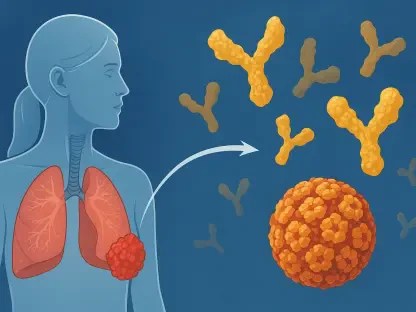

Suboptimal cancer care results in massive financial waste because treatments are frequently administered to patients who cannot biologically benefit. The modern healthcare landscape is reaching a critical turning point where traditional, generalized cancer treatments are no longer sufficient to

Secure inference through the Cheon-Kim-Kim-Song scheme represents a promising but technically difficult path toward providing cloud-based medical diagnoses. For millions of people across the globe, the sudden and unpredictable loss of consciousness known as vasovagal syncope is more than a medical

The gap between how an imaging scanner performs on a simple test object and how it performs on a human patient has widened significantly as technology advances. This disparity marks a pivotal moment in the evolution of medical imaging quality assurance, shifting the primary focus from purely

The emergence of New Approach Methodologies is driven by both a need for higher scientific accuracy and the ethical considerations surrounding traditional laboratory testing. As drug developers navigate an increasingly complex landscape where costs for a single successful launch often exceed two

The integration of artificial intelligence into biological research enables the analysis of vast datasets to accelerate both life-saving cures and the potential engineering of biological weapons. This dual nature of modern science has transformed the way governments perceive national safety and

With over 1,000 patents filed and nearly 400 papers accepted at global conferences, the institute has already addressed more than 100 distinct industrial challenges. As LG AI Research pushes the boundaries of innovation, the current landscape of industrial research is witnessing a profound