
The proposed six-level autonomy framework provides a shared technical vocabulary for engineers and regulators to navigate the gradual handoff of tasks from humans to machines. This strategy, unveiled at the Roche Pharma Day, establishes a rigorous pathway for the integration of robotics and artificial intelligence into the delicate world of drug discovery. By standardizing these tiers of automation, the company is attempting to move beyond the current trend of isolated digital tools and instead create a cohesive, self-improving research environment. This approach recognizes that the complexity of human biology requires more than just faster data collection; it demands a system where the physical execution of experiments and the computational analysis of results are inseparable components of a single, continuous loop. As drug development costs continue to soar, the necessity for such a structured transition becomes undeniable. This roadmap is not merely a technical guide but a strategic pivot aimed at maximizing the value of experimental data while fundamentally shortening the time required to bring novel therapies from the bench to the clinic, ensuring that scientific precision keeps pace with technological capability.
Progressing Through the Levels of Laboratory Autonomy
Transitioning From Manual Work to Assisted Workflows
At the starting point of this journey, Level 0 and Level 1 define the historical and contemporary baseline for most pharmaceutical research. In a fully manual Level 0 environment, scientists perform every task by hand, from pipetting microscopic samples to manually documenting results in lab notebooks. While this allows for high levels of human intuition, it is inherently limited by physical speed and a significant margin for human error. Level 1 introduces a layer of mechanization where individual instruments, such as automated liquid handlers or plate readers, manage specific, repetitive duties. However, these machines still operate in silos, requiring humans to physically transport samples between stations and manually initiate each new phase of the experimental process, which creates bottlenecks and limits the overall throughput of the facility.
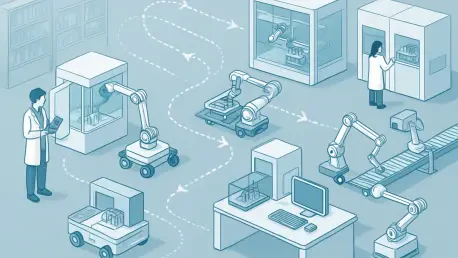
The transition to Level 2 marks a significant leap in operational efficiency by establishing connected workflows. At this stage, disparate automated instruments are integrated into a cohesive sequence, often linked by robotic arms or conveyor systems that move biological materials without direct human intervention. This connectivity reduces the physical burden on researchers and ensures that data is captured consistently across the entire workflow. By eliminating the need for manual handoffs, laboratories can operate with much greater precision and repeatability, ensuring that the results of a high-throughput screen are as reliable as those from a carefully controlled small-scale experiment. This technical foundation is essential for the higher levels of autonomy, as it provides the structured data environment necessary for artificial intelligence to begin its role in scientific decision-making.
Achieving Domain Independence and Lab-Wide Autonomy
As the laboratory environment moves into Level 3, the relationship between the machine and the scientist begins to shift from simple execution to intelligent assistance. In these AI-assisted workflows, computational models do not just store data; they actively suggest experimental directions or optimize specific parameters based on real-time findings. For example, if a model detects a specific pattern in how a protein reacts to a series of chemical compounds, it might recommend a new set of concentrations to test in the next hour. This level of interaction allows for a much more dynamic research process, where the software acts as a partner that helps the human researcher navigate the vast search space of possible drug candidates more effectively than manual analysis ever could.
The ultimate vision of the roadmap is realized at Level 4 and Level 5, where laboratories achieve domain-specific and eventually lab-wide autonomy. Level 4 focuses on specialized scientific areas, such as synthesis or assay development, operating with high degrees of independence from human input. This culminates in Level 5, where the entire research cycle—encompassing observation, prediction, design, execution, and reporting—functions as a self-sustaining loop. In such a system, the laboratory identifies a scientific question, designs the necessary experiments, executes them, and updates its internal models with the new results without requiring a human to intervene in the daily operations. This creates a continuous engine of discovery that can work around the clock, dramatically accelerating the pace at which we understand complex disease mechanisms and identify potential cures.
Redefining the Human Element in Research
The Evolution of the Scientist’s Daily Role
A common misconception about laboratory autonomy is that it aims to remove humans from the research process; in reality, the roadmap outlines a fundamental elevation of the scientist’s daily role. As machines take over the physical execution of experiments, the human worker moves through a four-stage evolution: Operator, Assistant, Approver, and Auditor. In the initial Operator and Assistant stages, the focus is on the manual handling of materials and the direct supervision of equipment. These roles require significant physical presence and a high degree of technical dexterity in the wet-lab environment. However, as automation matures, the scientist is liberated from these repetitive tasks, allowing them to focus on the higher-level intellectual challenges that a machine cannot yet navigate, such as conceptualizing entirely new therapeutic modalities or interpreting unexpected biological phenomena.
This shift in responsibility necessitates a change in the educational and training requirements for the next generation of biomedical researchers. Future scientists will need to be as proficient in data science and systems engineering as they are in molecular biology or chemistry. The transition from doing the work to managing the system requires a deep understanding of how autonomous loops function and where they might fail. Instead of mastering the art of manual pipetting, researchers will spend their time designing the logic of the experiments and ensuring that the automated systems are asking the right questions. This evolution transforms the laboratory from a place of manual labor into a hub of high-level strategic oversight, where human creativity is the primary driver of scientific progress, supported by an army of autonomous machines.
Governance and the Auditor Responsibility
As the scientist moves into the roles of Approver and Auditor, the nature of scientific accountability undergoes a profound transformation. In an autonomous laboratory, the human is no longer the one making every small decision; instead, they serve as the ultimate authority that validates the outputs of complex AI models. This role as an Auditor involves verifying that the autonomous processes remain within strict ethical, legal, and regulatory boundaries. When an AI agent suggests a new drug target or a specific experimental path, the human Auditor must be able to interrogate that decision, ensuring it is grounded in sound scientific logic and does not pose unforeseen risks. This governance is critical to maintaining the integrity of the research and ensuring that the speed of automation does not lead to systemic oversights.
Furthermore, the transition to high-level auditing carries significant implications for how liability and quality control are handled within the pharmaceutical industry. If an autonomous system produces a flawed result, the responsibility lies with the Auditor who failed to detect the systemic error rather than an Operator who made a manual mistake. This shift requires the development of new auditing tools and standardized protocols that allow humans to effectively monitor the “health” of an autonomous loop. By focusing on systemic oversight, scientists can ensure that the laboratory remains a reliable and ethical engine of discovery. This transition into a governance-focused role is not just a change in job description; it is a necessary evolution to ensure that the massive power of autonomous technology is harnessed safely and effectively for the benefit of global health.
Quantifying AI Impact and Strategic Partnerships
Measuring the Weight of Computational Contributions
One of the most transparent aspects of the new strategy is the implementation of a granular system for measuring how artificial intelligence actually impacts the drug discovery pipeline. Rather than treating AI as a vague marketing concept, the roadmap categorizes its contributions into three distinct tiers: Critical, Supportive, and Informative. Recent internal data revealed that 40 percent of pipeline decisions already involve some form of computational or AI-tracked input. Within those decisions, approximately 41 percent were classified as “Critical,” meaning they materially influenced the direction of the research. Another 48 percent were “Supportive,” meaning they significantly increased the confidence of the research teams, while only 10 percent were merely “Informative,” serving to broaden the understanding of a topic without changing the decision-making path.
This level of detailed reporting sets a new industry benchmark for transparency and accountability in the use of advanced technologies. By categorizing the “weight” of AI influence, the organization can accurately assess the return on investment for its computational tools and identify which areas of the pipeline benefit most from automation. This data-driven approach effectively counters the trend of “AI-washing” by providing concrete evidence of how and where machine learning is making a difference. For investors and regulators alike, this transparency provides a clear picture of how technology is being integrated into the core of the business, moving the conversation away from speculative potential and toward a rigorous assessment of actual scientific utility and impact on the success of new medicine.
Owning the Data Loop While Renting Infrastructure
The architectural strategy for achieving AI independence is built on a sophisticated “buy versus build” logic that distinguishes between the infrastructure layer and the application layer. Instead of attempting to build foundational large language models or specialized hardware from scratch, the company leverages partnerships with established technology leaders. By collaborating with NVIDIA for the “AI factory” hardware and utilizing models from OpenAI and Anthropic through Model-as-a-Service arrangements, the firm can access cutting-edge computational power without being tied to a single technology that might rapidly depreciate. This approach allows the organization to remain agile, swapping out models or hardware as the tech landscape evolves while focusing its internal resources on its core strength: high-quality biological data.
Crucially, while the infrastructure is “rented,” the organization maintains absolute ownership over the proprietary data loops generated within its laboratories. The real value in the “Lab-in-a-Loop” model is not the generic AI model itself, but the unique, compounding scientific data that the model produces and learns from over time. By owning the loop, the firm ensures that its intellectual property remains a proprietary asset that competitors cannot easily replicate. This distinction allows the company to harness the best of Silicon Valley’s innovation while insulating its long-term research value from the volatility of the technology sector. This strategy ensures that as models become commoditized, the proprietary insights derived from clinical expertise and autonomous experimentation continue to grow in value, forming a durable competitive advantage.
Strategic Implementation and Future Implications
Front-Loading Decisions With TargetNexus
A central component of the autonomous roadmap is TargetNexus, an advanced AI agent specifically designed for the critical task of target assessment. In the world of drug development, identifying the correct biological target—such as a specific protein or gene involved in a disease—is the most high-stakes decision a researcher can make. A mistake at this stage can lead to a failure in clinical trials years later, costing billions of dollars. TargetNexus is designed to intervene at this earliest point in the loop, using vast datasets to evaluate the probability of success for various targets before significant resources are committed. The goal is for this agent to be involved in 80 percent of all research portfolio decisions by the end of the current year, providing a level of predictive power that was previously impossible.
By concentrating AI power at the “front-of-the-loop,” the organization aims to shift the entire probability distribution of its success. Identifying flawed targets early allows the company to fail quickly and cheaply, redirecting resources toward the most promising candidates. This front-loading of decision-making is strategically brilliant because it addresses the most expensive part of the drug discovery lifecycle: the late-stage clinical failure. As TargetNexus continues to learn from every successful and unsuccessful target assessment, its predictive accuracy will only improve, creating a virtuous cycle of better decisions and higher success rates. This focus on high-leverage, early-stage intervention demonstrates how autonomous systems can be used not just to do things faster, but to do things much more intelligently from the very beginning of the process.
Preparing for a New Regulatory and Competitive Landscape
The shift toward autonomous laboratories highlighted a significant governance gap that required regulatory bodies to reconsider traditional validation methods. Because current frameworks were largely designed for manual processes and human-led documentation, the move to a Level 5 autonomous lab necessitated a new way of thinking about compliance. Regulators like the FDA began exploring how to audit the logic of a complex autonomous loop rather than just the final output. The industry consensus suggested that the future of regulation would focus on the “human-in-the-loop” acting as a high-level auditor who could guarantee the integrity of the machine’s decisions. This evolution ensured that the rapid pace of technological adoption did not outstrip the frameworks designed to protect patient safety and scientific rigor.
The strategic roadmap successfully presented a blueprint for how the pharmaceutical industry could navigate the transition from manual experimentation to a fully integrated digital ecosystem. By categorizing AI contributions with high transparency and focusing on early-stage target assessment, the organization established itself as a leader in the next generation of drug discovery. This disciplined approach encouraged other firms to move away from vague technological claims and toward evidence-based disclosures of AI utility. Ultimately, the successful implementation of these autonomous systems depended on the ability of scientists to evolve into high-level auditors, ensuring that the new “Lab-in-a-Loop” model remained a reliable source of medical innovation for years to come.