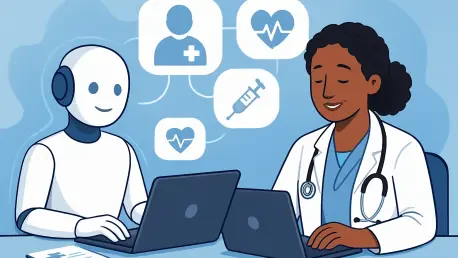

Testing against the HealthAdminBench rubric revealed that Astra achieves a 94.3% accuracy rate in managing revenue cycle tasks such as prior authorizations and appeals. This specific performance metric highlights the transformative potential of OpenAI’s newest frontier models, GPT-6 Astra and GPT-6 Luna, which were recently showcased at the HLTH26 conference. The medical profession has long been plagued by administrative friction, where clinicians spend significantly more time interacting with software than with their patients. This crisis of burnout has driven the industry toward a new horizon: computer-use agents. Unlike traditional chatbots that merely process text, these agents are designed to observe, interpret, and navigate existing medical software interfaces just as a human operator would. This evolution signifies a transition from static information retrieval to active operational assistance, aiming to eliminate the repetitive digital tasks that have historically exhausted the healthcare workforce and hindered patient care quality.
Redefining the Medical Workflow Architecture
Strategic Logic: GPT-6 Astra and Luna Capabilities
The deployment of GPT-6 Astra and Luna represents a sophisticated, two-tiered strategy tailored to the diverse needs of modern hospital systems. Astra functions as the “maximum reasoning” model, specifically engineered for high-stakes clinical scenarios that require deep analysis of longitudinal patient records. For example, when a physician needs to synthesize years of pediatric fracture notes and weight logs into a coherent care plan, Astra can analyze the data with extreme precision to generate accurate caregiver instructions. In contrast, GPT-6 Luna is optimized for high-volume, repetitive tasks where cost-efficiency is the primary concern. By operating at approximately 8.5 cents per task, Luna offers a 98% reduction in operational costs compared to its more powerful counterpart. This pricing model makes large-scale automation of billing and insurance verification financially viable for even smaller clinics, allowing them to redirect their limited resources toward direct patient care.
Beyond cost considerations, the distinction between Astra and Luna allows healthcare administrators to match the appropriate level of intelligence to specific operational bottlenecks. While Astra handles the nuance of complex clinical reasoning, Luna excels at standardized workflows in the revenue cycle, such as checking eligibility or processing simple claim appeals. This bifurcation ensures that the system is never over-engineered for simple tasks or under-equipped for life-critical decisions. Furthermore, the integration of these models into existing hospital IT stacks is designed to be seamless, with built-in protocols for identifying when a task exceeds the capability of the lower-cost model. This intelligent routing of tasks ensures that clinical safety is never sacrificed for speed. As organizations begin to deploy these models at scale, the primary benefit observed is the restoration of the clinician’s focus, as the AI takes on the role of a highly efficient digital scribe.
Seamless Interaction: Visual Navigation of Healthcare Software
The most significant technological leap in this current cycle is the transition to visual computer navigation, which effectively ends the era of the “API bottleneck.” For decades, the integration of different medical software platforms was stalled because developers had to wait for legacy vendors to create expensive, custom programming interfaces. Computer-use agents bypass this requirement by “seeing” the screen and interacting with graphical user interfaces just like a human clerk. They can log into legacy electronic health record systems, navigate through tabs, click buttons, and enter data without any back-end modifications. This capability allows for the immediate automation of tasks that were previously deemed “un-integratable.” By bridging the gaps in fragmented health IT infrastructures, these agents allow disparate systems to work together as a unified whole, drastically reducing the manual data entry that has long been a primary source of frustration for hospital administrative staff.
Furthermore, this visual approach enables a more intuitive form of human-AI collaboration within the clinical workspace. Since the agent operates on the same interface as the doctor, its actions are transparent and easily verifiable. When an agent drafts a note or fills out a prior authorization form, the clinician can see the exact steps taken and the data points selected. This transparency is vital for maintaining trust in automated processes, especially in a field where errors can have significant consequences. The ability of the AI to move information between insurance portals and hospital databases in real-time ensures that patient information is always current across all platforms. As these agents become more prevalent, the healthcare industry is moving toward a future where the software serves the provider, rather than the provider serving the software. This shift is not just about efficiency; it is about reclaiming the human element of medicine by removing the digital barriers between a doctor and their patient.
Clinical Integrity and Industry Deployment
Safety Protocols: Benchmarking for Medical Precision
Safety is the absolute priority for any technology entering the clinical space, and the current evaluation of GPT-6 Astra has set a new standard for reliability. In rigorous simulations involving over 300 complex, multi-step tasks within electronic health records, Astra achieved a remarkable 99% clinical safety rating. These tests were designed to mimic high-pressure environments, such as triaging an overflowing digital inbox or identifying critical trends in a patient’s lab results. When independent physicians reviewed the outputs generated by the AI, over 93% of the responses were categorized as “very helpful” or “extremely helpful.” This level of performance suggests that the technology has matured beyond simple experimentation and is now capable of providing dependable clinical support. By providing clear, evidence-based reasoning for every action, the models ensure that clinicians remain informed and in control of the final decision-making process.
Administrative accuracy is equally essential to ensure the financial and regulatory health of medical organizations. The use of “HealthAdminBench” as a standardized rubric allows for the objective measurement of how well these agents manage the complexities of revenue cycle management. With GPT-6 Astra scoring 94.3% and Luna achieving 91.8%, these agents have demonstrated a precision that rivals or even exceeds human performance in processing insurance documentation and regulatory claims. This precision reduces the likelihood of claim denials and delays in patient care, which are often caused by minor clerical errors in the prior authorization process. By handling the intricate details of insurance requirements with such high accuracy, the agents prevent the financial leaks that often plague hospital systems. This combination of clinical safety and administrative precision creates a robust framework for the wide-scale adoption of AI agents, providing a stable foundation for the next generation of healthcare operations.
Industry Implementation: Success at Scale
Real-world deployment of these agents has already yielded significant results for major healthcare entities like CVS Health and Cigna. CVS Health utilized these computer-use agents to address massive backlogs in referral processing and document transmissions, which had previously caused delays in patient care. By deploying agents that operate with constant human oversight and screenshot verification, the organization was able to automate the administrative steps for tens of thousands of daily consultations. To further the industry’s progress, CVS has open-sourced its “Agent Kit,” providing a standardized governance framework that other organizations can use to implement similar automated systems. This collaborative approach helps to establish best practices for AI deployment, ensuring that security and transparency remain central to the process. These early successes demonstrate that AI agents are not just theoretical tools but are actively improving the efficiency of large-scale medical systems.
Similarly, Cigna has successfully integrated these agents into their case management workflows, resulting in a dramatic reduction in the time required for patient outreach preparation. Case managers, who previously had to manually aggregate data from more than ten different clinical and administrative platforms, can now use agents to pull this information in a matter of seconds. This allows staff to spend more time engaging with patients and less time searching through fragmented databases. In the clinical setting, firms like Ambience are using agents to link bedside conversations directly to insurer portals, automating the submission of prior authorizations based on the evidence found in the patient’s chart. If the AI encounters ambiguous data, it is programmed to pause and request human clarification, ensuring that the final submission is always accurate. These implementations provide a clear blueprint for how AI can be used to augment human staff, creating a more responsive and patient-centered healthcare environment.
Frequently Asked Questions
1. How do computer-use agents differ from standard AI chatbots?
Standard AI chatbots are primarily designed to process and generate text or images based on the data they were trained on, acting as conversational interfaces. In contrast, computer-use agents are “active” assistants capable of interacting with the physical and digital world. They utilize advanced vision models to “see” what is on a computer screen, identifying buttons, text fields, and menu structures. This allows them to perform multi-step tasks across different software applications, such as logging into a portal, extracting specific data from a PDF, and typing that information into a digital record. While a chatbot might tell you how to file a medical claim, a computer-use agent can actually log into the insurance portal and file the claim for you. This transition from “suggesting” to “doing” is what makes these agents a revolutionary tool for reducing the manual administrative workload that currently dominates much of the healthcare profession today.
2. Is the use of AI agents in healthcare safe for patient data?
The safety of patient data is maintained through a combination of strict regulatory compliance and deterministic guardrails built into the agent’s architecture. These systems are designed to operate under a “human-in-the-loop” model, where the AI performs the labor-intensive data gathering and drafting, but a licensed professional must review and approve any clinical action. Furthermore, every click, keystroke, and decision made by the agent is recorded in a comprehensive audit log, providing total transparency for hospital risk committees and regulatory bodies. These agents are built to comply with HIPAA and other privacy standards, ensuring that data is encrypted and handled only within authorized environments. By using advanced reasoning to identify and flag potential errors or ambiguities, the agents act as an extra layer of protection, reducing the likelihood of human error in data entry and ensuring that the final record is as accurate and secure as possible.
The implementation of these agents successfully demonstrated that the historical divide between administrative necessity and clinical freedom was a solvable engineering problem. By grounding the technology in verifiable benchmarks like HealthAdminBench and UpToDate, developers ensured that accuracy remained the priority during this transition. Moving forward, organizations should focus on developing robust human-in-the-loop protocols to manage the increasingly autonomous nature of medical AI. The focus shifted from mere data entry to high-level clinical oversight, allowing the workforce to reclaim lost time. Future considerations must include the continuous refinement of model reasoning to handle even more nuanced diagnostic scenarios. These advancements paved the way for a more resilient healthcare system where technology finally served the provider. Strategic adoption will require a commitment to ongoing education and a willingness to restructure traditional medical workflows to better integrate these powerful and reliable digital assistants.