
The recent emergence of light-driven nanomotors has fundamentally altered the trajectory of precision oncology by providing a sophisticated mechanism for delivering complex therapeutic payloads directly into the heart of malignant tumors. For years, the primary obstacles in treating aggressive breast cancer have remained the same: the inability of drugs to penetrate dense tumor tissue and the tendency of the body’s immune system to neutralize therapeutic agents before they reach their destination. A research team led by Professor Hu has developed a groundbreaking biomimetic nanomotor, known as PFB@CM, which addresses these challenges through a synergistic combination of photothermal, chemodynamic, and gas-based therapies. This multimodal approach does not simply rely on passive drug delivery; instead, it uses active propulsion to navigate the biological landscape, ensuring that the treatment is both highly concentrated and precisely targeted. By integrating biology with nanotechnology, researchers are now capable of bypassing traditional hurdles that have long limited the efficacy of conventional monotherapies.
Engineering the Biomimetic Nanomotor
Strategic Design: Architecture and Components
The structural integrity of the PFB@CM nanomotor is rooted in a unique bowl-shaped nanoparticle made of polydopamine, which was selected specifically for its biocompatibility and asymmetric physical properties. This hollow, bowl-like geometry is essential for generating the directional force needed for movement, as it allows for an uneven distribution of heat when exposed to light. These nanoscopic containers are carefully loaded with two critical agents: iron ions, which act as a catalyst for chemical destruction within the tumor, and BNN6, a specialized molecule designed to release nitric oxide upon thermal activation. The choice of polydopamine is particularly advantageous because it inherently converts light into heat, serving as the primary engine for the entire system. By packing multiple therapeutic functionalities into a single, uniquely shaped vessel, the design ensures that the treatment is not only portable but also capable of performing complex chemical operations once it reaches the tumor site.
Building on the physical architecture, the researchers took the innovation a step further by coating these nanoparticles in a protective layer derived from actual cancer cell membranes. This biomimetic camouflage serves a dual purpose that is vital for clinical success; it essentially tricks the immune system into recognizing the nanomotor as a natural part of the body rather than a foreign intruder. Known as homologous targeting, this process utilizes the specific proteins found on the breast cancer cell membrane to help the nanomotors home in on the exact same type of cancer cells within the body. This selective binding mechanism significantly reduces the risk of the nanomotors affecting healthy tissue, which is a common side effect of traditional chemotherapy. Consequently, the combination of a precisely engineered physical core and a biological exterior allows these motors to circulate safely through the bloodstream until they reach their intended target, where they can begin their lethal mission against the tumor.
Mechanisms of Movement: Powering Deep Tissue Penetration
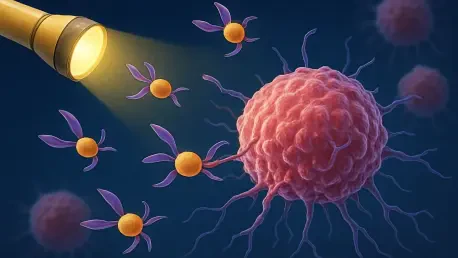
The propulsion of these nanomotors is achieved through the application of a near-infrared laser, which acts as the external power source for the entire operation. When the 808-nanometer laser light hits the polydopamine shell, it triggers a rapid photothermal effect, causing the particle’s temperature to rise significantly in a controlled manner. This localized heating creates a temperature gradient across the bowl-shaped structure, leading to a phenomenon known as self-thermophoresis. Essentially, the nanomotor converts the thermal energy from the laser into kinetic energy, allowing it to move with a directed velocity rather than drifting aimlessly. In experimental tests, the speed of the nanomotors could be precisely adjusted by changing the intensity of the laser, reaching speeds that allow them to push through the high-pressure environment found inside solid tumors. This ability to actively swim through dense tissue is what distinguishes this technology from traditional drug delivery methods.
This active motility is a critical factor in overcoming the biological barriers that typically prevent medicine from reaching the deep-seated core of a malignant growth. Most standard treatments rely on passive diffusion, which is often too slow and inefficient to combat rapidly growing tumors that have built up dense extracellular matrices. By contrast, the PFB@CM nanomotor uses its light-driven engine to penetrate these barriers, ensuring that the therapeutic agents are distributed evenly throughout the entire tumor mass. The precision of the laser also means that the movement can be switched on and off at will, giving doctors unprecedented control over the timing and location of the drug delivery. This level of spatial and temporal precision ensures that the maximum dose is concentrated within the cancerous tissue while minimizing the exposure of the rest of the body to the powerful chemicals being transported. This represents a significant shift toward truly personalized and localized cancer care.
The Synergistic Triple-Therapy Cascade
Maximizing Cytotoxicity: The Chemical Chain Reaction
Once the nanomotor has successfully embedded itself within the tumor tissue, the laser-induced heat initiates a complex chemical chain reaction designed to maximize cancer cell destruction. The rising temperature within the polydopamine matrix triggers the release of the encapsulated iron ions, which then interact with the hydrogen peroxide naturally present in the acidic tumor environment. This process, known as a Fenton-like reaction, produces highly toxic hydroxyl radicals that immediately begin to break down the cellular structures of the cancer. Simultaneously, the heat causes the BNN6 molecules to decompose, releasing a controlled burst of nitric oxide gas. While each of these components is lethal on its own, their combination creates a synergistic effect that is far more powerful than the sum of its parts. This multi-layered attack ensures that even the most resilient cancer cells are unable to adapt or survive the treatment, providing a comprehensive solution to tumor eradication.
The most devastating aspect of this therapeutic cascade is the formation of peroxynitrite, a highly reactive nitrogen species that occurs when the hydroxyl radicals and nitric oxide interact. Peroxynitrite is significantly more effective at damaging DNA and proteins than the original radicals, creating a lethal environment from which the cancer cells cannot recover. This specialized reaction is localized entirely within the area illuminated by the laser, which prevents systemic toxicity and protects the surrounding healthy organs. The researchers found that this triple-threat approach—photothermal, chemodynamic, and gas therapy—achieved nearly total tumor inhibition in laboratory models. By using the laser as both a motor and a chemical trigger, the system ensures that the most dangerous substances are only created at the exact moment and location they are needed. This methodology represents a highly refined strategy for treating complex malignancies that have historically been resistant to single-mode therapies.
Future Potential: Proving Efficacy and Safety
The practical effectiveness of the PFB@CM system was demonstrated through rigorous testing in animal models, where the results were nothing short of remarkable. After undergoing just two brief laser treatment sessions, the subjects treated with the light-driven nanomotors showed a staggering 98 percent reduction in tumor volume compared to those in the control groups. Histological analysis confirmed that the treatment caused extensive cell death within the tumor while leaving the heart, liver, and lungs completely unharmed. Furthermore, there was no observed weight loss or other signs of systemic distress in the subjects, suggesting that the nanomotor is exceptionally safe for living organisms. These findings provide a strong foundation for the transition from laboratory research to human clinical trials. The success of this study highlights the potential for nanotechnology to provide a less invasive and more effective alternative to surgery and traditional radiation.
As the medical community looks toward the next phase of development, the focus shifted to expanding the reach of this technology to include deeper and more inaccessible tumors. While the current 808-nanometer laser is highly effective for superficial breast cancer, future iterations of the nanomotor may utilize different light frequencies or even magnetic fields to penetrate deeper into the body. Researchers also aimed to fine-tune the concentration of nitric oxide to ensure it remains within a specific therapeutic window, avoiding any unintended effects on healthy tissue growth. The integration of these intelligent nanomachines into standard oncology protocols could eventually offer a versatile platform for treating a wide variety of cancers beyond the breast. The successful deployment of the PFB@CM nanomotor proved that combining active propulsion with a multi-stage chemical attack was a viable path for the future of cancer treatment, ultimately leading to higher survival rates and a better quality of life for patients.