
The productivity of integrated systems is initially three times higher than traditional methods and continues to amplify throughout the duration of a production run. This reality marks a departure from the rigid constraints of traditional batch manufacturing, where isolated steps often lead to inefficiencies and idle time. Integrated Dynamic Bioprocessing, or IDB, represents the next logical step in the maturation of the biopharmaceutical industry, moving beyond simple continuous flow toward a holistic system where every unit operation is tethered by automation and real-time data. Rather than viewing the production of monoclonal antibodies or viral vectors as a sequence of disconnected events, modern facilities are being reimagined as unified engines of output. This transformation is not merely about keeping material moving; it is about the dynamic nature of the process, which allows for rapid adaptation to the evolving state of the cell culture. By focusing on the connectivity between upstream cultivation and downstream purification, organizations are finding that they can produce significantly more material in a fraction of the time required by legacy systems.
Assessing Economic and Strategic Benefits
Strategic Drivers: Value in Research and Development
The strategic shift toward integrated systems is largely driven by the distinct needs found at different stages of the drug development lifecycle, particularly within research and development. In this high-stakes environment, the primary objective is often speed to clinic, as getting a candidate into human trials as quickly as possible can determine the long-term success of a therapy. By adopting a connected bioprocessing framework, R&D teams can bypass many of the time-consuming manual handoffs and sampling delays that characterize traditional methods. This efficiency allows for a more predictable development timeline, ensuring that budgetary resources are utilized where they matter most: advancing the science. Furthermore, the ability to generate larger quantities of material from smaller, integrated setups means that early-stage studies can be completed with fewer runs. This lean approach reduces the overall cost of development and allows scientists to focus on optimizing the molecule rather than struggling with manufacturing bottlenecks. Consequently, the value of IDB in the R&D space is measured by the accelerated pace of innovation and the mitigation of early project risks.
Commercial Incentives: Long-Term Operational Sustainability
Transitioning to the commercial scale, the value proposition of integrated bioprocessing shifts toward maximizing the bottom line and ensuring long-term operational sustainability. The reduction in capital expenditure is perhaps the most significant financial benefit, as integrated systems typically require a much smaller physical footprint than the massive, stainless-steel facilities of the past. By decreasing the size of the required cleanroom space and the complexity of the facility’s infrastructure, companies can drastically lower their upfront investment. Beyond CapEx, the cost of goods sold becomes a central focus for high-volume products that face significant market competition. Integrated systems streamline labor requirements and minimize material waste through tighter process control, leading to a much more favorable COGS profile. For biologics produced at a massive scale, these incremental efficiencies translate into billions of dollars in savings over the course of a drug’s commercial life. The ability to pivot production quickly and respond to fluctuating market demand further reinforces the business case for these connected systems, making them an essential component of a modern commercial strategy.
Enhancing Productivity Through Technical Innovation
Technical Superiority: Achieving High-Density Cycles
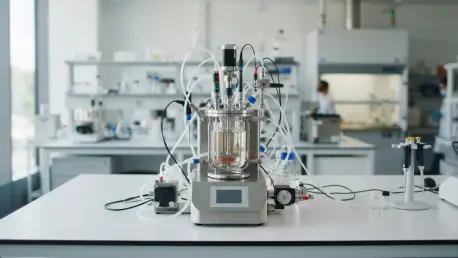
Technical superiority in modern biomanufacturing is defined by the ability to achieve and maintain extremely high cell densities that were previously thought to be unsustainable at scale. Integrated Dynamic Bioprocessing achieves this by utilizing condensed 14-day cycles that focus on maximizing the output of each individual cell during its most productive phase. Unlike steady-state perfusion, which aims for a consistent but often lower-level output over a long period, IDB pushes the boundaries of biological limits to deliver a surge of product in a shorter window. This approach results in a three-fold increase in productivity compared to traditional fed-batch systems, with the potential for even greater gains as the run progresses and the system hits its peak. This massive increase in throughput means that a smaller bioreactor can outperform a much larger traditional vessel, fundamentally changing how companies plan their manufacturing capacity. By packing more productivity into a smaller timeframe and footprint, the industry is resetting the standard for what a modern bioprocess facility can achieve, allowing for more flexible and responsive production schedules.
Advanced Control: Digital Twins and Real-Time Data
Maintaining the environment required for such intense productivity requires a level of process control that goes far beyond traditional manual monitoring. When cell densities reach extreme levels, the bioreactor becomes a highly sensitive environment where oxygen levels, nutrient delivery, and waste removal must be managed with surgical precision. To address this, manufacturers are increasingly relying on process analytical technology, such as Raman spectroscopy, to provide real-time data on glucose and metabolite levels. This stream of information is then fed into digital twins and mechanistic models that act as the brain of the operation. These digital models allow operators to move from a reactive posture—adjusting parameters after a problem occurs—to predictive control, where software anticipates the needs of the culture. By estimating particle counts and predicting titers hours or days in advance, these systems enable semi-autonomous processing. This means the system can automatically trigger filter cleaning or determine the optimal moment to load a chromatography column, ensuring that the process remains within its tight operating window without the constant need for human intervention.
Resolving Logistical and Cultural Challenges
Engineering Breakthroughs: Solutions for Buffer and Filtration
The move toward integrated systems introduces significant logistical challenges that often go unnoticed until a facility begins to scale its operations. One of the primary hurdles is managing the sheer volume of buffers and media required to support high-density cultures; without a strategic approach, a manufacturing plant can quickly become little more than a massive storage facility for liquids. To combat this, innovative engineering solutions like buffer concentrates and inline formulation have become essential. These technologies allow for the preparation of highly concentrated solutions that are diluted to the correct strength just as they are needed in the process, drastically reducing the storage space and labor required. Another major breakthrough involves the management of tangential flow filtration, which has historically been a bottleneck due to filter fouling. By implementing automated, in-line filter cleaning—a technique that involves flushing filters with media and hydroxide without removing them from the system—engineers have solved a major scaling issue. This allows for the use of massive bioreactors while maintaining continuous flow, effectively turning a logistical nightmare into a manageable process.
Cultural Transformation: Overcoming Resistance and Mindset Gaps
Perhaps the most complex challenge to overcome in the shift to connected bioprocessing is not the engineering itself, but the cultural and organizational resistance to new ways of working. Scientists and operators who have spent decades perfecting traditional batch methods often view innovations like filter reuse or automated in-line cleaning with deep skepticism. Concerns regarding potential contamination or the impact of cleaning agents on sensitive cell cultures are common and must be addressed through rigorous data collection and internal advocacy. At many leading firms, it took months of consistent results to prove that these engineering shortcuts were not only safe but actually improved the consistency of the final product. Overcoming this mindset gap requires a dedicated effort to educate the workforce on the benefits of connectivity and the reliability of modern automation tools. Once the internal culture shifts from viewing these steps as risky to seeing them as essential for efficiency, the path toward a fully integrated facility becomes much clearer. This evolution in thinking is the final piece of the puzzle, enabling the biopharmaceutical industry to fully embrace a more robust and productive manufacturing future.
Future Outlook: Strategy and Implementation
Global Standardization: Protocols for Worldwide Networks
The industry successfully shifted toward standardized protocols that allowed for the seamless transfer of connected processes across different global manufacturing sites. This period was characterized by a move away from bespoke, one-off engineering solutions in favor of modular platforms that could be rapidly deployed in response to emerging health crises. Organizations that prioritized these integrated systems early on found themselves in a position of significant competitive advantage, having already amortized the initial research and development costs of the transition. The data generated during these years provided a clear blueprint for the next generation of biopharmaceutical production, proving that the integration of unit operations was a far more robust approach than traditional batch processing. By 2026, the focus had shifted entirely toward refining these automated loops to handle increasingly complex modalities, such as cell and gene therapies, which required even tighter control than standard monoclonal antibodies.
Sustainable Infrastructure: Long-Term Environmental and Financial Goals
The final realization of this technological evolution was the establishment of a manufacturing infrastructure that was both more sustainable and significantly more cost-effective. Decision-makers within the sector recognized that the path forward required a commitment to digital transformation and the decommissioning of aging, inefficient batch facilities. This shift was not merely an economic necessity but a moral one, as the resulting reduction in production costs directly influenced the accessibility of essential therapies for patients in underserved markets. By 2026, the industry had moved beyond the trial phase, and connected bioprocessing became the gold standard for all new product launches. The journey demonstrated that while the technical and cultural hurdles were substantial, the benefits of a fully synchronized production engine far outweighed the risks. Moving forward, the industry must continue to foster collaboration and transparency to ensure that the efficiencies gained through connectivity are utilized to drive further innovation.