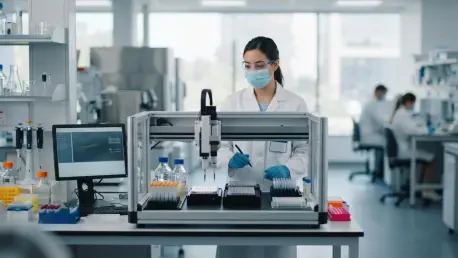

Transitioning to a software-defined laboratory model allows researchers to change scientific protocols without making major mechanical overhauls. The global pharmaceutical industry is currently witnessing an unprecedented pivot from mass-market pharmaceutical blockbusters to highly targeted genetic interventions that address the unique biological markers of an individual patient. This shift necessitates a complete reimagining of the manufacturing pipeline, as the standardized processes of the past several decades cannot accommodate the variability inherent in patient-specific care. Today, the challenge lies in bridging the gap between cutting-edge molecular biology and the legacy industrial systems that still populate many laboratories. As researchers push the boundaries of what is medically possible, they find themselves constrained by hardware that was designed for repetition rather than adaptation. The evolution of personalized medicine requires a foundation that prioritizes data density and operational agility over static efficiency, ensuring that every unique batch is treated with absolute precision and documented care.
The Drive: Modular and Flexible Systems
Meeting the Demands: Advanced Therapies
The surge in advanced therapy medicinal products, specifically within the cell and gene therapy niches, has fundamentally altered the expectations for manufacturing equipment. By mid-2026, the volume of clinical trials involving complex genetic manipulations has reached a critical mass, necessitating a scale-out approach rather than just a scale-up strategy. These therapies often involve the extraction, modification, and re-infusion of a patient’s own biological material, a process that is as delicate as it is expensive. Automation systems must now navigate the nuances of biological variability, where every batch has different expansion rates and chemical requirements.
Traditional systems, built for the high-volume production of identical pills, lack the granular control needed to manage these living medicines. Consequently, equipment manufacturers are under immense pressure to deliver systems that can pivot between different therapeutic protocols without necessitating a complete reconstruction of the production line. The biological materials utilized in these treatments are frequently irreplaceable, carrying a high emotional and financial cost. Advanced automation ensures that every step is performed with robotic precision, implementing real-time monitoring that detects deviations before they result in a failed batch.
Adapting to New Frameworks: Regulatory Evolution
Regulatory agencies are currently evolving their oversight to support modular and decentralized manufacturing models that bring drug production closer to the patient’s bedside. In 2026, the concept of point-of-care manufacturing has moved from a theoretical ideal to a practical reality, with mobile production units and hospital-based laboratories becoming increasingly common. These decentralized hubs require automation that is not only highly capable but also compact and portable. Traditional large-scale factory automation is ill-suited for these environments, as it lacks the modularity required for rapid deployment in varying clinical settings.
By adopting control architectures that support modularity, manufacturers can ensure that their equipment remains compliant with strict international standards, regardless of where the production occurs. The ability to maintain rigorous quality standards becomes more critical as production moves away from centralized facilities. Automated systems must provide a comprehensive digital audit trail that proves every step of the process followed the approved protocols. This necessitates a control system that can communicate seamlessly with cloud-based management platforms, providing real-time visibility to regulatory bodies. Modern control architectures bridge the gap between physical production and digital compliance.
Overcoming Limitations: Traditional Automation
Eliminating Gaps: Automated Islands
Historically, the laboratory environment has been defined by “automated islands,” which are standalone instruments that perform specific tasks but do not communicate with one another. While a liquid handler or a centrifuge may be automated in isolation, the transit of samples between these stations often remains a manual process. This fragmentation creates significant bottlenecks and introduces the risk of sample mix-ups or contamination during human handling. In 2026, the industry is moving toward fully integrated ecosystems where the movement of materials is as automated as the analytical processes themselves.
By connecting these disparate islands into a cohesive whole, laboratories can maximize their equipment utilization and reduce the time samples spend in transit. This integration is not just about physical connection but also about creating a unified control environment. One of the most significant consequences of fragmented automation is the creation of data gaps that compromise the chain of custody. A unified control architecture ensures that every physical movement is mirrored by a digital update in real-time. This creates a seamless record of a sample’s journey, including the precise temperature and instrument settings used at every stage, which is vital for patient safety.
Moving Beyond Linear: Variable Workflows
Traditional laboratory automation was largely designed for fixed, linear sequences where every sample follows the exact same path through a series of stations. This hard-coded approach is efficient for mass production but becomes a significant liability when dealing with the variable requirements of individualized therapies. In personalized medicine, different samples may require different incubation times, specific diagnostic tests, or even repeated processing steps based on real-time analytical results. A rigid system cannot easily accommodate these deviations without expensive and time-consuming reprogramming.
Consequently, the industry is transitioning toward software-defined workflows that allow for non-linear sample movement. In this model, the control system determines the path of each individual sample based on its unique digital profile. This flexibility allows for much higher throughput and ensures that the laboratory can handle a diverse mix of therapeutic protocols simultaneously. Instead of being limited by the physical layout, researchers can now reconfigure their workflows on the fly through a software interface. This capability is particularly important as scientific protocols are updated frequently in response to new genetic discoveries. This adaptable infrastructure ensures that today’s investments remain relevant.
The Advantages: Converged Control Architectures
Integrating Systems: Data and Motion
PC-based control architecture has emerged as the definitive solution for the complex integration demands of modern life sciences. While traditional controllers are excellent for simple tasks, they often struggle with the high-level data processing and communication protocols required by personalized medicine. An industrial PC provides a converged environment where machine control, high-speed motion, and complex data management coexist on a single platform. This allows the system to process massive amounts of analytical data from sensors while simultaneously executing precise motion commands for robotic arms.
By running these tasks on a multi-core processor, the industrial PC eliminates the latency and synchronization issues often found in multi-controller setups. Adopting a PC-based architecture also simplifies the laboratory’s overall IT infrastructure by reducing the need for specialized gateway devices. Industrial PCs are inherently designed to support a wide range of communication standards and third-party software applications. This makes it much easier to bridge the gap between standard lab instruments and enterprise-level management systems. Furthermore, the use of a single processor for multiple functions reduces the physical footprint of the control cabinet, allowing operators to focus on the science.
Ensuring Integrity: Digital Traceability
In the specialized world of individualized care, traceability is a fundamental requirement for clinical success. A fully connected laboratory ensures that every physical event—whether it is a sample being moved or an incubator being opened—is captured as a digital data point. This synchronization between the physical and digital realms allows for the creation of a digital twin of the entire production process. By building this traceability directly into the control architecture, providers guarantee that the final treatment delivered to the patient is exactly what was prescribed based on their genetic profile.
The transition toward PC-based control and smart motion technologies fundamentally reshaped the laboratory of the future, making it more adaptable and data-centric. By prioritizing software-defined workflows, the life sciences sector successfully overcame the rigid limitations of traditional automation. These advancements allowed for the rapid scale-out of personalized treatments, ensuring that high-quality care reached patients faster than ever before. Moving forward, laboratory operators prioritized investments in modular hardware and open communication standards. The focus shifted from mere speed to the strategic integration of motion and data, which proved to be the decisive factor in the success of advanced therapy programs.