
University of Cambridge experts verified that the integrated Takara Bio and SPT Labtech system delivers the precision required for complex stratified medicine research projects. This collaboration represents a pivotal shift in the landscape of next-generation sequencing (NGS) by merging Takara Bio’s high-performance chemistries with the robust automation capabilities of SPT Labtech’s firefly liquid handling platform. In the current 2026 environment, genomics facilities face increasing pressure to process massive sample sets with absolute reproducibility while maintaining tight operational budgets. The partnership addresses these needs by providing pre-validated, automated library preparation workflows that remove the technical barriers typically associated with transitioning from manual protocols to robotic systems. By focusing on core laboratories and high-volume sequencing facilities, both organizations have established a framework that prioritizes scalability and efficiency without sacrificing the sensitivity required for transcriptomics research.
Synergy of Design: The Integration of Firefly and SMART-Seq
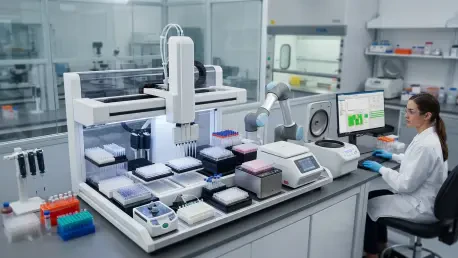
The technical backbone of this initiative rests on the firefly instrument, a system designed to consolidate various laboratory functions into a single, compact footprint. This all-in-one design is particularly beneficial for modern research hubs where laboratory space remains a premium commodity and staffing constraints require intuitive, easy-to-use technology. The firefly platform utilizes advanced air displacement pipetting and non-contact dispensing to handle delicate reagents, making it a perfect match for the precise demands of the SMART-Seq RNA-seq library preparation chemistries. By automating these intricate steps, the system significantly reduces the risk of human error and cross-contamination, which are frequent challenges in manual NGS workflows. The integration ensures that even laboratories with limited automation experience can achieve high-quality results, as the hardware is specifically tuned to the nuances of Takara Bio’s enzymatic reactions and purification protocols.
One of the most significant advantages of this partnership is the provision of ‘ready-to-run’ validated scripts, which allow facilities to bypass the traditional month-long optimization cycles. Historically, the implementation of new automation equipment required extensive internal development, custom coding, and rigorous troubleshooting by highly specialized bioinformatics teams. Now, researchers can deploy standardized protocols for the SMART-Seq mRNA LP and SMART-Seq Total RNA Library Prep with ZapR Depletion directly upon installation. This streamlined approach allows laboratories to move quickly from the evaluation phase to routine, large-scale production, ensuring that critical research data is generated faster than ever before. Furthermore, the standardization of these scripts across different sites promotes better data comparability in multi-center studies, as every laboratory utilizes the same validated parameters, thus enhancing the overall reliability of the scientific findings.
Technological Horizons: Advancing Long-Read and Total RNA Workflows
Looking toward the immediate developments in transcriptomics, the partnership is set to launch the SMART-Seq mRNA Long Read Extended kit in January 2027, marking a milestone in product development strategy. This is the first time a product has been designed with an automation-optimized workflow from its very inception, rather than being adapted for robotics at a later stage. This forward-thinking design philosophy ensures that researchers can achieve enhanced recovery of full-length transcripts and improved quantification through the use of unique molecular identifiers (UMIs) from day one. The ability to capture full-length RNA sequences is vital for understanding complex splice variants and isoforms that are often missed by short-read sequencing methods. By integrating these advanced capabilities into an automated framework, the collaboration provides a pathway for scientists to explore the human transcriptome with unprecedented depth and accuracy, catering to the needs of stratified medicine.
The successful validation of these automated NGS workflows provided a clear blueprint for laboratories aiming to scale their operations without compromising on data integrity. Researchers who adopted these integrated systems realized significant gains in throughput and operational efficiency, which allowed them to pivot resources toward data analysis and experimental design. The collaboration effectively removed traditional infrastructure barriers, making high-quality transcriptomics accessible to a broader range of scientific institutions. To maintain this momentum, laboratories evaluated their existing manual protocols and identified specific bottlenecks that could be alleviated through robotic integration. Future considerations focused on the integration of even more diverse chemistries and the expansion of automated capabilities into emerging fields like single-cell analysis and spatial biology. By establishing these foundations, the industry moved closer to a model where precision automation became an essential component of the genomic research lifecycle.