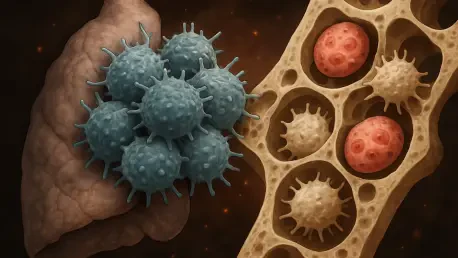

Orthotopic mouse models and human rib specimens reveal that lung cancer triggers emergency granulopoiesis, a systemic remodeling of the bone marrow that accelerates disease progression. This transformation represents a sophisticated survival tactic where the tumor communicates with distant skeletal sites to hijack the production of immune cells. Historically, the bone marrow remained a “black box” in lung cancer research due to the difficulty of obtaining samples, yet modern analysis of human rib fragments has changed this perspective entirely. The findings suggest that the cancer does not merely hide from the immune system; it actively reconfigures the hematopoietic factory to ensure that newly born cells are biased toward supporting the tumor rather than attacking it. This systemic impact explains why many patients fail to respond to localized therapies, as the malignancy essentially recalibrates the patient’s entire biological defense infrastructure long before traditional symptoms might suggest such an extensive spread.
Cellular Reprogramming within the Medullary Niche
The study identifies a significant expansion of hematopoietic stem and progenitor cells (HSPCs) within the bone marrow, yet this growth does not stem from a typical increase in cell division. Analysis showed a distinct absence of the proliferation marker Mki67, indicating that the progenitor population is not simply multiplying faster through the cell cycle. Instead, the research points to a profound shift in intracellular signaling pathways, specifically a notable reduction in the p38/MAPK pathway. This molecular adjustment creates a survival advantage for these progenitors by reducing their susceptibility to programmed cell death, or apoptosis. By fostering a “low-stress” environment for these specific cells, the cancer steers the hematopoietic lineage bias toward the production of immature G1 and G2 neutrophils. These cells, rather than becoming effective defenders against pathogens or tumors, emerge as immature precursors that are essentially primed to suppress immune responses once they enter the bloodstream.
Beyond internal signaling changes, the research highlights a critical failure in the physical mechanisms that normally keep progenitor cells anchored within the bone marrow. In a healthy state, the interaction between the CXCR4 receptor and the CXCL12 ligand acts as a molecular “glue,” maintaining the medullary niches where these vital cells mature. However, both human and murine samples revealed a significant reduction in this signaling axis, effectively weakening the bonds between the progenitors and their protective environment. This breakdown allows immature and potentially harmful cells to leak into the systemic circulation prematurely. When these cells depart the bone marrow and infiltrate the primary lung tumor, they act as a reinforcement for the malignancy, creating a vicious cycle of immunosuppression. The discovery that this structural remodeling occurs in human patients confirms that the bone marrow serves as a central hub for the systemic dysfunction observed in advanced non-small cell lung cancer cases.
Molecular Signatures and Novel Therapeutic Pathways
Advanced molecular profiling through single-cell transcriptomics has provided a high-resolution map of the changes occurring across various hematopoietic populations. One of the most striking findings is the broad upregulation of the protein S100A9, which appears consistently across multiple cell lineages in the bone marrow. While other markers like Lcn2 showed a more restricted expression pattern within specific myeloid subsets, the presence of S100A9 served as a reliable signature of the emergency granulopoiesis triggered by the lung tumors. This molecular consistency between species suggests that the systemic medullary response is a fundamental biological consequence of the disease. By identifying these specific protein signatures, researchers developed a clearer understanding of how the tumor “broadcasts” its presence to the bone marrow. This work suggests that monitoring these proteins in the blood or bone marrow could eventually provide clinicians with a tool to gauge how much the cancer has already manipulated the patient’s immunity.
These biological insights directly led to the identification of tasquinimod as a potent therapeutic candidate to reverse these systemic changes. As an immunomodulatory compound targeting the S100A9 protein, tasquinimod showed remarkable efficacy when used as an adjuvant alongside established anti-PD-L1 immunotherapies. In preclinical models that were previously resistant to standard checkpoint inhibitors, the addition of this compound successfully reduced the overall tumor burden and restored a more functional immune landscape. This breakthrough suggested that by addressing the “emergency” signals sent to the bone marrow, clinicians can dismantle the tumor’s defensive reinforcements from the source. Moving forward from 2026, the focus will likely shift toward human trials that integrate these medullary-targeted agents into early-stage treatment protocols. This approach represented a departure from treating lung cancer solely as a pulmonary disease, instead managing it as a systemic disorder that requires the restoration of the immune centers.