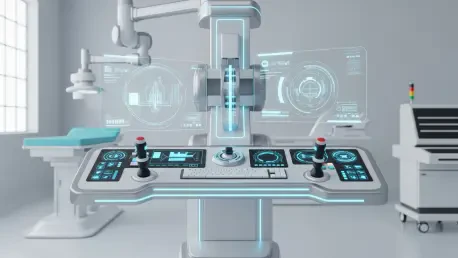

The surgical theater is undergoing a profound metamorphosis as silent algorithms transform once-passive robotic tools into active partners that anticipate a clinician’s every move during life-critical procedures. This transition represents the birth of embodied AI, where intelligence is no longer confined to a screen but is physically integrated into the mechanical joints and sensors of the operating room. Surgeons are finding themselves at the center of a data-driven revolution that moves beyond mere assistance, aiming instead for a level of precision that was previously considered the domain of science fiction. As healthcare systems grapple with increasing patient complexity, the move toward these intelligent ecosystems has become a necessity rather than a luxury.
The Shift Toward Embodied AI and Data-Driven Surgery
Market Evolution and Adoption Statistics
The transition from traditional robotic-assisted surgery to a framework defined by embodied AI marks a significant departure from the remote-controlled interfaces of the past decade. Market trajectories from 2026 to 2030 suggest a rapid acceleration in the deployment of systems that possess physical awareness, allowing them to interact more fluidly with human tissue. This evolution is backed by a substantial increase in capital investment into platforms that prioritize machine learning over simple mechanical dexterity. Hospitals are increasingly viewing these investments as a means to improve throughput and reduce the costly complications associated with human fatigue or variability in surgical technique.
The modern operating room has become a sophisticated hub of sensory input, utilizing high-fidelity feedback loops to inform every incision. Modern data indicates that the integration of haptic sensors and real-time visual analytics has surged, providing surgeons with a layer of “digital intuition” that complements their years of training. By capturing millions of data points per second, these systems create a comprehensive map of the surgical site, allowing for a level of anatomical transparency that was once impossible. This surge in data is the primary driver behind the trend of personalized surgery, where every procedure is tailored to the specific geometric and physiological realities of the individual patient.
Real-World Applications and Technological Milestones
One of the most remarkable breakthroughs in recent years is the development of cause-and-effect recognition within surgical software. This technology enables predictive decision support, allowing the system to warn a surgeon about the potential downstream consequences of a specific action before it is finalized. By analyzing vast repositories of previous surgical outcomes, the AI can identify patterns that lead to complications, acting as a high-speed safety net. This shift from reactive monitoring to proactive guidance is fundamentally changing the risk profile of complex vascular and neurological interventions.
Institutions like King’s College London have pioneered the concept of the sensor-equipped operating room, where the entire environment acts as a single intelligent entity. In these settings, spatial sensors track the movement of staff, tools, and the patient to optimize the workflow and prevent accidental contamination or instrument collisions. Furthermore, autonomous assistance is now being utilized to handle routine, repetitive tasks such as suturing or retraction. By delegating these high-volume, low-variability actions to the robotic platform, the surgical team can preserve their cognitive resources for the most critical phases of the operation, effectively reducing the overall mental strain of the procedure.
Expert Perspectives on the AI Transformation
The consensus among leading authorities like Professor Prokar Dasgupta and Dr. Alejandro Granados is that AI is moving the needle from reactive execution to proactive strategy. They argue that the surgeon of the future will function more like a mission commander, overseeing a suite of autonomous and semi-autonomous systems rather than performing every minute movement manually. This perspective emphasizes that the true value of AI lies in its ability to synthesize information that the human brain cannot process in real time, such as subtle changes in tissue perfusion or microscopic tremors.
Moreover, experts stress the necessity of careful stewardship when managing the delicate interaction between human judgment and algorithmic suggestion. While the technology offers immense benefits, there is a professional consensus that the “human in the loop” must remain the final arbiter of medical decisions. This stewardship involves not only the technical operation of the machines but also the ethical oversight of how the AI arrives at its conclusions. The goal is to create a symbiotic relationship where the machine handles the data-heavy lifting while the human provides the nuanced, empathetic decision-making that complex patient care requires.
Future Outlook: Navigating Challenges and Global Implications
A major hurdle facing the industry is the pivotal puzzle of regulatory reform for algorithms that continue to learn after they have been cleared for clinical use. Current frameworks are designed for static devices, but learning algorithms evolve based on the new data they encounter, making traditional “snapshot” approvals obsolete. Regulators are now looking toward dynamic certification processes that monitor system performance in real time to ensure that as an AI adapts, it does not deviate from established safety parameters. This shift in oversight is essential for maintaining public trust in autonomous medical technologies.
The evolution of the surgical team is also sparking a demand for new professional roles within the hospital environment. The emergence of clinical data scientists and specialized robotic engineers who work alongside surgeons is becoming the new standard for high-tech medical centers. These professionals are responsible for ensuring the integrity of the data streams and the calibration of the hardware, creating a more multidisciplinary approach to operative care. This change necessitates a complete overhaul of medical education, where future surgeons must be as proficient in data interpretation as they are in physical technique.
Addressing the ethical imperatives of dataset bias is another critical step in ensuring health equity across diverse populations. If the AI models are trained primarily on data from specific demographic groups, their predictive accuracy may falter when applied to others, potentially worsening existing disparities in healthcare. Leaders in the field are calling for more inclusive data collection strategies to ensure that the benefits of robotic precision are available to everyone regardless of ethnicity or background. Mitigating these biases is not just a technical challenge but a moral obligation for the developers of next-generation medical tools.
Furthermore, there is a growing concern regarding a global digital divide, where the high cost of these robotic ecosystems could leave lower-income regions behind. To combat this, researchers are focusing on the development of cost-effective, modular robotic platforms that can be integrated into existing infrastructure without requiring multi-million dollar investments. By prioritizing interoperability and affordability, the industry can ensure that AI-enhanced surgery becomes a global standard rather than a luxury for the elite. The long-term success of these technologies will depend on their ability to deliver precision and safety in diverse economic settings.
Conclusion: Balancing Innovation with Human Oversight
The transition toward AI-enhanced surgical robotics demonstrated a remarkable capacity to redefine the boundaries of medical precision and patient safety. Clinicians and engineers successfully collaborated to move beyond simple automation, fostering an environment where predictive analytics and embodied intelligence became standard components of the operative workflow. It was observed that the integration of real-time feedback loops significantly reduced the margin for human error, especially in procedures requiring extreme delicacy. This period of rapid innovation proved that the most effective surgical outcomes were achieved when technological capabilities were used to augment, rather than replace, the sophisticated reasoning of the human mind.
Regulatory bodies eventually recognized that static approval models were insufficient for learning algorithms, leading to the implementation of more agile oversight frameworks that prioritized continuous performance monitoring. This shift ensured that as robotic systems evolved, they remained aligned with rigorous safety standards and ethical guidelines. Furthermore, the global medical community began to address the digital divide by championing more accessible, cost-effective technologies that allowed developing regions to benefit from these advancements. The focus shifted toward creating a unified standard of care that utilized AI to close the gap in surgical quality across different socioeconomic landscapes.
Moving forward, the primary objective remained the preservation of the human chain of authority within this increasingly complex technological framework. The industry established that while machines could process data and execute movements with incredible speed, the responsibility for the patient’s well-being stayed firmly with the surgical lead. Future efforts were directed at refining the training of multidisciplinary teams, ensuring that clinical data scientists and surgeons could work in perfect harmony. By maintaining this balance of innovation and human oversight, the healthcare sector effectively turned the promise of personalized, predictive surgery into a sustainable and equitable reality for patients worldwide.