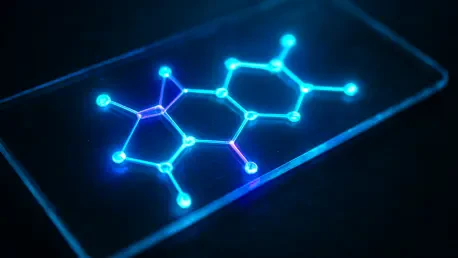

The deceptive simplicity of a single hydrogen atom moving across a molecular scaffold has long been the invisible wall separating promising drug candidates from clinical failure. This phenomenon, known as tautomerism, involves the rapid relocation of a proton and a corresponding shift in double bonds, fundamentally altering a molecule’s shape and chemical behavior. Because these different states, or tautomers, exist in a delicate equilibrium, identifying the most stable form is crucial for understanding how a drug will interact with its biological target. Recent breakthroughs in computational chemistry have moved the industry toward a more automated, high-precision era of molecular modeling.
The Evolution of Molecular Modeling and Tautomer Identification
Statistical Growth: The Transition from Quantum Mechanics to Deep Learning
The landscape of molecular modeling is undergoing a profound shift as researchers move away from the prohibitive costs of traditional simulations. For decades, the gold standard for predicting tautomeric stability was Quantum Mechanics (QM) calculations. While QM provides an exceptionally high degree of accuracy, it is notoriously slow, making it impractical for the massive compound libraries used in modern drug discovery. The current trend marks a decisive transition toward high-speed artificial intelligence models that can mimic the precision of QM at a fraction of the temporal cost. This shift is not merely about speed; it represents a fundamental change in how chemical properties are calculated and utilized in real-time research environments.
One of the most significant drivers of this evolution is the unprecedented expansion of training datasets available to machine learning models. Previously, tautomer prediction tools were limited by datasets containing only a few hundred experimentally verified states. However, recent initiatives have expanded these libraries to include over 1.1 million tautomeric states, derived from high-resolution structural data. This jump in data volume has enabled the development of Graph Neural Networks (GNNs) that can interpret molecules as complex networks of atoms and bonds. Adoption statistics across the pharmaceutical sector show an increasing reliance on these GNNs, as they allow for the rapid processing of chemical information that was once considered too complex for automated systems.
Real-World Applications: From the Cambridge Structural Database to Drug Pipelines
The practical utility of AI-driven prediction is most visible in the refinement of existing structural repositories. The implementation of the New York University “Tautomer-Predictor” has specifically targeted entries within the Protein Data Bank (PDB), where hydrogen positions are often missing or incorrectly assigned due to the limitations of X-ray crystallography. By re-evaluating these biological structures through the lens of AI, scientists are identifying and correcting misassigned tautomers that have historically skewed research results. This process of “chemical cleaning” ensures that the foundational data used by laboratories worldwide is as accurate as possible, reducing the risk of downstream errors in drug development.
Furthermore, the speed of these new tools is transforming the early stages of the drug pipeline. In modern high-throughput screening, where millions of potential drug compounds are analyzed for their binding affinity, the ability to process data quickly is a competitive necessity. Current AI models can now evaluate the tautomeric stability of millions of molecules in mere hours—a task that previously required months of high-performance computing time. This efficiency is already showing tangible results in the improvement of hydrogen-bonding models. By ensuring that the hydrogen atoms are correctly placed within protein-ligand complexes, researchers can more accurately predict how a drug will “lock” into its target, significantly enhancing the success rates of structure-based designs.
Industry Perspectives on Chemical Accuracy and AI Integration
Medicinal chemists frequently highlight the “tautomer misassignment” problem as a hidden contributor to high drug failure rates. When a molecule is modeled in its less stable form, its predicted surface charge and shape are incorrect, leading to binding models that do not reflect reality. Experts in the field argue that a significant portion of failed clinical trials could potentially be traced back to these early-stage modeling errors. There is a growing consensus that integrating AI tools early in the design phase is essential for verifying molecular identity before a compound ever enters a laboratory for synthesis.
Computational biologists are also emphasizing the necessity of accurate protonation states for reliable molecular dynamics simulations. These simulations, which track the movement of atoms over time, are highly sensitive to the initial placement of hydrogens. If the wrong tautomer is selected as the starting point, the entire simulation becomes a series of compounding errors. To combat this, many in the industry are advocating for the use of small-molecule crystal data from the Cambridge Structural Database (CSD) to inform macromolecular research. Leveraging the high-resolution experimental data found in the CSD allows AI models to learn from “ground truth” examples where hydrogen positions are explicitly known, providing a level of reliability that was previously unattainable.
The Future of AI-Driven Molecular Design
Developments in High-Resolution Chemical Discovery
The potential for AI to provide near-instantaneous standardization of multi-million compound libraries is reshaping the expectations of chemical discovery. As we progress through the late 2020s, the focus is shifting toward the creation of universal “chemical fingerprints” that automatically include tautomeric variations. This level of standardization ensures that every researcher, regardless of their specialization, is working with the most chemically plausible version of a molecule. Moreover, the role of open-source AI tools is becoming increasingly vital. By democratizing access to advanced computational chemistry, these tools allow smaller laboratories and academic institutions to compete with large pharmaceutical firms in the race to discover novel therapeutics.
Challenges and Broader Implications for the Pharmaceutical Industry
Despite the rapid progress, predicting tautomeric shifts induced by specific biological microenvironments remains a significant challenge. Molecules can behave differently inside a highly acidic cellular compartment compared to a neutral bloodstream, and AI models must continue to evolve to account for these environmental variables. Balancing the sheer speed of machine learning with the rigorous experimental verification required for clinical safety is another ongoing concern. While AI can narrow down candidates with incredible efficiency, the industry must maintain a robust verification process to ensure that predicted molecular behaviors hold up under physical testing.
Improving molecular “identity” verification is expected to yield substantial financial benefits for the pharmaceutical industry. By reducing the time spent on flawed leads and improving the accuracy of initial screens, companies can significantly lower the costs of bringing new medicines to market. This trend toward high-resolution accuracy serves as the foundation for the next generation of personalized medicine, where drugs can be designed with an even greater degree of specificity for their intended targets.
Summary of Innovations in Tautomer Prediction
The integration of deep learning and high-resolution crystallography finally addressed the long-standing “missing proton” dilemma that hindered molecular modeling for decades. Researchers successfully leveraged massive datasets to create predictive tools that surpassed the efficiency of traditional quantum mechanical methods. The industry moved toward a standard where chemical accuracy was no longer sacrificed for the sake of computational speed. This transition proved that the convergence of experimental data and artificial intelligence was necessary for the evolution of biotechnology.
The scientific community determined that the path forward required a commitment to open-source collaboration and the continuous refinement of structural databases. By correcting historical errors in the Protein Data Bank and standardizing chemical libraries, laboratories worldwide established a more reliable baseline for drug discovery. These advancements ensured that the molecular foundations of new therapeutics were built on precise, verified data. Ultimately, the industry recognized that solving the smallest structural puzzles was the key to unlocking the next generation of life-saving medical breakthroughs.