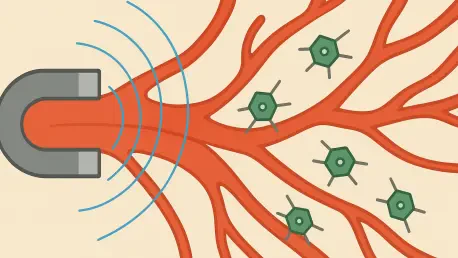

Biohybrid systems integrate living biological components like Spirulina algae with synthetic iron oxide to create steerable platforms for photothermal therapy. This innovative approach addresses a long-standing challenge in oncology, where traditional chemotherapy often acts like a blunt instrument, causing extensive collateral damage to healthy tissues. As the global medical community prepares for a projected rise to over 35 million new cancer cases annually by 2050, the necessity for active, programmable interventions has become undeniable. Unlike previous generations of nanomedicine that relied on the passive accumulation of drugs through leaky tumor vessels, these modern magnetic nanorobots (MNRs) operate with a distinct sense of agency. They are not merely drifting through the bloodstream; they are driven by external magnetic fields that allow them to overcome the chaotic nature of biological flow. This transition from passive “carpet bombing” to active, surgical strikes represents a fundamental shift in how physicians conceptualize the delivery of toxic agents. By navigating dense fluids and penetrating deep into the core of malignant growths, these microscopic machines are redefining the limits of therapeutic efficacy and patient safety in a landscape that increasingly demands precision.
Engineering Philosophies: From Atomic Assembly to Structural Design
The development of magnetic nanorobots relies on a sophisticated duality of manufacturing philosophies, categorized as top-down and bottom-up approaches. Top-down fabrication utilizes advanced methods such as photolithography and focused ion beam milling to carve intricate three-dimensional structures out of bulk materials with sub-10-nanometer precision. These techniques allow engineers to create highly durable structural chassis that can withstand the mechanical stresses of the circulatory system. In contrast, bottom-up approaches leverage the principles of molecular self-assembly and DNA origami to build robots one atom at a time. This method provides unparalleled control over the chemical composition of the device, enabling the attachment of bioactive ligands like polyethylene glycol to help the robots evade the immune system. The most successful recent designs often integrate both philosophies, using a top-down frame to provide structural integrity while employing bottom-up chemistry to load the device with magnetic nanoparticles and therapeutic payloads. This hybrid manufacturing strategy ensures that the final product is both physically robust enough to navigate the body and chemically complex enough to interact with specific cancer cell receptors.
The functional versatility of these robots is further expanded by their diverse structural configurations, which are specifically engineered for different biological environments. Researchers have identified five primary families of magnetic nanorobots: spherical, helical, flexible, wire-like, and biohybrid. Helical robots, inspired by the flagella of swimming bacteria, use a corkscrew motion to propel themselves through viscous fluids, making them ideal for navigating the microvasculature. Spherical robots are better suited for rolling or sliding along the interior walls of blood vessels, while flexible robots utilize molecular hinges to deform their bodies and squeeze through narrow interstitial spaces. Wire-like variants offer high agility in complex, maze-like environments within dense tumor tissues. Finally, biohybrid systems represent a pinnacle of biological mimicry, fusing living organisms like algae with synthetic magnetic materials. By coating these living templates with iron oxide, scientists have created steerable platforms that are inherently biocompatible and capable of performing physical work, such as perforating cell membranes to deliver drugs directly into the cytoplasm, bypassing traditional cellular resistance mechanisms.
Intelligent Release Strategies: On-Demand Delivery and Biological Cloaking
A critical advantage of magnetic nanorobots is their ability to release therapeutic payloads “on demand,” ensuring that toxic drugs are only deployed when the robot reaches its target. This capability is managed through stimuli-responsive designs that react to both external triggers and internal physiological changes. For instance, near-infrared light can be used to vibrate magnetic carriers, weakening the electrostatic bonds that hold the drug in place and allowing for a controlled release. Internally, the unique chemistry of the tumor microenvironment serves as a natural trigger. Cancers often rely on high rates of glycolysis, which creates an acidic environment that can break pH-sensitive chemical bonds on the robot’s surface. To refine these processes, researchers are currently utilizing machine learning algorithms and physics-informed neural networks to predict drug release kinetics with high precision. These AI tools analyze how different physiological conditions, such as varying flow rates or temperature fluctuations, affect the behavior of the nanorobots, allowing for a level of customization that was previously impossible with traditional drug delivery systems.
To further enhance the success of these missions, engineers have looked to nature to develop sophisticated “cloaking” and penetration strategies. Biomimetic robots often utilize cellular membranes harvested from macrophages or platelets to wrap their synthetic components, effectively tricking the immune system into recognizing the robot as a native cell. This “Trojan Horse” approach prevents the body from attacking the device before it reaches the tumor. More advanced “marsupial” systems have been designed to tackle the formidable blood-brain barrier. In these setups, a larger “mother” robot navigates the bloodstream and carries smaller “child” robots across the barrier into the brain. Once the crossing is successful, the child robots deploy to perform hyper-localized targeting within the brain tissue. Other designs, such as amoeba-inspired robots made of deformable polymers, can change their entire shape to migrate from blood vessels deep into the hypoxic core of a tumor. These biological mimicry techniques allow magnetic nanorobots to bypass the body’s natural defenses and reach areas of the body that were previously considered inaccessible to traditional medicine.
Environmental Remodeling: Neutralizing the Tumor Microenvironment
Modern research in magnetic nanorobotics has expanded beyond the simple task of killing cancer cells to the more complex goal of remodeling the environment that allows those cells to thrive. Tumors are notorious for creating “sanctuaries” characterized by high acidity and low oxygen levels, which effectively suppress the patient’s immune system. New “enzymatic cascade” robots have been engineered to consume lactate, the primary source of tumor acidity, while simultaneously generating oxygen bubbles. This dual action serves two purposes: the oxygen bubbles provide a form of self-propulsion that drives the robot deeper into the tumor tissue, while the reduction in acidity helps to restore the natural function of the immune system. By neutralizing the toxic local environment, these robots make the tumor more vulnerable to both the drug payload they carry and the body’s own natural defenses. This holistic approach recognizes that treating cancer requires not just the destruction of malignant cells but also the systematic dismantling of the supportive infrastructure that the tumor builds for itself.
The efficacy of these robots is further magnified by the integration of multiple therapeutic modalities, such as photothermal therapy and chemodynamic therapy. Magnetic navigation allows researchers to deliver agents that convert light into lethal local heat, essentially cooking the tumor from the inside without damaging surrounding healthy tissue. Simultaneously, chemodynamic therapy exploits the tumor’s own hydrogen peroxide levels to trigger Fenton-like reactions, which generate highly toxic hydroxyl radicals. These radicals cause irreversible damage to the DNA of cancer cells, leading to rapid cell death. The most effective contemporary systems are those that combine these physical and chemical attacks with traditional chemotherapy and modern immune checkpoint blockades. For example, biomimetic nanorobots designed for glioblastoma now utilize a combination of heat, radical generation, and targeted drugs while delivering inhibitors that prevent the tumor from hiding from the immune system. This multi-pronged strategy ensures that even the most resilient and adaptable cancer cells are unable to survive the coordinated robotic intervention.
Clinical Translation: Overcoming Barriers With Artificial Intelligence
While the technical achievements of magnetic nanorobots in laboratory and animal models have been remarkable, the path to human clinical implementation involves overcoming several significant biological and regulatory hurdles. One of the primary obstacles is the “protein corona,” a layer of proteins that spontaneously coats any synthetic object entering the bloodstream. This coating can mask the robot’s targeting ligands and fundamentally change its biological identity, potentially leading to unintended clearance by the liver or spleen. Additionally, the challenge of real-time tracking within the human body remains a significant concern, as existing imaging technologies like MRI and ultrasound often struggle to provide the resolution necessary to monitor individual nanorobots in deep tissues. Despite these difficulties, recent preclinical milestones have been encouraging, with magnetic robots successfully navigating the complex vascular systems of large animals like pigs and sheep with over 95 percent accuracy. These successes suggested that the fundamental principles of magnetic steering were sound even when scaled up to larger, more complex biological systems.
The integration of artificial intelligence has been identified as the most promising solution for bridging the gap between laboratory success and clinical utility. AI-driven systems managed complex navigation through reinforcement learning, allowing robots to adapt their movements autonomously based on real-time sensory feedback from their environment. These “closed-loop” systems enabled the robots to sense local chemical changes, make decisions about drug release, and execute precise movements without constant human intervention. Furthermore, neural networks were employed to reconstruct accurate three-dimensional positions from two-dimensional imaging data, significantly improving the safety and accuracy of robotic procedures. As the field moved forward, the focus shifted toward standardized mass production and the development of clear regulatory frameworks for these hybrid devices. By combining the physical capabilities of magnetic machines with the analytical power of modern computing, researchers paved the way for a future where oncology is no longer a battle of attrition but a highly controlled, precise robotic operation that prioritized patient recovery and long-term health.