
Visualizing the intricate inner workings of a living cell requires more than just a powerful lens; it demands the ability to observe biological structures from every possible angle without compromising their fragile integrity. Researchers at the Karlsruhe Institute of Technology (KIT) have achieved a significant breakthrough by developing a contact-free method to rotate microscopic samples in three-dimensional space using specialized laser technology. Led by Professor Moritz Kreysing and Dr. Fan Nan, this innovation marks a departure from traditional mechanical manipulation, which often proves too “violent” for delicate organic specimens. By shifting the focus from physical tools to light-induced fluid dynamics, the team has successfully bypassed a long-standing hurdle in optical microscopy, enabling high-resolution 3D imaging of living cells in their natural state. This advancement ensures that the specimen remains undisturbed by external pressure, allowing scientists to capture the true spatial complexity of biological life with unprecedented precision and safety.
The Limitations: Why Traditional Microscopy Struggles With Depth
Modern optical microscopy has reached a zenith of clarity in two-dimensional imaging, yet the true three-dimensional architecture of a cell often remains an elusive target due to the inherent flatness of standard perspectives. To construct a reliable 3D model, researchers must capture a series of images from various orientations, but the methods used to reposition these microscopic samples are frequently detrimental to the subject’s health. Traditional techniques rely on mechanical micro-tools, such as glass needles, pipettes, or tiny grippers, to physically nudge or turn the specimen into the correct position. While these tools work efficiently for inorganic materials, they pose a significant threat to living cells, which are highly sensitive to physical contact. The mere act of touching a cell can cause structural deformation, trigger unwanted stress responses, or lead to the complete destruction of the sample before a full suite of images can be captured for analysis.
Beyond the risk of physical damage, the precision of depth information in standard microscopy is often insufficient for advanced biological research, leading to what scientists describe as a “flattened” understanding of complex systems. Because these biological samples are exceptionally fragile and translucent, internal structures can be obscured or distorted when viewed from a single, static plane. The inability to safely rotate a specimen means that critical features, such as the exact positioning of organelles or the distribution of specific proteins, may remain hidden behind other cellular components. This technical bottleneck has historically limited the scope of developmental biology and pathology, as researchers were forced to make do with incomplete spatial data. The need for a gentler, non-invasive orientation technique has therefore been a primary goal for the imaging community, seeking to bridge the gap between high-resolution 2D snapshots and comprehensive 3D biological modeling.
The Solution: Harnessing Opto-Thermoviscous Fluid Flows
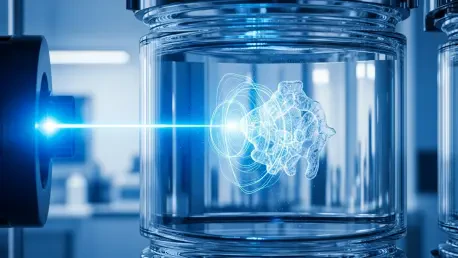
The innovative approach developed by the KIT research team bypasses the need for physical contact by manipulating the liquid environment surrounding the sample rather than the sample itself. This method utilizes a precision laser to locally heat the aqueous medium in which the cell is suspended, creating minute temperature gradients that induce subtle movements known as opto-thermoviscous flows. By carefully controlling these temperature shifts, the researchers effectively create a “micro-weather system” within the microscopic chamber. The laser scans the liquid in specific, rapid patterns, directing the resulting fluid currents to push and pull the specimen with extreme gentleness. Because the laser targets the fluid and not the biological matter, the cell is shielded from potential heat damage, allowing it to remain in a natural, viable state while being guided into the perfect position for high-resolution 3D scanning.
The ingenuity of this technique lies in its ability to provide total spatial control through the mastery of fluid dynamics rather than mechanical force. These opto-thermoviscous flows act as invisible hands, aligning the suspended cell with a level of precision that was previously unattainable without direct intervention. This contactless manipulation is particularly advantageous for studying living organisms over extended periods, as it eliminates the variables of mechanical stress and contamination that often plague traditional experiments. By refining the speed and pattern of the laser scanning, the KIT team has demonstrated that it is possible to achieve highly predictable and repeatable orientations of microscopic objects. This breakthrough transforms the microscope from a passive observation tool into an active, controlled environment where the laws of thermodynamics are leveraged to unlock the full potential of three-dimensional biological imaging.
The Breakthrough: Achieving True 3D Control Through Helical Flows
While the concept of using laser-driven fluid flows has been explored in previous research, those earlier applications were largely confined to two-dimensional movement, such as sliding an object across a flat surface. The primary challenge remained the “out-of-plane” rotation required for comprehensive 3D imaging, which requires the sample to turn along multiple axes. The breakthrough achieved by Kreysing and Nan involves the implementation of high-speed laser scanning to generate complex spiral or helical flows within the fluid. These whirlpool-like structures function much like a miniature vortex, catching the microscopic sample and causing it to rotate in all three spatial directions simultaneously. This level of control represents a monumental leap forward, as it allows for the seamless visualization of the top, bottom, and sides of a specimen with equal clarity, removing the blind spots that have hindered microscopic analysis for decades.
The technical execution of these helical flows requires a sophisticated understanding of how light interacts with the viscosity of the liquid medium at the micro-scale. By alternating the scanning patterns of the laser at high frequencies, the researchers can “spin” the sample at specific rates, providing enough time for the imaging system to capture every necessary angle for 3D reconstruction. This capability is essential for observing dynamic processes that occur across the entire volume of a cell, such as the complex reorganization of the cytoskeleton or the movement of vesicles. The transition from simple 2D sliding to complex 3D rotation means that researchers are no longer limited to a single perspective; they can now interact with the microscopic world in a way that mimics the freedom of observing a macroscopic object by hand, but with the extreme precision required for the sub-micron level.
The Impact: Medical Research and Future Industrial Applications
The primary beneficiaries of this enhanced imaging capability are the fields of basic medical research and pharmacology, where the ability to view biological structures from multiple perspectives is essential. With the KIT technique, scientists can now map the distribution of proteins and the placement of organelles with unprecedented accuracy, observing how these components shift and interact during critical phases like cell division. Professor Kreysing points out that better alignment directly translates to better detail, as rotating a sample reveals hidden features that would otherwise be obscured by the cell’s own internal density. This clarity is expected to drive significant progress in pathology, allowing for a more nuanced understanding of how diseases alter cellular architecture. Furthermore, the ability to monitor these changes in real-time and in 3D provides a more robust platform for testing the efficacy of new drug treatments at the cellular level.
Beyond the confines of biological laboratories, this contactless manipulation technology holds immense potential for high-tech industries such as micro-robotics and precision manufacturing. As global technology trends continue to push toward extreme miniaturization, the need for tools that can move micrometer-sized components without causing surface scratches or contamination has become paramount. The KIT method offers a blueprint for “contactless assembly lines” in a micro-fluidic environment, where delicate micro-machines could be built or targeted materials delivered with zero physical friction. This could revolutionize the production of medical implants, sensors, and other micro-electromechanical systems (MEMS). By integrating the laws of thermodynamics with optical precision, the research team has established a new standard for micro-manipulation that will likely expand into diverse sectors, from advanced materials science to the next generation of targeted drug delivery systems.
The Future: Integrating Light-Driven Rotation Into Standard Practice
The transition toward light-driven, contact-free manipulation marks a fundamental shift in the methodology of microscopic observation and interaction. As the research pioneered at the Karlsruhe Institute of Technology moves into the wider scientific community, the integration of these helical fluid flows into standard laboratory equipment is the next logical step. Future developments should focus on automating the laser-scanning patterns to allow for high-throughput 3D imaging, which would enable researchers to analyze thousands of cells in a fraction of the time currently required. This scalability is crucial for large-scale genetic screening and the development of personalized medicine, where the 3D morphology of a patient’s cells can provide vital clues for treatment. Software advancements will also play a key role, as machine learning algorithms can be trained to recognize the optimal orientation of a sample and adjust the laser flows automatically to capture the most informative angles.
Ultimately, the work published in the field of opto-thermoviscous flows provides a clear path forward for overcoming the physical limitations of current microscopy. To fully capitalize on this innovation, developers and researchers should collaborate on creating user-friendly interfaces that allow even non-experts to utilize these complex fluid dynamics in their daily work. The move from destructive mechanical tools to gentle light-based manipulation is not merely a technical upgrade; it is an essential evolution that protects the sanctity of biological specimens while expanding the boundaries of human knowledge. As this technology matures from 2026 and beyond, it will likely become a cornerstone of modern science, facilitating a deeper understanding of the building blocks of life. By removing the physical barriers between the observer and the observed, light-driven rotation has opened a new window into the microscopic world, ensuring that no detail remains hidden from view.