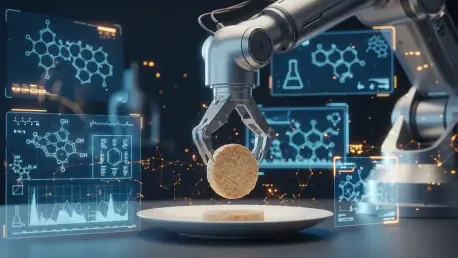

When a machine begins to deconstruct the chemical architecture of a hamburger, it does not see a meal but rather a high-dimensional optimization problem waiting to be solved. This shift represents a significant advancement in the food technology and culinary engineering sectors, where the traditional reliance on heritage and intuition is being replaced by data-driven precision. By integrating mechanical engineering with computational biology, the current landscape of recipe development is moving away from the messy trial-and-error of the past. This review explores how the synthesis of these fields allows for the creation of culinary products that were previously impossible to conceptualize, let alone manufacture at scale.
The purpose of this review is to provide a thorough understanding of the technology, its current capabilities, and its potential future development. By examining the evolution of these tools, it becomes clear that we are no longer simply automating the kitchen but reinventing the very nature of food composition. The emergence of specialized systems demonstrates how machine learning is moving from simple prediction to active, generative discovery. This transformation is particularly evident in the way developers now balance the conflicting demands of consumer taste, personal health, and ecological responsibility.
The Evolution of Culinary Engineering: From Intuition to Algorithm
The transition of food preparation from an art form to a quantitative science marks the end of an era defined by subjective guesswork. Historically, chefs relied on a lifetime of experience to understand how flavors interact, but this human-centric approach is limited by the number of combinations a person can realistically test. Modern generative design tools, such as the BurgerAI framework developed at Stanford University, treat every ingredient as a variable in a complex equation. This allows for a level of precision that ensures consistency and optimization across thousands of production units, something traditional methods could never achieve.
The intersection of mechanical engineering and biology has birthed a new class of tools that treat food as a sophisticated material. By analyzing the structural properties of proteins and the chemical reactions during cooking, these algorithms can predict the exact point where a recipe achieves the perfect texture. This is a leap forward from earlier AI applications that merely predicted market trends; today, the technology actively suggests new molecular combinations. This shift ensures that the discovery process is no longer constrained by human imagination, allowing for the emergence of “active discovery” in gastronomy.
Core Components of Generative Gastronomy
Mapping High-Dimensional Design Spaces
Navigating the mathematical complexity of food design requires a system capable of processing near-infinite variables. Scientists estimate that the potential ingredient combinations for something as simple as a burger reach roughly $10^{43}$ possibilities, a number that vastly exceeds the cognitive limits of even the most experienced research teams. To manage this, generative systems utilize high-dimensional design spaces, where every ingredient, cooking temperature, and nutritional requirement is a different dimension. The AI maps these coordinates to find “sweet spots” where all objectives are met simultaneously.
This mathematical approach is what truly differentiates generative design from traditional recipe software. While a standard program might suggest a substitution based on a simple database, a generative model understands the underlying chemistry of how that substitution affects the entire system. This allows the technology to explore regions of the design space that humans might ignore, such as unconventional plant-based protein blends that mimic the mouthfeel of traditional meats. The result is a highly efficient discovery process that cuts down research time from years to a matter of weeks.
Diffusion-Based Modeling and Multi-Objective Optimization
The technical architecture of modern food generators shares a surprising amount of DNA with the diffusion-based models used in image and text generation. Just as an image generator refines noise into a clear picture, these food models refine a chaotic set of ingredient possibilities into a coherent, optimized recipe. The core of this process is multi-objective optimization, which allows the system to solve for multiple targets at once. A developer can ask the system for a recipe that is high in protein, low in carbon emissions, and satisfies the flavor profile of a specific demographic.
This optimization is unique because it treats these targets not as separate tasks, but as a singular, unified problem. If the system increases the fiber content, it immediately recalculates how that change impacts the moisture retention and flavor release of the final product. This level of systemic awareness is why generative design is more effective than simple iterative testing. It avoids the common pitfall where improving one aspect of a food product, such as its health score, inadvertently ruins the taste or texture.
Innovations in Balancing Personal and Planetary Health
Recent developments in the field have moved toward a total synchronization of human preference with ecological necessity. By utilizing massive datasets that include demographic information—such as age, gender, and physical activity levels—AI can now generate personalized nutritional profiles for specific populations. This means a burger designed for an athlete will have a fundamentally different molecular structure than one designed for a sedentary office worker. This hyper-personalization ensures that food acts as a functional health intervention rather than just a source of calories.
Moreover, the shift toward “planetary health” represents a critical step in reducing the environmental footprint of the global food industry. Generative tools are now programmed to prioritize ingredients with lower water and land usage, often suggesting substitutions that humans would find counter-intuitive but that provide identical sensory experiences. By substituting traditional livestock products with data-driven alternatives, the technology offers a pathway to maintain our culinary standards without the associated ecological cost. This balance between personal enjoyment and global sustainability is the hallmark of the current generative era.
Practical Applications and Empirical Validation
The validity of these AI-designed recipes has been confirmed through rigorous, blinded taste tests in professional culinary environments. In recent trials, recipes generated by the BurgerAI framework were compared against industry-standard products in San Francisco. The results indicated that diners often could not distinguish between a burger designed by a machine and one crafted by human experts. In some cases, the AI-generated “Delicious Burger” actually outperformed traditional versions in terms of texture and overall flavor profile, proving that algorithmic design is no longer a futuristic concept but a present reality.
Beyond simple flavor, specific use cases like the “Mushroom Burger” and the “Bean Burger” have demonstrated the power of nutrient density optimization. The bean-based variant, for instance, achieved twice the nutritional score of conventional options while maintaining high consumer acceptance. This framework is already extending its reach beyond the kitchen. The same logic used to optimize a burger is being applied to materials science and pharmaceutical design, where the need to balance efficacy, cost, and safety mirrors the challenges of culinary engineering.
Technical Hurdles and Market Constraints
Despite these successes, several technical hurdles remain that prevent the immediate, universal adoption of AI-generated diets. Balancing conflicting objectives is still a computationally expensive task, especially when trying to maintain a precise flavor profile while significantly increasing nutritional value or reducing costs. There is often a “uncanny valley” of food texture where a machine-designed product looks correct but feels slightly off to the human palate. Modeling these complex textural interactions in a digital environment requires more granular data than what is currently available.
Furthermore, the industry faces significant regulatory and consumer acceptance obstacles. Many people remain skeptical of “lab-designed” or “machine-optimized” food, fearing a loss of cultural heritage or the introduction of processed ingredients. Current datasets are also limited by their historical nature; they are excellent at mimicking what has worked in the past but can struggle to innovate truly original textures that have no existing reference point. Overcoming these limitations will require a new generation of sensors that can translate human sensory perception into data that an algorithm can process.
The Future Trajectory of Generative Discovery
The outlook for generative discovery suggests that AI will soon act as a primary partner in scientific exploration, moving far beyond the confines of the kitchen. We are moving toward a period where automated material composition will allow for the real-time creation of specialized products tailored to immediate environmental or health needs. Imagine a system that analyzes a person’s blood biomarkers in real-time and generates a meal specifically designed to correct a nutrient deficiency. This hyper-personalized production at scale will likely be the next major disruption in the global food supply chain.
Long-term, this technology will enable a move toward data-driven health interventions that are integrated into our daily lives. As the algorithms become more sophisticated, they will begin to solve engineering challenges that were previously considered unsolvable, such as creating entirely carbon-neutral protein sources that are indistinguishable from beef. This trajectory points to a future where the distinction between “natural” and “designed” food becomes irrelevant, as the focus shifts entirely toward the optimal outcome for both the individual and the planet.
Concluding Synthesis of Generative Food Design
The transition from mimicking existing patterns to inventing optimal new solutions represented a fundamental shift in how society approached the concept of nourishment. The generative food design framework successfully moved culinary science away from subjective art and into the realm of high-precision engineering. By resolving the traditional trade-offs between enjoyment, health, and sustainability, the technology proved that it was possible to satisfy the human palate while respecting ecological boundaries. This objective-driven approach provided a pathway for creating products that met the rigorous demands of both the market and the environment.
The technology demonstrated a remarkable ability to navigate vast design spaces, identifying configurations that human intuition would have likely missed. As these systems integrated with other fields like materials science and pharmaceuticals, the impact of generative AI reached far beyond the food industry, influencing the broader scientific community. Ultimately, the framework established a new paradigm for discovery, where the machine acted as a partner in solving complex global challenges. The success of these early applications confirmed that data-driven interventions could lead to a more sustainable and healthier future for everyone.