
The relentless pursuit of scientific discovery often finds its greatest bottleneck not in the complexity of the hypothesis itself but in the physical limitations of manual liquid handling protocols. Historically, the reliance on human dexterity for repetitive pipetting has introduced significant variables that can jeopardize the integrity of experimental data. While large-scale robotic installations have revolutionized throughput for major pharmaceutical entities, smaller academic and boutique research facilities have remained tethered to manual techniques due to the prohibitive costs and spatial requirements of industrial automation. However, the current shift toward compact, benchtop liquid handling systems is dismantling these traditional barriers, offering a pathway to precision that was previously inaccessible to the broader scientific community. These systems provide a sophisticated bridge between basic manual tools and high-capacity industrial platforms, enabling labs to maintain high standards of reproducibility while optimizing their human capital for more complex cognitive tasks.
Transitioning to Automated Precision
The Core Benefits: Accuracy and Safety
Modern automated liquid handling involves programmable instruments that execute aspiration and dispensing tasks with extreme accuracy. Unlike manual methods, where the fatigue or technique of an individual scientist can skew data, these robots perform identical cycles every time. This consistency is vital for sensitive applications like antibody functionality tests or enzyme assays, where even the slightest discrepancy in volume can lead to unreliable data “noise.” When laboratories utilize these compact systems, they effectively eliminate the physiological variability inherent in human performance, ensuring that every microliter is accounted for with robotic precision. This level of control is particularly beneficial when working with precious or limited reagents, as the margin for error is significantly reduced compared to traditional handheld pipetting. Furthermore, the ability to replicate identical dispensing speeds across multiple plates provides a foundation for high-quality data sets that can be validated with greater confidence.
The implementation of these automated tools also addresses the ergonomic risks that have long plagued laboratory environments, specifically repetitive strain injuries associated with thousands of manual plunger depressions. By delegating these physical burdens to an automated system, institutions protect their most valuable assets—their researchers—from long-term physical discomfort and potential career-shortening injuries. Beyond safety, the reduction in manual intervention translates directly into a reduction in procedural errors, such as skipped wells or double-dispensed reagents, which are common during long sessions at the bench. When the mechanical aspects of fluid transfer are handled by a calibrated machine, the likelihood of cross-contamination is also minimized through standardized tip handling and movement paths. Consequently, the laboratory experiences fewer failed experiments and a more efficient use of consumables, which ultimately lowers the overall cost per data point and enhances the reliability of the research outputs.
Operational Impacts: Productivity and Scalability
Beyond accuracy, these systems provide labs with “walk-away” time, which is a major boost to overall productivity. By delegating the repetitive movement of liquids across microplates or tubes to a robot, researchers are free to focus on experimental design and data analysis. This shift effectively increases the capacity of the laboratory without needing to hire additional staff, maximizing the value of the current team’s expertise. In many instances, the time recovered by automating a single assay allows a scientist to process an additional set of samples or engage in the critical literature review necessary to advance a project. This transition from “hands-on” to “minds-on” work is a defining characteristic of the modern laboratory, where the quality of thought is prioritized over the quantity of physical repetitions. As a result, projects that previously took months to complete can now be finalized in a fraction of the time, accelerating the pace of innovation within the institution and the broader community.
Strategic adoption of these entry-level systems allows for a scalable approach to laboratory growth, where automation is introduced gradually rather than as a disruptive overhaul. This modularity ensures that as the volume of samples increases, the existing infrastructure can handle the load without a corresponding increase in human error or fatigue. By standardizing liquid handling at the benchtop level, even small labs can achieve a throughput that rivals much larger competitors, democratizing the ability to participate in high-speed screening and complex longitudinal studies. Furthermore, the metadata generated by these systems provides an additional layer of experimental documentation, as every move and volume is logged digitally for future reference. This audit trail is invaluable for maintaining compliance with modern data integrity standards and for troubleshooting any anomalies that might arise during the analysis phase. Ultimately, the integration of compact automation creates a more resilient research environment.
Versatility and Strategic Design
Workflow Integration: Protocols and Software
Compact liquid handling systems are designed to handle a wide range of common laboratory tasks, from PCR and qPCR setup to complex serial dilutions. They are not restricted to a single type of experiment; instead, they function as adaptable tools that can grow alongside a lab’s research goals. A system initially purchased for simple reagent addition can eventually be repurposed for more intricate assay development or high-throughput screening as project demands evolve. This flexibility is essential in the current fast-paced research environment where the focus of a laboratory can shift rapidly in response to new discoveries or funding opportunities. By investing in versatile hardware, labs avoid the trap of purchasing specialized equipment that becomes obsolete when a specific project concludes. Instead, they gain a multi-functional asset that provides value across a variety of scientific disciplines, from molecular biology to clinical chemistry, ensuring that the laboratory remains relevant and productive.
The move toward user-friendly software has lowered the entry barrier for automation, making it possible for bench scientists with no technical background in robotics to design and execute complex liquid handling protocols. Modern compact units solve the programming hurdle by offering intuitive, visual software interfaces that require no coding knowledge. These systems often include digital simulation features, allowing users to verify their methods before a single drop of liquid is moved, which prevents costly mechanical errors and protects precious reagents. This democratization of technology ensures that the benefits of automation are available to the entire scientific staff rather than a few specialized engineers. Furthermore, many systems now offer pre-validated method libraries for common tasks, which significantly reduces the time required to set up new experiments. By standardizing the digital instructions for liquid handling, institutions can ensure that a protocol can be replicated with identical results regardless of the operator.
Structural Implementation: Workspace and Future Standards
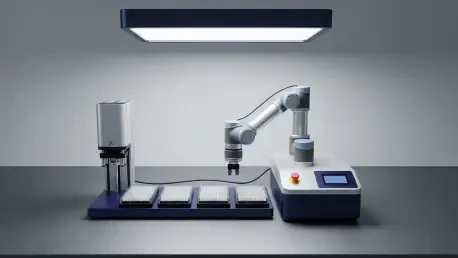
Modern labs are often cramped, and bench space is at a premium, making the compact design of these systems a critical factor in their adoption. Engineered with a small footprint and features like front-opening doors, these units fit easily under overhead shelving or in tight corners. Despite their small size, they offer significant flexibility with configurable deck positions and exchangeable liquid ends, ensuring they provide maximum utility without overwhelming the available work area. This focus on space efficiency is particularly important in urban research hubs where real estate costs are high and lab footprints are minimized to reduce overhead. By optimizing the design of the hardware, manufacturers have made it possible for even the smallest startup to incorporate automation without needing to remodel their existing space. Furthermore, the aesthetic and functional design of these units often complements the modern laboratory environment, providing a clean and organized workspace that encourages more efficient workflows.
The transition to compact automation was ultimately characterized by a shift in how laboratories evaluated their operational success and data reliability. Stakeholders who prioritized the early adoption of these systems found that the immediate improvements in throughput and accuracy provided a necessary cushion against rising research costs and competitive pressures. Moving forward, the focus should remain on the integration of these platforms into broader digital ecosystems, where automated data logging connects directly to cloud-based analysis tools. It was essential for lab managers to audit their current manual workflows to identify the specific protocols that would benefit most from robotic precision. By establishing a culture that values technological proficiency alongside scientific curiosity, organizations set a new standard for excellence. The era of manual dominance in fluid transfer reached its conclusion as precision and efficiency became the non-negotiable foundations for all credible scientific inquiry.