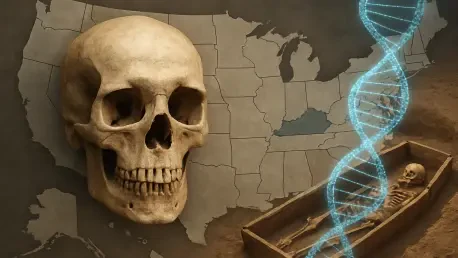

Tracing the subtle threads of human history often relies on fragile paper trails that succumb to decay, yet the microscopic codes written into our very cells offer a far more resilient narrative of the American experience than any archive could ever provide. Recent breakthroughs in genetic sequencing have allowed researchers to perform an unprecedented feat by linking the remains of early Maryland settlers to millions of people currently living across the United States. This scientific endeavor utilized biological samples from St. Mary’s City, which served as the original capital of Maryland and was founded in 1634 as a refuge for those seeking religious freedom during a time of intense European persecution. By bridging a gap spanning nearly four centuries, this study effectively transforms ancient DNA into a silent witness that speaks for individuals whose stories were long buried beneath layers of earth. The results provide a scientific foundation for family legends and oral traditions that were previously impossible to verify with traditional tools.
Advanced Methodology: The Power of Identity by Descent
The primary mechanism behind these discoveries is a sophisticated computational process known as identity-by-descent assessment, which identifies long stretches of DNA shared by individuals who inherited them from a common ancestor. Unlike traditional ethnicity estimates that provide broad geographical percentages, this method allows scientists to pinpoint specific genetic connections between historical remains and modern populations with surgical precision. To achieve these results, the research team extracted high-quality genomic data from the skeletal remains of seventeenth-century colonists and compared them against a massive repository of over eleven million genetic profiles provided by contemporary participants. This vast scale of comparison enabled the identification of shared segments that have survived through dozens of generations, effectively reconstructing complex ancestral paths that had become invisible over time. Such a technological leap moves the field of genealogy from the realm of educated guesses into a rigorous, evidence-based science.
Genomic Mapping: Connecting Millions of Modern Americans
Building on this robust computational framework, the study also leveraged advanced bioinformatics to filter out random genetic noise and focus on markers that signify direct lineage. This approach was essential because the American population has undergone centuries of diversification and migration, which often dilutes the genetic signal of original colonial groups in modern descendants. By focusing on rare variants and long haplotypes, the researchers successfully demonstrated that the genetic footprint of a few hundred early settlers could expand exponentially through the centuries to encompass millions of people. This realization highlights the profound impact that small founder populations had on the demographic landscape of the North American continent, shaping the biological heritage of the nation long before the massive waves of immigration in the nineteenth century. The success of this methodology suggested that the history of every early settlement could eventually be mapped with similar detail.
Social Stratification: Uncovering Hidden Figures and Realities
Beyond the sheer volume of connections, the research provided a rare glimpse into the social hierarchy of the colonial era by identifying specific historical figures whose burial sites were previously unidentified. For instance, the analysis confirmed the presence of Governor Thomas Greene and his family members within the Chapel Field site, providing a tangible link to the leadership of the Maryland colony. This identification was achieved without prior archaeological clues, proving that genetic data can independently verify historical records or fill in the blanks where documentation is missing. Identifying these elite figures allows historians to understand the health, diet, and lifestyle of the colonial upper class with greater clarity than ever before. Furthermore, these findings create a sense of continuity for the direct descendants of these prominent families, who can now connect their personal history to the individuals who navigated the challenges of establishing a new society.
Historical Synthesis: Tracing Migration and Future Directions
The genetic data confirmed that while most settlers originated from western England and Wales, there was a significant and often overlooked Irish presence among the early population. Furthermore, the study mapped out specific internal migration patterns, such as the post-Revolutionary War movement of Catholic families from Maryland to Kentucky. As the United States approached its 250th anniversary, this research offered a more comprehensive and inclusive narrative of the nation’s founding. The integration of ancient DNA with modern records allowed for a deeper understanding of both elite leaders and common laborers. Future research involving more specific markers, such as mitochondrial and Y-chromosome data, continued to reveal the stories of those forgotten by traditional history books. Experts established that shared biology was a powerful tool for discovery, and they encouraged the systematic preservation of historical remains to facilitate further genomic breakthroughs.