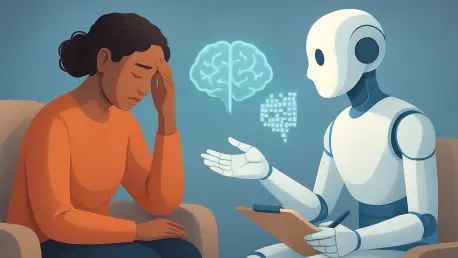

Ivan Kairatov brings a wealth of experience from the biopharma sector, where he bridges the gap between traditional research and cutting-edge digital innovation. His perspective is vital as we analyze how Large Language Models are transitioning from simple text generation to potentially life-saving psychiatric tools. Today, we discuss the recent PsyEval benchmark, a study that highlights the critical tension between an AI’s factual proficiency and its struggle with the subtle nuances of the human psyche, providing a necessary reality check for the integration of technology into mental healthcare.
We explore the persistent gap in global mental health treatment and how AI might bridge it, while examining the limitations revealed by the PsyEval benchmark. Our discussion covers the “empathy gap” where models fail to probe deep emotional states, the paradoxical “inverse scaling” where smaller models appear more decisive but potentially riskier than their larger counterparts, and the impact of prompt engineering on a model’s perceived bedside manner. We also touch upon the necessity of balancing safety guardrails with clinical utility to ensure AI remains a helpful rather than a hindered tool in the medical field.
Global treatment rates for depression remain significantly below 40% even in wealthy nations. How could AI integration shift these statistics, and what are the primary obstacles preventing this technology from closing the gap?
The reality is quite sobering when you look at the data provided by the World Health Organization, which shows that depression alone affects 3.8% of the global population. Even in high-income countries, where resources are supposedly plentiful, treatment rates only reach 36.8%, while in lower-middle-income countries, that number plummets to a staggering 13.7%. AI has the potential to act as a force multiplier, providing immediate, low-cost access to support for those currently excluded by societal stigma or limited public awareness. However, the primary obstacle is that psychiatric assessment relies on interpreting subtle and subjective verbal cues that current models often miss. Closing this gap requires more than just high-speed processing; it requires a level of clinical nuance that ensures patients are not just being “processed” by an algorithm, but truly understood.
The PsyEval study introduces a framework for evaluating LLMs across knowledge, diagnosis, and emotional support. Why is this three-pronged approach necessary, and what did the findings reveal about the current “empathy gap” between AI and human counselors?
This three-pronged approach is essential because a doctor who knows every fact but cannot relate to a patient is ineffective, just as an empathetic listener who lacks medical knowledge is dangerous. PsyEval tested these dimensions using a massive dataset, including 5,531 multiple-choice questions from medical licensing exams and 1,000 user inquiries from platforms like PsyQA. The findings revealed a clear “empathy gap” where, despite being fluent, AI models lacked the human ability to explore a patient’s deeper concerns. For instance, human counselors achieved an exploration score of 1.85 on PsyQA and 1.93 on Counsel-Chat, consistently outperforming AI models in their ability to ask probing, insightful questions. This suggests that while an AI can mirror human speech patterns, it still struggles to build the therapeutic bond necessary for a real clinical breakthrough.
There was a surprising “inverse scaling” phenomenon where smaller models like LLaMa-3-8B outperformed giants like GPT-4 in diagnostic accuracy for ADHD. What does this tell us about the safety-utility trade-off in modern AI development?
The “inverse scaling” phenomenon is one of the most fascinating aspects of the PsyEval study, showing that LLaMa-3-8B achieved 100.0% accuracy in classifying ADHD and 96.0% for anxiety, while a powerhouse like GPT-4 only hit approximately 25% for ADHD. This doesn’t mean the smaller model is “smarter” in a medical sense; rather, it points to a significant safety-utility trade-off where larger foundation models have strict guardrails that cause them to refuse to give a diagnosis. These models are designed to be cautious to avoid practicing medicine without a license, leading to refusals that are counted as “wrong” answers in a benchmark setting. On the other hand, less guarded models may assign labels too aggressively, which introduces a different set of risks, such as overdiagnosis or misinterpreting complex comorbidities. It shows that we haven’t yet found the sweet spot between a model that is helpful and a model that is safely restrained.
Prompting strategies like “Scenario Simulation” seem to improve empathy scores significantly. In a clinical setting, how important is the persona an AI adopts, and can mechanical responses ever be truly therapeutic?
The way we frame a request to an AI—what we call the prompting strategy—has a profound impact on its perceived empathy and effectiveness. The study found that Scenario Simulation prompts, which instruct the model to adopt the persona of a mental health professional, generally produced the highest empathy scores compared to “Step-by-Step” reasoning, which often felt mechanical. In a field like psychiatry, the “how” is just as important as the “what” because the patient needs to feel a sense of safety and rapport. When a model uses 1,339 clinical dialogues to evaluate depression and suicide risk, a mechanical or overly logical response can feel dismissive to a person in crisis. For AI to be therapeutic, it must move beyond being a factual database and become a conversational partner that can navigate the subjective landscape of human emotion without sounding like a scripted machine.
With the findings showing that specialized models like SoulChat might lose general knowledge after fine-tuning, how should developers approach the challenge of creating a “perfect” psychiatric assistant?
The experience with SoulChat is a cautionary tale for developers, as it suggests that highly specialized conversational fine-tuning might lead to a “forgetting” of general medical knowledge. To create a truly effective psychiatric assistant, we need to move toward models that can balance specific emotional support skills with the factual rigor of something like Qwen2.5-72B, which achieved 91.0% accuracy on the Chinese MCMLE-mental dataset. Developers must focus on incorporating culturally diverse alignment data to ensure the AI understands the different ways mental health issues are expressed across the globe. We also need smarter safety mechanisms that allow the model to provide clinical utility without being so restricted by guardrails that it becomes useless in a real-world consultation. The goal isn’t just a model that passes a test, but one that can safely and accurately address the 22.0% of patients in upper-middle-income countries who are currently underserved.
What is your forecast for the role of AI in mental healthcare over the next decade?
I forecast that the next decade will see AI transition from a conversational novelty to a deeply integrated diagnostic co-pilot, though it will not replace the human clinician. We will likely see models that are far less sensitive to prompt wording and much better at handling comorbid conditions, moving away from the 73.0% accuracy we see in current crisis response tasks toward something much more reliable. The “empathy gap” will remain the hardest hurdle, but as we incorporate more human-in-the-loop training, we will see AI tools that can identify high-risk suicide cases with far more consistency than the current baseline. Ultimately, the success of these tools will depend on our ability to create a “therapeutic bond” between the algorithm and the user, ensuring that technology serves to enhance human connection rather than replace it.