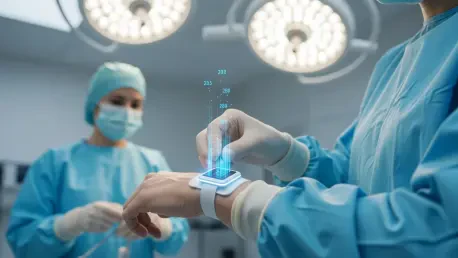

The medical community has long sought a way to quantify the invisible toll that stress takes on the human body, moving beyond the anecdotal to the analytical. This challenge is particularly acute in neonatal wards and emergency rooms, where the stakes are life-altering and patients often cannot articulate their distress. Recent breakthroughs from Northwestern University have introduced a revolutionary wearable polygraph—a soft, skin-interfaced patch that weighs less than eight grams—capable of tracking the body’s subtle “cries for help” through a suite of integrated sensors. By monitoring heart activity, breathing patterns, sweat, and blood flow simultaneously, this technology offers a window into the autonomic nervous system that was previously only accessible via bulky laboratory equipment. This interview explores how these thin, bandage-like devices are transforming our understanding of physiological pressure, the technical hurdles of miniaturizing high-fidelity sensors, and the potential to revolutionize patient care for the most vulnerable populations.
Traditional stress monitoring often relies on single metrics like heart rate. How does measuring sweat, blood flow, and temperature simultaneously improve accuracy, and what are the technical challenges of synchronizing these distinct data streams in a single device weighing less than eight grams?
Measuring stress is an inherently complex task because the human body doesn’t react in a vacuum; it is a multi-dimensional response that involves the heart, the lungs, and the skin. If you only look at heart rate, you might mistake a flight of stairs for a panic attack, but by integrating sweat gland activity—which is a well-known marker of psychological stress—alongside near-surface blood circulation and heat flow, we get a much clearer picture of the body’s internal state. We essentially crammed as many sensors as possible into a platform that weighs about the same as eight paperclips, ensuring it remains unobtrusive while capturing a “whole-body” view. The synchronization is the real feat here, as we have to align mechanical and acoustic signals from a miniature microphone with electrical conductivity data from the skin in real-time. This allows our machine learning algorithms to analyze these synchronized streams on a smartphone or tablet, identifying patterns that a single-metric device would simply miss.
Pediatricians frequently struggle to quantify pain in infants who cannot communicate. How does this wearable technology remove subjectivity from traditional nursing assessments, and can you describe the specific ways this data might change how a neonatal intensive care unit manages patient comfort?
In the past, determining whether a baby was in pain or just fussy relied heavily on what a caregiver could see or hear, such as the tonality and volume of a cry or a specific facial expression. These traditional nursing assessments and survey sheets are inherently subjective and can vary wildly between observers, especially when an infant’s signals are subtle or inconsistent. By using this soft, wireless device, we can provide clinicians with quantitative measurements of stress intensity and duration around the clock without ever needing to draw blood or collect saliva for biochemical markers. In a neonatal intensive care unit, this means a nurse can see a digital dashboard that reflects the baby’s actual physiological state, allowing for immediate interventions to restore a healthy balance. It empowers the medical team to identify environmental or disease-induced stress before it leads to irreversible health consequences, effectively giving a voice to those who cannot yet speak for themselves.
High-pressure environments, such as emergency rooms, often lead to diminished decision-making. What specific physiological patterns have been observed in medical students during high-stress simulations, and how might real-time alerts help professionals recalibrate their performance before a mistake occurs?
During our validation studies with medical students in emergency room training sessions, we observed a striking and consistent pattern: those who exhibited the strongest physiological stress responses tended to perform significantly worse in their clinical tasks. The device captured coordinated spikes in cardiac activity and breathing irregularities that the students themselves often didn’t realize were happening until they were deep into the simulation. By tracking these hidden signals, the technology acts as an early warning system, highlighting how stress quietly impairs cognitive function and decision-making during high-stakes maneuvers. If the device sends a real-time alert to a smartwatch when stress levels hit a certain limit, it gives the professional a chance to pause, breathe, and recalibrate their focus. This kind of “bio-feedback” could prevent the tunnel vision that often leads to medical errors, ensuring that performance remains sharp even when the pressure is at its peak.
Clinical sleep studies and polygraph tests usually involve bulky, restrictive wiring. What materials allow a device to move naturally with the skin for over 24 hours, and what steps were taken to ensure sensors remain accurate without needing access to biochemical markers in blood or saliva?
The goal was to move away from the “patchwork of bulky, wired sensors” found in television crime dramas and create something that feels like a simple bandage. We utilized soft, skin-interfaced materials that are designed to move naturally with the human body, ensuring that the device doesn’t become a source of stress itself over a 24-hour monitoring period. To maintain accuracy without invasive biofluid sampling, we focused on biophysical body responses—using a built-in motion sensor and a miniature microphone to capture the mechanical rhythms of the heart and lungs. We also integrated sensors that detect skin temperature and heat flow, which are vital for understanding how blood is circulating near the surface during a stress event. This non-invasive approach is crucial for long-term wear, as it avoids the skin irritation and logistical hurdles of traditional polygraph machines while providing data comparable to hospital-grade equipment.
Differentiating between physical pain and psychological stress is notoriously difficult. How would adding brain activity sensors like EEG change our understanding of stress perception, and what are the primary hurdles in miniaturizing brain-sensing technology into a soft, wearable patch?
While our current device captures how the body manifests stress, adding electroencephalogram (EEG) capabilities would allow us to capture how the brain actually perceives it. This is the “holy grail” of stress research because it would help scientists distinguish between the raw sensation of physical pain and the emotional weight of psychological stress, even in a home setting. The primary hurdle in miniaturizing EEG technology is the sensitivity required to pick up tiny electrical signals through the hair and scalp while maintaining a soft, flexible form factor that doesn’t require “tethering” the patient to a wall. We are currently exploring ways to incorporate even more sensors into the patch to bridge this gap, aiming to understand the context of simultaneously recorded stress biomarkers. If we can successfully integrate brain activity, we will move from simply measuring a response to truly understanding the individual’s subjective experience of their environment.
What is your forecast for wearable stress-monitoring technology?
I believe we are entering an era where wearable technology will move beyond simple fitness tracking and become a proactive guardian of our mental and physical health. My forecast is that within the next decade, these bandage-like polygraphs will be integrated into standard hospital-at-home systems, providing continuous, real-time insights that allow for early intervention before stress-induced conditions become critical. We will see a shift where both patients and healthcare providers use these quantitative measurements to monitor the effectiveness of stress-reduction treatments just as routinely as we check blood pressure today. Ultimately, this technology will empower pregnant mothers, critically ill patients, and even high-performance professionals to manage their “hidden” stress, transforming our healthcare system from one that reacts to illness to one that actively preserves a healthy physiological balance.