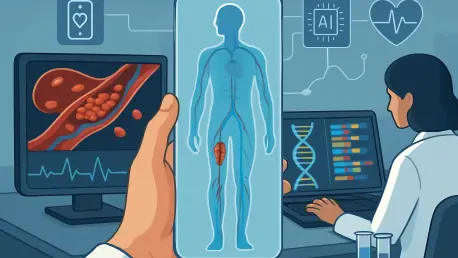

The silent threat of venous thrombosis often bypasses the most rigorous clinical filters, making the sudden onset of life-threatening blood clots one of the most frustrating puzzles in modern hematology. Currently, the landscape of cardiovascular medicine is undergoing a seismic shift as digital health technologies transition from experimental tools to clinical necessities. While venous thrombosis remains a leading cause of global mortality, its onset frequently defies traditional diagnostic logic, leaving many patients vulnerable despite appearing healthy on paper. The industry is moving toward a precision medicine framework where genomic and transcriptomic data are no longer viewed in isolation but are synthesized via artificial intelligence to create a holistic view of patient health. Major research institutions and biotech players are increasingly focusing on the missing heritability of vascular diseases, leveraging high-performance computing to identify hidden risks in idiopathic cases that standard screenings overlook.
Transforming Cardiovascular Diagnostics Through Advanced Computing
Cardiovascular health is increasingly defined by the ability of researchers to parse through vast quantities of biological noise to find specific, actionable signals. This evolution represents a departure from the reactive model of medicine, where treatment began only after a symptomatic event occurred. Instead, the focus has shifted toward high-performance computing environments that process complex datasets at speeds impossible for manual review. By examining the subtle interactions between various biological markers, these systems can predict potential clotting events with a degree of accuracy that was previously unavailable. This transition is essential for addressing idiopathic cases, which have historically lacked clear triggers and left both patients and clinicians in a state of uncertainty.
Furthermore, the integration of advanced computing into the clinical workflow has necessitated a more collaborative relationship between data scientists and hematologists. This interdisciplinary approach ensures that the insights generated by artificial intelligence are not merely mathematical abstractions but are grounded in the practical realities of patient care. The goal is to develop a comprehensive digital twin for every patient, allowing for the simulation of health scenarios and the preemptive adjustment of treatment plans. As these technologies mature, they are expected to become the cornerstone of vascular risk management, providing a level of foresight that fundamentally changes the prognosis for millions of individuals at risk of thrombotic disorders.
Catalysts for Change in Genomic Health and Data Analysis
Emerging Trends in Multi-Omic Integration and Molecular Profiling
The primary trend reshaping hematology is the integration of multi-omic data, which combines clinical variables, genetic sequences, and transcriptomic activity. Recent breakthroughs highlight the rising importance of long noncoding RNAs as regulatory signals for blood clotting. This shift reflects a broader movement toward understanding how genes are expressed rather than just their presence within the genome. By identifying specific molecular signatures, clinicians can move beyond one-size-fits-all risk assessments and toward highly personalized preventative strategies that account for the dynamic nature of a patient’s biological environment.
Moreover, the focus on transcriptomics allows for a real-time assessment of health that static genetic testing cannot provide. This creates a more fluid diagnostic process where a patient’s risk profile can be updated as their lifestyle or environmental factors change. The ability to monitor these regulatory signals means that medical interventions can be timed with surgical precision, reducing the likelihood of adverse events. This trend is driving a new era of biological transparency, where the hidden mechanisms of the blood become visible through the lens of advanced molecular profiling.
Market Trajectory and the Growing Valuation of AI-Driven Healthcare
The market for AI in healthcare is projected to witness exponential growth as health systems prioritize cost-effective early interventions over expensive emergency treatments. Data indicates that traditional risk models often result in a high rate of false positives, leading to unnecessary medical expenses and patient anxiety. Advanced algorithms that refine risk stratification—reducing false-positive rates from over 40% to approximately 23%—offer significant economic value to insurers and providers alike. As performance indicators shift toward sensitivity and specificity in predictive modeling, the demand for sophisticated diagnostic software is expected to surge, driving further investment into bio-computational research from 2026 to 2030.
This financial evolution is also being fueled by the demand for decentralized healthcare solutions that empower patients to monitor their own risks. High-performance computing is no longer confined to massive research laboratories; it is being integrated into cloud-based platforms that can be accessed by local clinics. This democratization of data ensures that high-level diagnostic capabilities are available to a broader population, further increasing the market footprint of digital health firms. Consequently, the valuation of companies that can successfully bridge the gap between complex molecular data and user-friendly diagnostic outputs is reaching record highs.
Overcoming Barriers in Precision Hematology and Predictive Modeling
Despite the promise of AI-driven diagnostics, the industry faces significant hurdles in scaling these technologies across diverse global populations. The complexity of idiopathic venous thromboembolism means that high-risk signatures are often subtle and vary significantly across different ethnic and demographic groups. Furthermore, the black box nature of some machine-learning models can make it difficult for clinicians to interpret why a certain risk score was assigned. To overcome these obstacles, researchers are focusing on developing similarity scores that correlate a patient’s profile with historical data from established cohorts like GAIT2.
Ensuring that these models are validated across larger, more diverse populations is essential to move from successful pilot studies to global clinical standards. There is a pressing need for standardized data collection protocols that allow for the seamless exchange of information between different healthcare systems. Without this interoperability, the power of AI to identify universal molecular signatures remains limited. Industry leaders are currently working to create open-access frameworks that encourage the sharing of anonymized transcriptomic data, which will help refine the accuracy of predictive algorithms and build trust among the medical community.
Navigating the Regulatory Landscape of Algorithmic Medicine
As AI tools become integral to identifying molecular risks, the regulatory framework surrounding genetic data and algorithmic transparency is tightening. Compliance with standards such as the GDPR in Europe and HIPAA in the United States remains a top priority, particularly when handling sensitive transcriptomic data. Regulatory bodies are increasingly scrutinizing the clinical utility of AI markers, requiring rigorous evidence that these digital tools actually improve patient outcomes rather than just providing interesting data points. This scrutiny ensures that only the most reliable technologies reach the bedside.
The challenge lies in creating a standardized pathway for the approval of software-as-a-medical-device that can adapt to the rapid pace of machine-learning iterations. Traditional regulatory cycles are often too slow for the fast-moving tech sector, leading to calls for a more dynamic oversight model. This new approach would allow for continuous monitoring of an algorithm’s performance in the real world, ensuring that it remains accurate as it encounters new patient data. By balancing the need for innovation with strict safety and privacy protocols, regulators can foster an environment where digital health can thrive without compromising patient safety.
The Future of Personalized Prophylaxis and Disease Prevention
The horizon of cardiovascular care points toward a future where vascular health is managed through continuous molecular monitoring. Emerging research into the cross-system links between thrombosis, renal function, and cardiomyopathy suggests that AI will eventually provide a unified view of systemic health. We are moving toward a proactive model where similarity scores are generated as part of routine screenings, allowing for the early identification of individuals whose biological environments are primed for clotting. This shift will likely lead to a significant reduction in the incidence of emergency hospitalizations for vascular events.
Innovation in drug development will likely follow, with new therapies targeting the very long noncoding RNAs identified by AI, offering a level of surgical precision in pharmacological intervention. Instead of broad-spectrum anticoagulants that carry a risk of bleeding, future medications could specifically modulate the regulatory pathways that lead to clot formation. This would represent a paradigm shift in how we treat chronic conditions, focusing on the root molecular causes rather than the symptoms. As our understanding of the human transcriptome deepens, the line between diagnostics and therapeutics will continue to blur, leading to a more integrated approach to human health.
Synthesizing the Impact of Molecular Insights on Global Health Outcomes
The identification of molecular signatures for blood clot risk marked a pivotal moment in the struggle against cardiovascular disease. By harnessing the power of artificial intelligence to decode the complexities of the human transcriptome, researchers provided a blueprint for the next generation of preventive care. This breakthrough transitioned the industry away from reactive treatments and established a foundation for highly personalized medicine. Stakeholders recognized that the reduction of false-positive rates was a primary driver for both clinical efficacy and economic sustainability. The move toward similarity scores enabled a more nuanced understanding of patient risk that bypassed the limitations of traditional genetic screenings.
Furthermore, the industry prioritized the development of transparent regulatory pathways to ensure that these sophisticated tools met the highest standards of safety. The integration of renal and cardiac health markers into a unified systemic view offered new avenues for drug discovery and long-term patient monitoring. Efforts were focused on expanding validation cohorts to include diverse ethnic backgrounds, ensuring that the benefits of precision medicine reached a global audience. Ultimately, the adoption of these molecular insights transformed the healthcare landscape, creating a system that possessed the digital tools necessary to anticipate life-threatening events before they occurred.