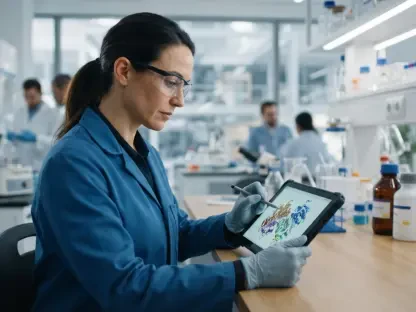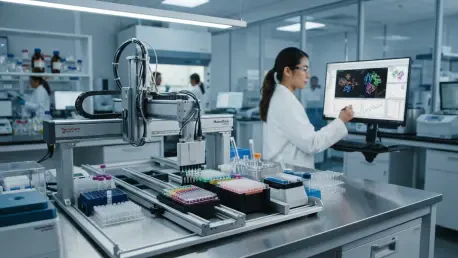

Warp Sciences emerged from stealth on October 22 with $215 million in funding and a proposal to automate more of the chemistry behind drug research. The company describes a U.S.-based contract research organization combining AI, robotics, and medicinal chemistry. Its launch puts a concrete commercial question before biopharma: can advances in computational design translate into dependable experimental work?
Why the Next Step in AI Needs Physical Evidence
Warp’s arrival draws attention to the work between proposing a molecule and deciding whether it deserves further investigation. A digital design gives researchers something to consider. Producing the compound and examining its behavior gives them evidence on which to act.
The company says its first offering will be lead optimization analog synthesis: producing related versions of promising molecules for customers to compare. Clients will choose the compounds and keep control of their research programs. Warp says it has no drug pipeline of its own.
That business model makes this launch relevant beyond another AI announcement. The startup is offering to perform a defined part of research for other companies, so its technology will face a practical purchasing test. Customers will need usable material, appropriate quality checks, and delivery schedules that fit their projects.
The timing also reflects a convergence of laboratory research and substantial commercial backing. Earlier studies have demonstrated that robots and software can work together on bounded experimental tasks. Warp now proposes to turn that general direction into a chemistry service. Funding creates room to attempt the transition, but it does not establish that the service will perform as intended.
Early Research Gains Must Remain Clinically Proportionate
Lead optimization sits well before the clinical evidence needed to guide treatment. Improving this work could help researchers compare chemical alternatives or decide sooner that an idea should be dropped. Neither outcome, by itself, shows that a candidate will benefit patients.
The FDA describes drug development as a progression through discovery, preclinical work, studies in people, regulatory assessment, and ongoing safety monitoring after market entry. Faster synthesis would change an early step within that process. Questions about human safety and effectiveness would still require evidence from later stages.
For healthcare systems, this distinction sets the appropriate frame. Warp’s proposed service is research infrastructure, rather than a diagnostic tool or a treatment technology ready for clinical use. Any eventual care benefit would depend on what customers discover with it and how those findings hold up during development.
Still, early experimental decisions deserve attention. In a hypothetical program, easier access to related compounds could allow scientists to compare alternatives before committing further resources. The useful gain would be better-informed selection, including a clearer reason to stop an unpromising line of work.
Automation Has to Include Measurement and Judgment
The research background offers a reason to take automated chemistry seriously while keeping claims narrow. A 2020 study reported a mobile robotic chemist conducting 688 experiments across eight days in a search for better photocatalysts. That was materials research, not a demonstration of Warp’s proposed drug-research service.
A separate study published in 2024 brought together mobile robotics, automated synthesis, and several analytical instruments. Software used measurements to choose reactions for additional investigation, and the work included automated checks on whether screening hits could be reproduced.
These examples suggest that the important technical connection is between execution and verification. Moving equipment or completing a reaction is only part of an experimental workflow. Researchers also need to establish what happened and whether the result supports another decision.
Warp says experienced chemists will direct experiments while automation capabilities develop. That leaves a central implementation question: how will the service divide routine operations from tasks requiring scientific judgment?
A well-defined automated procedure could handle repeated work while a chemist investigates an unexpected result. Customers should be able to understand those boundaries. Human intervention is part of the operating model to evaluate, rather than something to conceal behind a broad claim of autonomy.
Buyers Need to Assess the Complete Research Job
The pressure on a commercial laboratory differs from the demands of a demonstration. A fast robotic operation may offer little benefit if requests spend longer waiting for review, preparation, analysis, or delivery. Biopharma customers should therefore evaluate elapsed time across the whole assignment.
A useful assessment would ask:
- How long does an agreed request take to yield material and information the customer can use?
- What quality criteria apply, and how are results checked?
- How often must work be repeated or reviewed by a chemist?
- What happens when a request falls outside the automated workflow’s capabilities?
These are proposed purchasing criteria, not performance results Warp has disclosed. They would help distinguish productive capacity from an impressive individual procedure.
Warp also presents its United States location, close customer collaboration, and handling of sensitive research as parts of its offering. Those features may suit some buyers. Others may place greater weight on cost, specialist capabilities, or established relationships. Location alone cannot answer whether a service fits a particular program.
The Investment Case Now Needs an Operating Record
Lightspeed led Warp’s financing, with IVP, Mayfield, Lux, Premji Invest, and Menlo Ventures participating. That backing could support laboratory construction, specialist recruitment, and equipment-software integration, although the company has not disclosed such a spending breakdown.
The next evidence to look for is operational: clearly defined work completed against stated requirements, with transparent reporting on timing and exceptions. Warp’s ambition to connect experimental information with improved AI will also need measurable results. Collecting additional data does not guarantee that subsequent choices become better.
For biopharma teams, the immediate opportunity is to test whether an automated chemistry partner can reduce uncertainty in early research without adding new burdens of verification. If Warp can demonstrate that within a defined service, customers would have a practical basis for deciding where to use it. Claims about future medicines should remain tied to the evidence those programs generate afterward.