
Integrating automated high-throughput bioreactor platforms with macrokinetic modeling enables the systematic identification of critical trade-offs between product leakage and cellular lysis. In the current biopharmaceutical landscape of 2026, the reliance on Escherichia coli as a primary host for recombinant antibody fragments has reached new heights, specifically for Fab and scFv molecules used in complex therapeutic interventions. While these microbial systems are efficient, the traditional extraction of proteins from the periplasm or through the refolding of inclusion bodies remains a significant logistical hurdle, requiring intensive mechanical disruption that drives up operational costs. Transitioning toward extracellular production represents a pivotal shift, as it allows the target product to leak directly into the fermentation broth, bypassing the need for energy-intensive cell lysis steps. This paradigm shift demands a sophisticated understanding of how to maintain membrane permeability without compromising the overall survival and structural integrity of the bacterial population during long-term cultivation. By bridging the gap between small-scale experimentation and industrial-scale production, researchers have identified new ways to balance productivity with cell health.
Screening and Modeling
Experimental Infrastructure: Automated Robotic Systems
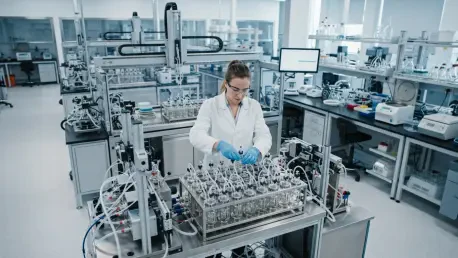
The implementation of automated high-throughput screening has revolutionized the way bioprocess engineers explore the vast multidimensional space of fermentation conditions. By utilizing advanced robotic facilities capable of managing forty-eight mini-bioreactors simultaneously, researchers can now generate extensive datasets that were previously impossible to obtain through traditional benchtop methods. These mini-bioreactor systems are fully equipped with online sensors that provide real-time monitoring of dissolved oxygen tension and pH levels, allowing for precise adjustments to the microenvironment within each vessel. This automation extends to nutrient dosing and base additions, which are handled by high-precision liquid-handling robots that ensure every cultivation run is conducted under strictly controlled and reproducible conditions. Such a high level of synchronization is essential for isolating the subtle effects of various process parameters on the delicate metabolic pathways of engineered E. coli strains, ensuring that the findings are statistically robust and reliable.
Furthermore, this sophisticated infrastructure allows for the rapid testing of dozens of distinct feeding regimens and induction strategies in a single experimental run, significantly compressing the development timeline for new therapeutics. In the context of 2026, where time-to-market is a critical factor for biopharmaceutical companies, the ability to conduct sixty-four parallel fed-batch cultivations provides a competitive advantage in process optimization. This scale of experimentation ensures that outliers are identified and that the statistical significance of the results is high enough to inform large-scale manufacturing decisions. By moving beyond the limitations of single-vessel testing, the industry can now map the complex interplay between growth rates and recombinant protein expression with unprecedented detail. The data generated by these systems serve as the foundational input for advanced mathematical models, bridging the gap between raw experimental observations and the fundamental biological principles that govern microbial secretion and cellular health during the production cycle.
Mathematical Analysis: Macrokinetic Modeling
To interpret the massive influx of data from automated systems, engineers have turned to macrokinetic mechanistic modeling as a tool for deconstructing the complexities of protein accumulation. This modeling approach is specifically designed to distinguish between the two primary pathways of extracellular product release: passive translocation through the outer membrane of living cells and the release of proteins resulting from cellular lysis. By isolating these mechanisms, the model provides a quantitative assessment of cellular robustness, which is expressed through a derived lysis rate parameter that measures the stability of the bacterial population under production stress. Integrating a Monod-like production load term into the model allows for more accurate predictions of metabolic capacity, ensuring that the burden of protein synthesis does not lead to overestimates of cellular growth. This mathematical distinction is vital for identifying the precise point at which the benefits of product leakage are negated by the release of host cell impurities into the broth.
The value of this mathematical framework lies in its ability to quantify the trade-offs that are often obscured by the noise of raw fermentation data. For instance, the model can determine whether a higher titer is the result of more efficient secretion or simply a consequence of a higher percentage of dead cells. In the pursuit of high-purity biopharmaceuticals, minimizing the presence of genomic DNA and host cell proteins in the extracellular medium is as important as the final yield of the target antibody fragment. By utilizing these models, researchers can establish a predictive baseline for how different E. coli strains will respond to changes in induction strength or nutrient availability. This quantitative identification of process drivers enables a more rational design of fermentation protocols, moving away from empirical trial and error and toward a model-driven approach that prioritizes both yield and quality. These insights ultimately lead to more stable production processes that are easier to validate for regulatory compliance in high-stakes manufacturing environments where precision is non-negotiable.
Optimization Parameters
Induction Strength: Optimizing Isopropyl-Beta-D-Thiogalactopyranoside
The concentration of the chemical inducer IPTG has been identified as the most powerful driver of total productivity in extracellular Fab production systems. Recent studies in 2026 have demonstrated a clear parabolic relationship between induction strength and final titer, where peak performance is achieved at a moderate concentration of approximately 50 micromolar. Below this threshold, the expression of the recombinant protein is insufficient to maximize the potential of the host strain, while exceeding this level leads to a sharp and significant decline in the final output. This peak represents a delicate metabolic equilibrium where the cell’s synthetic machinery is fully engaged without being completely overwhelmed by the burden of producing foreign proteins. Establishing this global optimum is critical for maintaining high specific formation rates, as it prevents the premature exhaustion of cellular resources that can occur when the induction stimulus is too aggressive for the bacterium’s natural metabolism.
When over-induction occurs, the metabolic strain on E. coli cells often results in a dramatic crash in productivity, sometimes reducing the final antibody titer by as much as 50 percent. This phenomenon is largely attributed to the saturation of translocons and periplasmic folding machinery, which become bottlenecks when too much protein is synthesized at once. The resulting accumulation of misfolded proteins within the cell can trigger a stress response that further diverts energy away from production and toward maintenance or even programmed cell death. By carefully calibrating the IPTG dosage to the 50 micromolar level, bioprocess engineers can ensure that the bacteria remain in a highly productive state for a longer duration during cultivation. This precision in induction management is one of the primary factors that allowed for the doubling of product titers in recent optimization trials. It serves as a reminder that more is not always better when it comes to the chemical stimulation of microbial protein factories.
Temperature Management: Enhancing Cellular Robustness
While the strength of induction drives the quantity of protein produced, the cultivation temperature is the primary factor determining the robustness of the engineered bacterial population. Standard bioprocessing protocols often utilize a reference temperature of 30 degrees Celsius, but this has proven to be highly detrimental to the specialized leaky strains used for extracellular secretion. At these higher temperatures, the weakened cell envelope is often unable to withstand the cumulative stressors of the fermentation process, leading to severe biomass degradation and catastrophic cell lysis. In some cases, the peak cell density can drop by as much as 70 percent toward the end of the run, releasing a flood of contaminating host cell proteins into the broth. This degradation not only lowers the overall yield but also significantly complicates the downstream purification process, as the target Fab fragments must be separated from a complex mixture of genomic DNA and other cellular debris that would otherwise remain sequestered.
Lowering the production temperature to 25 degrees Celsius has emerged as a transformative strategy for stabilizing the cell envelope and ensuring the longevity of the culture. This cooler environment dramatically reduces the cell lysis rate, with some experiments showing up to an eleven-fold improvement in population stability compared to runs conducted at 30 degrees. Although lower temperatures can slightly reduce the rate of passive protein transport across the membrane, the massive gain in cellular robustness far outweighs the minor decrease in secretion kinetics. The result is a much cleaner fermentation broth that contains high concentrations of functional antibody fragments with minimal contamination from dead cells. This approach highlights a fundamental trade-off in bioprocessing: the need to balance the speed of product release against the structural integrity of the host organism. By prioritizing the health of the cell population through careful temperature control, manufacturers can achieve more consistent and scalable results that meet the rigorous standards of modern biopharma.
Nutrient and Growth Control
Feeding Strategies: The Role of Discrete Pulsing
Conventional wisdom in bioprocessing typically favors continuous nutrient feeding to maintain a steady-state environment and avoid the potential risks associated with substrate gradients. However, contemporary research has challenged this assumption by demonstrating that discrete, pulse-based feeding regimes can actually enhance extracellular protein production. In these scenarios, delivering glucose in controlled pulses every few minutes has been shown to increase total Fab titers by 1.4-fold compared to continuous delivery methods. This counterintuitive result suggests that the transient presence of higher substrate concentrations may provide bacteria with the maintenance energy necessary to sustain protein synthesis without triggering the starvation responses that often lead to lysis. Under low-feed-rate conditions, continuous delivery can sometimes fail to meet the immediate metabolic demands of the cell, whereas pulsing provides a periodic surge of nutrients that supports both growth and the secretion process more effectively.
The use of pulse-based feeding also introduces a controlled level of substrate heterogeneity that appears to benefit the physiological state of the engineered E. coli strains. These periodic bursts of glucose allow for a more dynamic metabolic response, potentially preventing the accumulation of toxic byproducts that can occur when cells are kept in a perpetual state of nutrient limitation. This strategy is particularly relevant for large-scale industrial bioreactors, where mixing limitations often create natural gradients that are usually seen as a disadvantage. By intentionally designing a pulsing strategy that mimics or optimizes these conditions, engineers can turn a traditional manufacturing challenge into a tool for increasing cellular robustness. The increased specific formation rates observed in pulse-fed cultures indicate that the bacteria are better equipped to handle the metabolic load of recombinant production when nutrients are provided in a way that aligns with their internal energy cycles. This discovery provides a new avenue for optimizing high-density fermentations.
Biomass Development: Pre-Induction Physiological States
The physiological state of the bacterial population before the start of the induction phase is a critical but often overlooked factor in the success of the overall bioprocess. Research into growth dynamics has revealed that the rate at which cells multiply during the initial expansion phase directly impacts their subsequent ability to secrete recombinant proteins. Specifically, maintaining a higher exponential growth rate of 0.30 per hour during the pre-induction stage has been found to improve the specific product release rate by 1.6-fold once IPTG is added. This suggests that the early stages of the fermentation run establish a biological foundation that influences the membrane properties of the bacteria throughout the production cycle. Cells grown more rapidly may develop a different membrane protein composition or a higher degree of envelope fluidity, both of which are conducive to the non-destructive leakage of antibody fragments into the extracellular medium later in the process.
This relationship between early growth and final productivity underscores the importance of holistic process design, where every phase of cultivation is optimized to support the goal of high-titer production. If pre-induction growth is too slow, the bacteria may enter a more resistant but less productive physiological state that limits the efficiency of the secretion machinery. Conversely, by encouraging rapid biomass development in the early hours, engineers can prepare cells for the high metabolic demands of the induction phase. This priming of the cell population ensures that when protein synthesis begins, the outer membranes are already in a state that favors the translocation of Fab fragments without leading to premature rupture. Understanding these early-stage drivers allows for a more comprehensive control strategy that begins at the moment of inoculation and continues until harvest. It emphasizes that the history of the culture is just as important as the immediate conditions present during peak production hours.
Scaling and Outcomes
Production Results: Achieving Higher Titer Yields
The application of these optimized cultivation strategies resulted in a remarkable breakthrough in the extracellular production of recombinant antibody fragments. By combining the optimal induction strength of 50 micromolar with a reduced temperature of 25 degrees Celsius and a pulse-based feeding regimen, researchers successfully achieved a final Fab titer of 0.73 grams per liter. This figure represented a twofold increase over the initial reference protocols that were standard in the industry in previous years. Perhaps more importantly, this significant increase in yield was accomplished without any corresponding increase in cellular lysis, which remained at near-negligible levels throughout the run. This achievement proved that it was possible to maximize the leakage of a target protein into the fermentation broth while maintaining a healthy and robust host population, effectively solving one of the most persistent challenges in microbial bioprocessing. This progress marked a new era for extracellular secretion efficiency.
Beyond the raw increase in titers, the quality of the final product and the ease of its recovery were substantially improved by these new protocols. A fermentation broth with low lysis rates contained significantly fewer host cell proteins and genomic DNA, which translated to a higher initial purity for the target antibody fragments. This reduced contaminant load simplified downstream processing steps, such as chromatography and filtration, leading to lower overall manufacturing costs and higher recovery efficiency. The ability to double the production capacity of existing facilities by simply optimizing environmental and feeding parameters offered a massive economic incentive for the biopharmaceutical sector. As the demand for affordable diagnostics and therapeutics continued to grow throughout 2026, these advancements in E. coli cultivation provided a scalable and efficient path forward for the production of next-generation biologics. The success of this model-assisted optimization framework served as a blueprint for the future of microbial secretion.
Industrial Validation: Scalability in Stirred-Tank Reactors
To ensure that the findings from mini-bioreactor screenings were applicable to large-scale industrial manufacturing, the optimized conditions were validated in 150-milliliter stirred-tank reactors. The results of these trials were remarkably consistent with the small-scale data, producing a final Fab titer of 0.70 grams per liter with a low lysis rate of 0.048 per hour. This consistency confirmed that the high-throughput screening approach and the macrokinetic models were highly reliable tools for predicting performance across different scales of operation. The ability to translate findings from ten-milliliter vessels directly to larger systems was a critical requirement for this bioprocessing strategy, as it reduced the risk of failure during the expensive scale-up phase. The successful validation of these parameters in a stirred-tank environment demonstrated that the identified process drivers—such as temperature stabilization and pulsed feeding—were robust enough to withstand the mechanical and mixing differences present in larger bioreactors.
Looking ahead, the industry’s focus is shifting toward even more sophisticated control strategies, such as two-stage cultivations that leverage these specific findings. Future protocols will likely involve an initial phase at 25 degrees Celsius to maximize protein synthesis and maintain cell health, followed by a triggered release phase in which environmental shifts induce a rapid but controlled discharge of the accumulated product. By implementing these model-assisted frameworks, organizations can move toward a more proactive form of bioprocess management that anticipates and mitigates cellular stress before it impacts the final yield. The actionable next step for the industry is to integrate these high-throughput screening tools directly into the development pipeline for all new recombinant proteins, ensuring that every production run is tailored to the specific metabolic needs of the host strain. As biomanufacturing continues to evolve, the integration of automation and mathematical modeling will remain the cornerstone of efficiency.