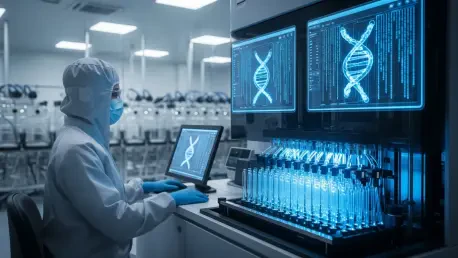

The staggering complexity of a single small protein, with its 50 amino acids creating more possible configurations than there are stars in the observable universe, has historically rendered traditional molecular biology a game of blindfolded archery. For decades, the biotechnology sector relied on directed evolution—a slow, iterative process of trial and error that could only scratch the surface of biological potential. Today, the convergence of high-throughput experimental data and generative artificial intelligence has finally moved us beyond these manual limitations. By treating amino acid sequences as a sophisticated biological language, researchers are no longer just discovering proteins; they are authoring them with mathematical precision. This shift represents a transition from descriptive biology to predictive engineering, where the primary constraint is no longer human patience, but the quality of the data fed into the machine.
The Intersection of Machine Learning and Molecular Biology
Modern protein engineering has evolved into a high-stakes synergy between computational power and experimental throughput. At its core, the technology seeks to solve the “sequence-to-function” problem, which involves predicting how a specific arrangement of amino acids will behave in a living system. Traditional modeling often focused on static structures—what a protein looks like—but the real value lies in functional activity, or what a protein does. By leveraging neural networks, scientists can now navigate the astronomical “sequence space” that defines life, identifying high-performing variants that would take centuries to find through manual laboratory testing.
This integration matters because it fundamentally changes the economics of drug discovery and enzyme design. Instead of testing one variant at a time, researchers use AI to simulate millions of interactions simultaneously. What makes this implementation unique is its move away from purely theoretical models. By grounding machine learning in real-world biological feedback, the industry has moved toward a more scalable and predictive framework. This transition allows for the design of specialized molecules that can perform tasks previously thought impossible, such as highly specific gene editing or the creation of heat-resistant enzymes for industrial use.
Core Components of the AI-Protein Integration
Sequence Display and Activity-Based Barcoding
The most significant hurdle in biological AI has always been the “data bottleneck.” To solve this, the sequence display method acts as a high-throughput engine that bridges the physical and digital worlds. Using molecular editors, researchers can record the functional performance of millions of protein variants directly onto DNA barcodes. This is not merely a tracking system; it is a live recording of biological success. When a protein performs its intended task, the associated DNA barcode is physically modified, creating a permanent record of that activity.
The uniqueness of this approach lies in its ability to generate over 10 million data points in a single three-day experimental cycle. Unlike competitors who may rely on slower, image-based screening or individual sequencing, this barcoding technique allows for the massive parallelization of experiments. It transforms the laboratory into a data factory where the “activity-based” output tells the AI exactly which mutations drive efficiency. This raw data is the essential fuel for predictive modeling, ensuring that the resulting algorithms are trained on actual performance rather than just theoretical predictions.
Protein Language Models and Predictive Analytics
Once the barcoded data is harvested, it is processed by protein language models that interpret amino acid sequences similarly to how a large language model processes human text. These models learn the “grammar” and “syntax” of protein folding, identifying subtle patterns in the data that are invisible to the human eye. By analyzing the performance of millions of variants, the AI can predict the effectiveness of sequences that were never even tested in the lab. This “in silico” testing allows researchers to skip thousands of physical steps, focusing only on the most promising candidates.
This predictive capability is what differentiates modern AI-driven engineering from the automated labs of the past. Traditional automation merely speeds up the physical work, but AI integration actually reduces the amount of physical work required. By refining the search space, these models achieve a level of precision that ensures nearly every sequence synthesized in the final stages of a project is a high-performing variant. It is a transition from searching for a needle in a haystack to using a magnet to pull it directly to the surface.
Latest Developments in Experimental-Computational Synergy
The most recent shift in the field is the emergence of “closed-loop” systems. In these environments, AI-driven predictions and automated experiments inform one another in real-time, creating a self-optimizing discovery cycle. We are moving away from the era where an AI was trained on a static dataset. Instead, modern frameworks allow the model to suggest an experiment, observe the results through automated sequencing, and immediately update its understanding of the protein’s functional landscape. This synergy significantly reduces the timeframe for developing new molecular tools.
Furthermore, the focus has shifted from structural modeling to functional activity modeling. It is no longer enough to know that a protein will fold correctly; it must also perform a specific task, such as repairing a DNA strand or breaking down a pollutant. Specialized molecular editors now act as biological sensors, automatically tagging high-performing variants for faster analysis. This advancement represents a maturation of the technology, where the complexity of biology is finally being met with an equally complex computational response.
Real-World Applications in Biotechnology and Medicine
The practical deployment of this technology is already transforming the landscape of gene therapy. A prime example is the enhancement of CRISPR-Cas systems. By using AI-driven engineering, researchers have expanded the ability of these “molecular scissors” to target and edit diverse DNA stretches that were previously inaccessible. This expansion is critical for developing treatments for rare genetic disorders where the target sequence does not conform to the requirements of naturally occurring enzymes.
Beyond gene editing, the pharmaceutical sector is utilizing these platforms to optimize critical enzymes like cytosine deaminases and aminoacyl-tRNA synthetases. These proteins are vital for base editing and the production of complex cancer treatments. In the realm of DNA repair research, the development of optimized uracil glycosylase inhibitors has demonstrated the platform’s versatility. These are not just incremental improvements; they are radical optimizations that turn finicky biological components into reliable, high-performance tools for clinical application.
Technical Hurdles and Implementation Obstacles
Despite the rapid progress, significant challenges remain, primarily centered on the quality and accessibility of data. AI models are notoriously sensitive; poor-quality experimental data leads to inaccurate “hallucinations” in protein design. This “garbage in, garbage out” risk means that the hardware used for sequence display must be perfectly calibrated. Additionally, as we move toward de novo protein design—creating proteins that have no equivalent in nature—regulatory and safety concerns become paramount. Ensuring that these designed proteins do not have unintended off-target effects in the human body is a hurdle that requires extensive validation.
There is also a growing concern regarding the democratization of this technology. Currently, the most advanced AI-integrated bioengineering requires massive computational resources and specialized laboratory setups often found only in large pharmaceutical firms or elite research institutions. Ongoing efforts are focused on simplifying these high-throughput methods to make them accessible to smaller labs. Overcoming these implementation obstacles is necessary to ensure that the power of AI-driven discovery is not concentrated in the hands of a few, but is instead used to solve global health and environmental crises.
Future Trajectory of AI-Integrated Bioengineering
The trajectory of this technology points toward a future where therapeutic proteins are “designed to order” using purely computational models. We are approaching a paradigm where a researcher can input a specific set of functional requirements—such as a specific binding affinity or thermal stability—and receive a validated sequence within hours. This would effectively decouple biological discovery from the constraints of natural evolution, allowing for the creation of entirely new classes of enzymes designed to solve specific medical or environmental challenges.
Long-term, the most profound impact will be the drastic reduction in the time and cost required to bring new biologics to market. The traditional decade-long drug development cycle could be compressed into a fraction of that time, as predictive models eliminate the high failure rates associated with early-stage candidate selection. This shift will likely lead to more personalized medicine, where proteins are tailored to the specific genetic makeup of an individual, marking the end of the “one-size-fits-all” approach to pharmacology.
Summary and Assessment of AI-Driven Engineering
The integration of high-throughput sequence display and protein language models effectively solved the functional data scarcity that once crippled the field. By creating a physical record of protein activity through DNA barcoding, researchers established a robust foundation for AI training that outperformed purely structural or manual methods. The results proved that when computational power is grounded in massive, high-quality experimental datasets, the pace of biological discovery accelerates exponentially.
The success of this framework across diverse protein classes, from gene editors to metabolic enzymes, confirmed that the synergy of AI and molecular biology was a permanent paradigm shift. This technological evolution transitioned the industry from a reactive state of discovering what exists in nature to a proactive state of engineering what is required for the future. Consequently, the focus moved toward establishing rigorous safety protocols and decentralized platforms to ensure these powerful tools were used responsibly and widely across the global scientific community.