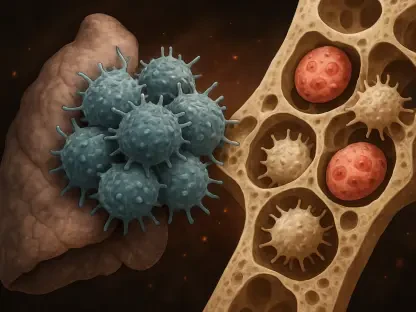

While cytokine release syndrome occurred in the majority of patients, the inflammatory responses were predominantly low-grade and manageable with standard interventions like tocilizumab or corticosteroids. This observation emerged from a critical phase 1 clinical trial conducted at City of Hope, which investigated the utility of chimeric antigen receptor (CAR) T-cell therapy targeting the CD123 antigen. The study specifically focused on adult patients with relapsed or refractory acute myeloid leukemia and blastic plasmacytoid dendritic cell neoplasm, two aggressive hematologic malignancies that have historically left clinicians with few viable options. For patients who experience a recurrence following an allogeneic hematopoietic cell transplant, the prognosis has been notoriously poor, with survival rates often failing to reach the two-year mark. By targeting the alpha subunit of the interleukin-3 receptor, which is present in roughly 70% of AML cases and serves as a definitive marker for BPDCN, the research team aimed to exploit a specific therapeutic window where leukemic stem cells could be neutralized without inflicting irreparable damage on the broader hematopoietic system.
Defining Research Objectives: Addressing High-Risk Malignancies
The primary mission of this open-label investigation was to determine whether a safe and biologically active dose of CD123-directed CAR T cells could be manufactured and successfully delivered to a patient population with advanced disease. This research was particularly vital because the target antigen, CD123, is more heavily expressed on the surface of leukemic blasts and stem cells compared to healthy cells. This differential expression provided the foundational logic for the trial, suggesting that an engineered immune response could be steered toward the cancer with precision. The cohort consisted primarily of adults who had already undergone multiple lines of systemic therapy, highlighting the high stakes involved for individuals who had essentially exhausted the standard of care. By evaluating the feasibility of this cellular approach, the study sought to establish a new roadmap for treating myeloid cancers that are resistant to conventional chemotherapy and secondary transplants.
Beyond the baseline safety assessments, the researchers focused on the biological activity of the infused cells and their ability to survive and expand within the complex environment of the patient’s bone marrow. The trial was structured to accommodate the volatile health status of those with acute myeloid leukemia, where the window for intervention is often narrow. By prioritizing the recruitment of patients with CD123-positive malignancies, the study ensured that the therapy was theoretically matched to the specific molecular profile of each participant’s disease. This personalized approach to immunotherapy represents a significant departure from broad-spectrum treatments, offering a more nuanced way to tackle the heterogeneous nature of AML. The insights gained from this recruitment phase emphasized that for such high-risk patients, the ability to successfully generate a potent cellular product from their own or a donor’s immune system is a substantial victory in itself.
Strategic Dose Escalation: Implementing a Safety-First Protocol
To manage the inherent risks of introducing genetically modified T cells into a human subject, the trial utilized a sophisticated statistical framework known as an activity-constrained for toxicity dose-escalation model. This protocol allowed for the gradual increase of the cell dosage across four distinct tiers, starting from a base level of 12.5 million cells and scaling up to 500 million CAR-positive T cells. If the initial anti-tumor activity was found to be insufficient, the rules permitted a step up to a higher concentration, provided that the rate of dose-limiting toxicities remained within a strictly defined safety margin. This methodical approach ensured that the clinical team could maximize the potential for a therapeutic response while maintaining a rigid safety net for the participants. Most patients received a lymphodepletion conditioning regimen before infusion, a step that is essential for clearing a space in the immune system for the newly introduced CAR T cells to thrive and multiply.
The manufacturing process itself underwent several refinements during the study to enhance the quality of the final cellular product. Initially, peripheral blood mononuclear cells were harvested and modified using a lentiviral vector to express a second-generation CAR construct that featured a CD28 costimulatory domain. This specific domain was chosen for its ability to provide the secondary signals necessary for robust T-cell activation and sustained survival within the patient. Additionally, a truncated epidermal growth factor receptor was integrated as a tracking marker, allowing the medical team to monitor the presence of the cells and providing a potential safety switch if needed. As the trial progressed into the highest dose cohorts, the investigators introduced advanced selection techniques to deplete immunosuppressive regulatory T cells and monocytes. This optimization was designed to ensure that the infused product was enriched with high-potency effector lymphocytes, thereby increasing the likelihood of a meaningful clinical impact against the leukemic cells.
Clinical Challenges: Navigating Attrition and Safety
The aggressive nature of myeloid malignancies presented a significant hurdle to the trial’s completion, as evidenced by a high rate of patient attrition before the infusion stage could be reached. While over forty patients were initially enrolled, only about half were able to receive the experimental therapy. The primary cause of this dropout was the rapid progression of the disease, which often outpaced the two-week manufacturing period required to prepare the CAR T cells. Some patients experienced declining organ function or succumbed to infections before their personalized cells were ready for delivery. This reality highlights the critical importance of operational efficiency in the field of cellular therapy; for patients with AML or BPDCN, the speed of production is not just a logistical detail but a life-saving necessity. The study confirmed that keeping a patient stable enough to receive treatment is often as challenging as engineering the cells themselves.
Despite the clinical difficulties associated with patient health, the safety results of the infused cohort were highly encouraging, with no dose-limiting toxicities observed even at the highest concentrations. While nearly every patient in the AML group experienced some form of high-grade toxicity, these were largely consistent with the effects of intensive lymphodepletion or the underlying leukemia, such as severe drops in blood cell counts. The instances of cytokine release syndrome and neurotoxicity were almost entirely low-grade and proved to be fully reversible with standard medical management. Significantly, there were no reported cases of graft-versus-host disease, even among those who received cells derived from a previous stem cell donor. These findings suggest that CD123-directed CAR T cells can be safely administered without triggering a catastrophic immune attack on healthy tissues, supporting the continued development of this antigen as a target for immunotherapy.
Therapeutic Outcomes: Achieving Remissions and Bridging Treatments
In terms of clinical efficacy, the trial demonstrated that targeting CD123 could indeed lead to complete remissions in a subset of patients who had very few other options. Among the evaluable individuals in the AML group, the overall response rate was approximately 26%, with several patients achieving a state of complete remission where no evidence of disease remained. For the BPDCN cohort, the impact was even more visible in one specific case where a large, extramedullary tumor mass completely disappeared following the infusion. Although these responses were sometimes temporary, they provided a crucial proof of concept that engineered T cells can successfully track down and eliminate myeloid cancer cells. The study also revealed that the CAR T cells expanded in the body according to the dose they received, usually peaking within the first two weeks post-infusion, though the relationship between this peak and long-term durability remained complex.
One of the most important takeaways from the trial was the ability of the CAR T-cell therapy to serve as a bridge to more permanent curative measures. For four of the leukemia patients, the infusion stabilized their condition or induced enough of a remission to allow them to proceed to a subsequent allogeneic stem cell transplant. This is a vital outcome, as many relapsed patients are typically too ill or have too much disease burden to undergo a second transplant. By using the CAR T cells to clear the way, the therapy provided a second chance at a durable cure. Laboratory analysis further indicated that the functional quality of the cells—specifically their ability to persist beyond the initial expansion phase—was a more significant predictor of success than the sheer number of cells infused. This shifting focus from quantity to quality is likely to guide future therapeutic designs in the myeloid space.
Resistance Mechanisms: Overcoming Antigen Escape
The investigation into why some patients eventually relapsed led to the discovery that the leukemia cells used a survival tactic known as phenotypic antigen modulation. In an exceptional case where a patient remained in remission for nearly two years, the eventual return of the cancer was found to be driven by the downregulation of the CD123 protein on the surface of the leukemic cells. Essentially, the cancer did not develop a new mutation; instead, it simply “turned down the volume” of the target antigen, making it invisible to the circulating CAR T cells. This mechanism of antigen escape was a recurring theme among those who did not respond to the treatment or who relapsed early. This finding underscores the adaptive nature of myeloid malignancies and suggests that targeting a single antigen may not be sufficient for a long-term cure in all patients, necessitating the development of multi-target therapies.
When comparing the source of the T cells, the researchers found that donor-derived products often exhibited superior biological characteristics compared to those made from the patients’ own heavily pretreated cells. The donor-derived CAR T cells expanded more efficiently during the manufacturing process and possessed a higher proportion of “memory” phenotypes, which are associated with better persistence and anti-tumor activity. Given that the manufacturing timelines were similar for both autologous and allogeneic sources, the use of donor cells represents a highly feasible strategy for patients who relapse after a transplant. By starting with a healthier immune system from a donor, clinicians can produce a more robust therapeutic product that is better equipped to handle the immunosuppressive environment of the patient’s bone marrow. These comparative insights are essential for optimizing the next generation of cellular products for high-risk leukemia.
Future Perspectives: Advancing Next-Generation Immunotherapies
The phase 1 trial successfully established a robust safety profile for CD123-targeted therapy, providing a clear foundation for more advanced clinical developments. Investigators observed that the therapy was most effective when it functioned as a transitional step toward a transplant, prompting a shift in how these treatments might be integrated into broader clinical workflows. To improve the durability of the remissions, future versions of this therapy were expected to utilize humanized binding domains that could potentially reduce the risk of the patient’s immune system rejecting the engineered cells. Furthermore, the clinical team suggested that combining CAR T cells with other targeted agents could prevent the antigen escape that was frequently seen in the early data. By refining the binding affinity of the cells, it may be possible to detect and eliminate even those cancer cells that express very low levels of the CD123 protein.
As the industry moved beyond the initial findings, the focus turned toward increasing the speed and reliability of the manufacturing process to minimize the number of patients who lost their window of opportunity. Strategies to enhance cellular persistence, such as modifying the costimulatory domains or using cytokine support, were identified as high-priority areas for subsequent research. The trial outcomes also highlighted the need for better “bridging” therapies to keep the disease under control while the CAR T cells were being manufactured. Ultimately, the work concluded that while CD123 CAR T-cell therapy faced significant hurdles in terms of long-term persistence and antigen modulation, its safety and ability to induce rapid remissions made it a powerful tool in the fight against refractory myeloid cancers. These results were viewed as a critical stepping stone toward more complex, multi-antigen approaches that could one day provide a definitive cure for these aggressive diseases.