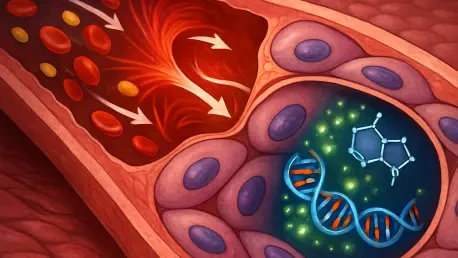

At the very sites where arteries branch and curve, the blood’s mechanical turbulence quietly erodes endothelial defenses while seeding DNA injury that stokes plaque formation yet, paradoxically, also triggers a built-in metabolic countermeasure. New research led by Baylor College of Medicine and collaborators, published in the Proceedings of the National Academy of Sciences, details how endothelial cells under disturbed flow switch on de novo purine synthesis to fuel DNA repair and stabilize the vascular barrier. The work refines a long-standing narrative that has centered on cholesterol and inflammation by adding a concrete, flow-sensitive metabolic–genomic axis that preserves arterial integrity. It also introduces a precision angle: this pathway may be therapeutically boosted to slow atherosclerosis while informing cardiovascular safety for oncology drugs that inhibit purine biosynthesis.
Why Disturbed Flow Matters
Atherosclerosis Beyond Lipids
Even with aggressive LDL-lowering, cardiovascular events remain stubbornly common, pointing to contributors that lipid therapy alone does not neutralize. Disturbed flow (d-flow) at arterial bifurcations and inner curvatures is one such driver, creating low, oscillatory shear that heightens oxidative stress, provokes DNA damage, and weakens tight junctions that normally limit lipid entry and leukocyte adhesion. These biomechanical hotspots historically predicted plaque formation, yet the cellular programs that determine whether endothelium adapts or fails under stress were incompletely charted. Prior studies suggested d-flow retools metabolism, but the “why” and “how” of that shift—particularly its connection to DNA repair and barrier integrity—lacked mechanistic closure in vivo.
A Metabolic–DNA Repair Axis Takes Center Stage
Building on this foundation, the study positions endothelium not as a passive victim but as an active responder that matches genomic demand with metabolic supply. Under d-flow, endothelial cells upregulate genes for de novo purine synthesis, increasing nucleotide pools to support base excision and homologous recombination pathways that resolve strand breaks. This coupling of shear-sensing to nucleotide anabolism reframes atherosclerosis risk at bends and branches: barrier failure is not only the result of stress but of an overwhelmed repair system starved of building blocks. By tying metabolism directly to genome maintenance, the findings expand the therapeutic horizon beyond lipids and canonical inflammation toward engineered resilience of the endothelial lining.
What the Team Tested and How
Hypothesis: Purines Power Repair Under D-Flow
The researchers advanced a clear hypothesis: d-flow activates a protective metabolic program that elevates purine biosynthesis to meet heightened DNA repair needs, thereby safeguarding endothelial viability and restraining plaque growth. This premise drew on the essential role of purines in DNA synthesis and repair fidelity, and on signals known to rise under oscillatory shear, including ATR/ATM pathway activation and NADPH-dependent redox shifts. By interrogating whether nucleotide scarcity is a hidden bottleneck under biomechanical stress, the team asked a decisive question for vascular biology and therapy design: does boosting purine availability tip the balance from injury toward recovery at atherosclerosis-prone sites?
Models, Measurements, and Perturbations
To probe causality in vivo, the team used a mouse carotid partial-ligation model that creates a well-characterized d-flow field with low, reversing shear. Endothelial cells were isolated from affected segments, enabling transcriptomic profiling focused on de novo purine synthesis enzymes across the PPAT–PAICS–ADSL–ATIC axis. Genetic disruption targeted Atic, the bifunctional enzyme that catalyzes the terminal steps of IMP formation, creating a stringent test of pathway necessity. Complementary assays evaluated apoptosis, junctional continuity via VE-cadherin staining, permeability to labeled dextrans, and lesion burden on a hyperlipidemic background. Exogenous purine supplementation served as a rescue maneuver to decouple purine scarcity from other Atic-linked perturbations.
Core Results That Link Flow to Repair
The data converged on a coherent chain of events. D-flow elevated transcripts and protein levels of key purine synthesis enzymes in endothelium, aligning with markers of activated DNA repair such as γ##AX resolution kinetics and upregulation of repair mediators. Conditional Atic deletion dismantled this compensatory program: endothelial cells exhibited increased cell death, fragmented junctions, heightened vascular leak, and larger, more inflamed plaques at the disturbed-flow site. Crucially, supplying purines restored repair capacity and barrier function, tempering lesion progression despite the genetic block upstream. The rescue established functional sufficiency of nucleotide provision, confirming that purine-driven repair is a core determinant of endothelial survival under mechanical stress.
Clinical Implications and Future Directions
Precision Therapy and Oncology Safety
These findings naturally point to strategies that augment endothelial DNA repair in tandem with LDL control, aiming to reinforce plaques where shear is hostile. Approaches could include targeted delivery of purine precursors to d-flow regions, small-molecule enhancers of salvage pathways that spare proliferative tissues, or transient activation of repair effectors timed to hemodynamic risk windows detected by imaging. There is also a timely caution for oncology: antifolate regimens and emerging inhibitors of de novo purine synthesis, designed to curb tumor proliferation, may blunt endothelial repair at arterial bends. Cardio-oncology programs should incorporate baseline vascular imaging, endothelial function testing, and dose adjustments when shear-prone vascular beds are already compromised.
Strengths, Limits, and Next Steps
The study’s genetic causality and pharmacologic rescue strengthened mechanistic confidence, while the in vivo hemodynamic model added physiological relevance. Nevertheless, translation requires human validation across coronary, carotid, and peripheral beds, development of biomarkers that reflect endothelial repair tone or purine pathway activity, and delivery systems that boost endothelial nucleotides without fueling neoplasia. Actionable steps followed from these insights: prioritize trials that pair lipid-lowering with endothelial-protective agents at high-shear-risk sites, embed cardiovascular endpoints into studies of purine synthesis inhibitors, and build imaging pipelines that map d-flow and repair capacity together. Taken together, the path forward favored precision reinforcement of the vascular barrier where mechanics and genome maintenance intersect.