
Colorectal cancer remains a top killer, yet traditional screening pathways leave many behind. Clinic-based outreach depends on staffed phone banks, open appointment slots, and patients’ ability to take time off, travel, and navigate insurance rules. In safety-net settings, those frictions stack. At-home stool testing promises a different flow: the test arrives at home, the sample ships back, and results trigger next steps—ideally without adding strain to clinics already operating at capacity. The question is not whether the kits work in a lab; the question is whether the surrounding system can convert mail-in convenience into completed care.
Moreover, this technology is colliding with a shift in guidelines that moved screening eligibility to age 45, which widened the pool of people to reach without adding capacity to serve them. Community health centers must scale access quickly while preserving equity. A recent multi-site randomized outreach comparing annual fecal immunochemical testing (FIT) with a triennial combined FIT-DNA option offers a practical test of whether newer mail-in approaches and centrally managed logistics can outperform clinic-run programs under real constraints.
What the Technology Is
At-home stool screening comprises two core modalities. FIT detects tiny amounts of blood using antibodies and is designed for yearly use. FIT-DNA pairs hemoglobin detection with markers of abnormal DNA shed by precancerous or cancerous lesions; it runs on a three-year interval when negative. Both are noninvasive, both are mailed, and both require only a small sample and a postage-paid return. The science is straightforward, but the implementation is not: the outcome depends on how the kit is delivered, how patients are nudged, and how abnormal results are managed.
The distinctive twist in the trialed models lies outside the cartridge. The FIT arm relied on clinics to generate lists, package and mail kits, and send automated bilingual texts. The FIT-DNA arm outsourced those layers to the manufacturer, which coordinated mailings and wrap-around assistance—live support, reminders, and troubleshooting. In other words, the technology bundle under review is not just a test; it is the test plus the operating model that moves it.
How It Works in Underserved Systems
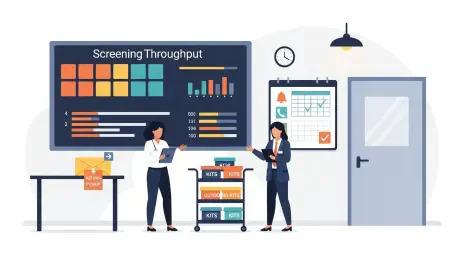
In resource-limited clinics, every new task competes with urgent care, chronic disease management, and documentation demands. FIT aligns naturally with primary care rhythms—annual, inexpensive, familiar—but requires repeat cycles of outreach, inventory, and follow-up each year. That cadence can become a treadmill for lean teams. FIT-DNA’s manufacturer-run logistics shift the burden: centralized eligibility, shipping, and reminders run as a service layer, which cuts the clinic workload and standardizes patient touchpoints.
This decentralization of operations matters because it changes the failure modes. Clinic-run outreach often frays at handoffs—printing labels, confirming addresses, retrying returned mail, chasing unresponsive numbers. A centralized, single-owner workflow reduces those seams. It also introduces trade-offs: cost per completed test rises, and clinics must integrate an external vendor’s data feed into the electronic record to keep a clean registry and ensure timely follow-up.
Performance and Evidence
In a randomized mailed-outreach across eight community health centers in Boston and Los Angeles, FIT-DNA outperformed FIT on short-term completion: 28% returned a completed test within 90 days versus 23% with FIT supported by automated bilingual texts. Statistically, that gap is modest; operationally, it signals that fewer touches at higher quality can beat more touches at lower intensity. For patients who juggle shift work, caregiving, or language barriers, fewer cycles to success raise the odds of any success.
Yet the same dataset exposes the pivotal weakness: only 36% of people with an abnormal stool test completed the required diagnostic colonoscopy. Rates were lower in Los Angeles than Boston, pointing to local capacity, coverage policies, and transportation as practical determinants of whether screening translates into detection and treatment. From a technology perspective, the kit did its job; from a system perspective, the pathway broke at the most consequential step.
Design Choices That Move the Needle
The performance edge for FIT-DNA appears to stem less from chemistry and more from service design. Manufacturer-coordinated mailings created a single accountable workflow. Wrap-around assistance—live calls in the patient’s preferred language, step-by-step guidance, and flexible reminder timing—reduced cognitive and logistical load. The three-year interval also mattered psychologically; less frequent testing feels like a lighter long-term commitment, which can lift initial uptake even if the per-test price is higher.
By contrast, the FIT arm succeeded when primary care teams could personalize outreach, but consistency wavered where staffing thinned. Annual recurrence is both a feature and a liability. It provides more engagement touchpoints, which can be good for building trust, yet it also multiplies the number of operational cycles clinics must execute flawlessly. In under-resourced systems, those cycles often stall.
Bottlenecks After a Positive Test
Follow-up colonoscopy is the critical path, and the data show it is the critical gap. The obstacles are concrete: limited procedure slots, prior-authorization friction, variable coverage for diagnostic colonoscopy, transportation and childcare, and complex prep instructions that are hard to navigate without support. Each barrier trims completion rates; together they erase screening gains.
Technology can mitigate some of this. EHR-integrated registries flag abnormal results in real time and auto-generate referrals. Bidirectional texting confirms readiness, offers prep micro-instructions, and surfaces ride needs. Closed-loop tracking escalates no-shows to navigators. But these tools only work if paired with negotiated access—reserved colonoscopy capacity for positive stool tests and clear, no-cost coverage policies. Without those guarantees, even perfect upstream screening yields disappointing downstream care.
Cost, Policy, and Market Dynamics
The market signal from a 5-point completion lift is clear: buyers in safety-net systems will pay more for a program that offloads logistics if the total cost per completed screen-plus-follow-up falls. That “plus-follow-up” clause is decisive. A cheap initial test that doubles the failure rate after a positive result is a false economy. Policy moves to eliminate cost-sharing for diagnostic colonoscopy after abnormal noninvasive screening change the calculus, lowering drop-off and making higher-cost outreach more defensible.
Regional differences in the trial reinforce that coverage rules and capacity shape outcomes as much as technology choice. Where payers streamline authorizations and systems protect colonoscopy slots for positive tests, vendors that guarantee end-to-end flow gain advantage. Where those conditions are absent, even sophisticated programs struggle to deliver impact that justifies price.
Competitors and Alternatives
The obvious comparator is colonoscopy-first strategies, which are definitive but infrastructure-heavy and prone to access inequities. In many safety-net contexts, colonoscopy capacity cannot stretch to every eligible adult at the recommended interval. Annual FIT offers the lowest sticker price and deep primary care familiarity; it wins where clinics can sustain high-touch outreach. FIT-DNA differentiates by bundling centralized logistics and longer intervals, which lower clinic workload and may raise patient acceptability at a higher per-test cost.
The unique value proposition in the reviewed FIT-DNA program is not superior biology alone; it is the integration of manufacturer-run navigation as an operational backbone. That bundling is the competitor to DIY clinic workflows, not just to other assays. In tribal and rural sites with vast catchment areas and thin staffing, that backbone becomes the deciding feature.
Verdict and Next Steps
This technology delivered a tangible but not transformative lift in initial screening, and its real advantage emerged from service orchestration rather than assay novelty. FIT-DNA with vendor-managed logistics nudged more people across the starting line than FIT with automated texts, especially where clinic capacity was strained. However, the decisive outcome—diagnostic colonoscopy after a positive test—remained the Achilles’ heel, suppressing the clinical return on investment.
A pragmatic next step would have paired the mail-in program with guaranteed colonoscopy access, no-cost diagnostic coverage, and navigator-led, language-concordant support, all wired into a real-time registry with closed-loop referrals. Under those conditions, the higher price of centralized FIT-DNA could have been amortized across more completed diagnoses. For systems with robust primary care outreach, annual FIT still offered a cost-efficient path that kept control in-house. The verdict favored whichever option arrived bundled with reliable navigation and protected downstream capacity, because the best test had been the one people completed—and the only test that ultimately mattered had been the colonoscopy that followed when results were abnormal.