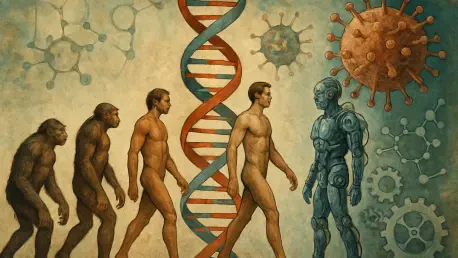

The silent acceleration of biotechnological innovation has reached a point where the manipulation of human DNA is no longer a speculative scenario found in science fiction but a present-day reality that threatens to eclipse the socioeconomic disruptions caused by artificial intelligence. While the global conversation remains tethered to the risks of algorithmic bias and digital surveillance, a more profound transformation is occurring within the sterile confines of private laboratories. Scientists are increasingly pivoting from the localized treatment of genetic disorders toward the wholesale modification of the human germ-line. This transition represents a fundamental departure from the slow, trial-and-error process of natural selection that has governed human development for millennia. Without a cohesive ethical framework to guide these advancements, the very blueprint of the human species risks being permanently rewritten by market forces and individual ambition. The stakes are nothing less than the definition of what it means to be human in an age of biological agency.
The Privatization and Evasion of Ethical Oversight
A significant shift in the landscape of biotechnology is the emergence of a new cohort of researchers who are bypassing traditional channels of public funding and government scrutiny to pursue radical genetic goals. Figures like Kathie Tie represent a trend where scientific pioneers rely on private capital to conduct experiments that currently exceed the boundaries of federal regulations in many Western nations. By operating within the shadows of private equity, these entrepreneurs aim to demonstrate the tangible benefits of germ-line editing directly to the public, effectively pressuring regulators to soften their stances. This approach creates a feedback loop where technological “proofs of concept” are used to justify the erosion of existing safety protocols. The result is a decentralized research environment where the pace of innovation is dictated not by collective ethical deliberation but by the speed of investment and the desire for competitive advantage in the burgeoning genetic marketplace.
This drive for progress frequently utilizes a strategic maneuver known as “playing hide the ball,” where the scientific community maintains voluntary bans on procedures that are not yet technically feasible. History demonstrates that as soon as a technical barrier is overcome—such as the previous limitations on maintaining embryos past the “14-day rule”—the associated ethical boundaries are often dismissed as outdated. This pattern suggests that many current international restrictions on genetic engineering serve merely as temporary placeholders rather than permanent safeguards for human dignity. Once the technology becomes commercially viable and the initial public hesitation fades, these barriers are systematically dismantled to accommodate the new status quo. The fragility of these voluntary moratoriums reveals a disturbing lack of resilience in existing regulatory structures, which seem designed to accommodate technological inevitability rather than to enforce meaningful ethical constraints on the biological frontier.
The New Eugenics and the Global Competition
The transition from somatic editing to germ-line modification marks the most significant ethical leap in the history of modern science because it alters the heritable code of the human species. Somatic editing focuses on treating non-heritable cells in existing patients, whereas germ-line editing changes the reproductive sequence, ensuring that any modifications are passed down to all future generations. This pursuit of so-called “designer babies” signals a resurgence of eugenics, where the wealthy could potentially purchase genetic traits such as increased cognitive capacity or specific physical aesthetics. Such a development risks the creation of a permanent social hierarchy anchored in biological superiority, potentially leading to a new era of systemic oppression. If access to genetic enhancement remains a luxury of the elite, the gap between the biologically “augmented” and the “unmodified” could lead to a fragmentation of the human species that no legislative remedy can easily bridge.
This complex ethical landscape is further complicated by a global environment where nationalistic ambitions frequently override international moral concerns. In China, the controversial case of He Jiankui, who announced the birth of the first CRISPR-edited infants, serves as a stark reminder of how quickly established norms can be ignored to achieve scientific dominance. As various countries compete to lead the biotechnological revolution, a “race to the bottom” has begun where nations might lower their ethical standards to ensure they are not left behind in the contest for biological supremacy. This geopolitical competition creates a scenario where the fear of falling behind technologically motivates a reckless disregard for the long-term biological integrity of the species. When the development of the human genome is treated as a theater of national security or economic warfare, the collective interests of humanity are sacrificed in favor of localized strategic gains, making a unified global regulatory framework nearly impossible.
Addressing Political Inaction and the Future of Governance
Despite the profound implications of these technologies, there remains a notable lack of political leadership in Western nations regarding the firm regulation of biotechnological advancement. Unlike the intense public debates over stem cell research that characterized previous decades, current political figures have largely avoided setting hard ethical boundaries for the next generation of genetic tools. This regulatory vacuum has fostered a state of “biotechnological anarchy,” where rogue actors and private corporations can operate with minimal oversight or accountability to the public interest. The absence of a clear legislative mandate allows for the commercialization of the human genome to proceed without the necessary public discourse that such a monumental change requires. Without an active engagement from the political sphere, the trajectory of human evolution will likely be determined by the profit motives of a few well-funded entities rather than by a democratic consensus on the future of the shared biological identity.
The notion that radical genetic engineering was inevitable served as a dangerous form of fatalism that disregarded the history of managing high-stakes technologies. Humanity previously established successful international frameworks for atomic energy and drafted protocols for artificial intelligence, proving that technological development could be steered. The future of the human genome was never a predetermined outcome; it was a choice that required active political willpower to protect a shared biological heritage from being treated as a commodity. Stakeholders recognized that establishing a permanent global commission on genetic integrity was the necessary next step to prevent fragmented oversight. By prioritizing human dignity over short-term economic gains, societies moved toward a governance model that integrated scientific transparency with strict moral accountability. This shift ensured that the power to rewrite DNA remained a tool for healing rather than a mechanism for permanent social division or the reckless alteration of the human species.