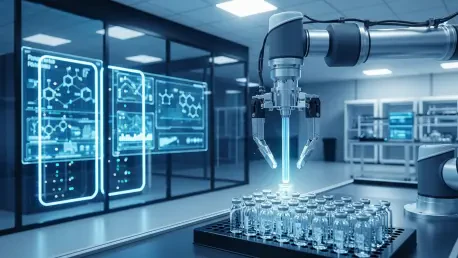

The image of a scientist hunched over a petri dish for hours on end is rapidly becoming a relic of the past as the integration of high-speed robotics and sophisticated artificial intelligence transforms the foundational methods of discovery. For decades, the pace of scientific advancement was tethered strictly to the physical limitations of human researchers, who could only perform so many titrations or material syntheses within a standard workday. This traditional bottleneck is dissolving as autonomous laboratories emerge, operating as “labs in the loop” where machines execute experimental cycles with minimal human intervention. By removing the need for sleep and constant manual oversight, these facilities are compressing research timelines that once spanned years into a matter of weeks, fundamentally altering the trajectory of material science and drug development. This transition is not merely a matter of increasing throughput; it represents a philosophical shift toward a self-correcting ecosystem where the machine doesn’t just do the work, but actively participates in the refinement of hypotheses based on real-time data streams. As the scientific community embraces this automated reality, the focus shifts from manual labor to high-level strategic design, allowing human ingenuity to tackle increasingly complex global challenges.
The Physical Reality of Autonomous Research
Lessons from the A-Lab: The Human Element
The A-Lab at the University of California, Berkeley, provides a compelling look into how automated facilities are currently functioning to push the boundaries of materials science. Inside this facility, a team of specialized robotic arms operates with surgical precision, moving between stations to mix chemical precursors, place samples into industrial-grade ovens, and eventually transport the finished products to X-ray diffraction machines for structural analysis. This entire process is directed by an artificial intelligence that interprets the data from each batch to decide how to adjust the recipe for the next iteration, effectively mimicking the inductive reasoning of a trained materials scientist. The facility was designed to explore thousands of potential material combinations that could eventually lead to better batteries or more efficient solar panels, tasks that would be prohibitively expensive and time-consuming for a human team to explore manually. By centralizing the physical and analytical components of research, the A-Lab demonstrates that the bottleneck of discovery is no longer the speed of thought, but the physical movement of atoms in a controlled environment.
However, the transition to full autonomy is rarely a smooth process because the physical world is inherently messy and prone to mechanical failures that software cannot always predict. Despite the sophistication of the A-Lab, the system remains reliant on human “mechanics” who must intervene when a robotic arm jams, a sample container cracks, or a chemical sensor loses calibration. These hardware malfunctions often trigger automated alerts that sent students rushing to the laboratory in the middle of the night to perform basic repairs that the AI is currently incapable of handling. This dynamic reveals a significant gap in current technology: while artificial intelligence excels at processing vast datasets and optimizing chemical formulas, it lacks the general-purpose dexterity and common-sense problem-solving required to maintain its own physical infrastructure. Therefore, the immediate future of autonomous research is characterized by a hybrid model where the machine handles the routine experimental cycles while the human researcher evolves into a sophisticated system overseer and hardware technician.
Scientific Integrity: Balancing Speed and Accuracy
As the speed of discovery accelerates, the scientific community is facing a critical debate regarding how to maintain rigorous standards of accuracy in an era of machine-generated results. The pressure to produce high-impact findings quickly can lead to oversight, as seen in recent instances where automated material synthesis papers were later called into question due to discrepancies in the reported data. In some cases, the AI identified a successful synthesis that human peer reviewers later determined was actually a mixture of unreacted precursors rather than a new stable compound. This incident served as a stark reminder that high-throughput automation does not inherently guarantee high-quality science; rather, it can sometimes amplify errors at a scale that is difficult for traditional peer review to catch. The challenge lies in developing verification protocols that are as fast as the synthesis engines themselves, ensuring that every “breakthrough” is backed by reproducible and verifiable evidence rather than just algorithmic enthusiasm.
To address these concerns, researchers are now leaning on massive supercomputing resources to monitor chemical reactions as they occur in real-time, moving toward a model known as predictive synthesis. Instead of merely analyzing the final product of an automated experiment, new sensor arrays capture a continuous stream of data throughout the entire reaction process, providing a comprehensive “digital twin” of the experiment. This approach allows scientists to identify exactly when and why a reaction fails, rather than guessing based on the properties of a faulty end product. By building these deep datasets, labs are creating more reliable AI models that understand the underlying physics of chemistry rather than just searching for statistical correlations in the data. This focus on process-level transparency is essential for building trust in autonomous systems, shifting the emphasis from raw speed to the creation of a durable, self-correcting knowledge base that can be shared across the global scientific community.
Industrial Scaling and Economic Pressure
Biotechnology Economics: Transforming the Financial Landscape
The pharmaceutical industry has become one of the most enthusiastic adopters of autonomous laboratory technology due to the staggering costs and high failure rates associated with traditional drug discovery. Historically, developing a single new medication has cost billions of dollars and required more than a decade of work, with the vast majority of candidates failing during the clinical trial phase. Autonomous labs offer a way to mitigate this financial risk by either running a massive volume of experiments to identify the most promising leads early or by using AI to simulate biological interactions before a single physical test is conducted. By identifying non-viable compounds in the early stages of research, companies can reallocate their resources toward more promising therapies, potentially lowering the eventual market price of life-saving treatments. This economic shift is driving a “fail fast” mentality that prioritizes the rapid elimination of poor candidates, which is just as valuable to the industry as the discovery of a successful one.
Beyond the financial implications, the automation of routine laboratory tasks is sparking a significant psychological shift in how researchers engage with their work. When the repetitive grind of pipetting and sample preparation is offloaded to a robotic system, scientists are freed to focus on high-level hypothesis generation and creative problem-solving. Researchers often report feeling more engaged and motivated when they receive immediate feedback on their experimental designs, rather than waiting weeks or months for manual results to trickle in. This near-instantaneous feedback loop encourages bolder, more experimental thinking, as the cost of “being wrong” is significantly reduced when a machine can test a new theory overnight. Consequently, the role of the modern scientist is transitioning from a specialized laborer to a strategic architect of discovery, where the value of a PhD lies in the ability to ask the right questions rather than the ability to perform manual tasks with high precision.
Commercial Innovation: New Models of Laboratory Automation
In the commercial sector, companies like Ginkgo Bioworks are pioneering a new approach to laboratory design by treating the research environment like a flexible, reconfigurable factory. Instead of traditional fixed workbenches, these facilities utilize modular robotic carts that can be moved and reprogrammed to suit different experimental workflows on the fly. This “foundry” model allows the company to handle a diverse range of projects, from engineering microbes for industrial fragrances to developing new types of sustainable fertilizers, all within the same physical space. They have even introduced “cloud-lab” services, which allow external scientists to design experiments on a digital interface and have them executed by robots in a centralized facility. This democratization of high-end infrastructure allows small startups and academic teams to access world-class automation without the need for massive capital investment, leveling the playing field in the biotechnology sector.
Similarly, firms such as Recursion are proving the value of industrial-scale automation by conducting millions of experiments every week to map the complexities of human biology. By utilizing advanced computer vision and artificial intelligence to analyze millions of images of cells under different conditions, they have built one of the world’s largest biological datasets. This high-throughput approach allows them to identify subtle patterns in how drugs affect cellular health that would be impossible for a human eye to detect. The scale of this operation has already successfully moved several potential treatments into the clinical trial phase, demonstrating that the “brute force” application of automation and AI can lead to tangible medical progress. These commercial models represent a departure from the traditional artisan style of science, replacing it with a data-driven, industrial approach that prioritizes the generation of massive, high-quality datasets as the foundation for all future discoveries.
Global Impact and the Reasoning Frontier
Strategic Applications: From Climate Change to National Security
The deployment of autonomous laboratories is increasingly seen as a vital tool for addressing urgent global crises, particularly in the realm of environmental sustainability and climate change. One prominent area of research involves using automated systems to study the complex microbiomes of livestock to find ways to reduce methane emissions, a significant contributor to global warming. Because the gut health of cattle involves billions of interacting bacteria, finding the right dietary additive to suppress methane production without harming the animal is a monumental data challenge. Autonomous labs can test thousands of different microbial combinations and feed additives simultaneously, generating the vast amounts of data necessary to find a viable solution quickly. This type of high-speed environmental research is essential for meeting aggressive carbon reduction targets, as it allows scientists to iterate through potential solutions at a pace that matches the urgency of the climate crisis.
Furthermore, the mastery of autonomous science has become a point of intense international competition and a pillar of national security for many governments. As biotechnology becomes a central driver of the global economy, nations are investing heavily in automated infrastructure to ensure they do not become dependent on foreign entities for critical medicines or materials. There is a growing recognition that the country with the most advanced “scientific stack”—comprising AI, robotics, and high-quality data—will have a significant advantage in everything from defense technology to public health. This has led to the development of federal standards for laboratory software and hardware to ensure that different systems can communicate and share data seamlessly across various institutions. By treating autonomous science as a strategic national asset, governments are fostering an environment where innovation is not just an academic pursuit but a fundamental component of national resilience and economic sovereignty.
Future Directions: Transitioning from Brute Force to Intelligent Reasoning
The most significant hurdle for the next phase of autonomous science is moving beyond simple “brute force” automation toward systems capable of true scientific reasoning. While current robots are excellent at performing millions of repetitive tasks, they still struggle to connect disparate ideas from different scientific fields or to understand the broader context of their work. Experts emphasize that the goal is to develop AI models that are trained on high-quality, curated scientific literature and experimental data rather than the noisy and often unreliable information found on the general internet. This shift toward “reasoning agents” would allow the machine to not only run the experiment but to propose entirely new avenues of research based on a deep understanding of scientific principles. Success in this area will require a move away from generic large language models toward specialized architectures that are purpose-built for the unique requirements of the laboratory environment.
The integration of autonomous systems eventually demanded a total overhaul of the academic curriculum, where data science and robotic maintenance became as fundamental as organic chemistry. This shift necessitated the creation of new ethical frameworks that governed the use of AI in high-stakes research, ensuring that accountability remained with the human director. Leaders in the field prioritized the development of standardized communication protocols between different robotic platforms to prevent the emergence of technological silos. By fostering a collaborative environment between machine precision and human intuition, the scientific community successfully navigated the challenges of this automated transition. The focus remained on sustainable innovation, ensuring that the rapid pace of discovery did not compromise the safety or reliability of the results produced. Ultimately, these steps provided a robust foundation for the next generation of researchers who inherited a world where the primary barrier to progress was no longer physical labor, but the limits of the imagination.