
The rapid evolution of biotechnological capabilities has brought humanity to a critical juncture where the potential for life-saving discoveries is matched by the escalating complexity of biological threats. Effective biorisk governance requires a structured institutional architecture that moves beyond simple rules to establish a sustainable culture of decision-making and resource prioritization. This approach represents a departure from the fragmented safety protocols of the past, moving instead toward a unified framework that recognizes the interconnectedness of laboratory environments and public safety. By consolidating the historically isolated disciplines of biosafety and biosecurity with a renewed emphasis on ethical responsibility, the scientific community is creating a more resilient defense against both internal mishaps and external interference. This integration is not merely an administrative convenience but a fundamental necessity in an era where high-containment research is becoming more prevalent worldwide. Today, global standards such as the World Health Organization’s updated guidance and the CWA 15793 standard serve as the blueprint for this transformation, ensuring that laboratories can operate as engines of progress without becoming sources of unintentional or deliberate harm.
Defining the Foundation: Core Components and Equipment Standards
Biosafety is the fundamental practice of implementing containment principles, technologies, and specialized methods to prevent the unintentional exposure to pathogens or their accidental release into the environment. In practice, this means focusing on the human factors and engineering controls that mitigate the risk of laboratory-acquired infections. Current trends in biosafety emphasize the use of highly specialized directional airflow and HEPA filtration, alongside the rigorous use of personal protective equipment to create a secure working environment. The goal is to allow researchers to manipulate infectious agents without risking their own health or the integrity of the surrounding community. Modern biosafety programs are increasingly data-driven, using incident reporting and near-miss analysis to identify systemic weaknesses before they result in a significant breach of containment. This proactive stance ensures that safety remains a dynamic and evolving priority rather than a static set of rules, particularly as new pathogens are discovered and studied in facilities around the world.
Laboratory biosecurity addresses a fundamentally different set of risks by focusing on the protection, control, and accountability of valuable biological materials to prevent unauthorized access, loss, theft, or misuse. Unlike biosafety’s focus on accidental exposure, biosecurity is primarily concerned with intent, aiming to stop the diversion of dangerous pathogens for malicious purposes. This involves the implementation of strict physical security measures, such as biometric access controls and surveillance systems, as well as robust inventory management protocols that provide a clear chain of custody for every sample. In the current global climate, biosecurity also encompasses the vetting of personnel and the management of sensitive information related to high-consequence research. By establishing rigorous accountability and oversight, institutions can mitigate the risk of biological agents being exploited. This distinction between accident and intent is critical for developing comprehensive risk management strategies that address the full spectrum of biological threats facing modern society through the decade from 2026 to 2036.
Practical Risk Mitigation: Decontamination and Containment Tiers
The management of biological waste is governed by strict, color-coded protocols designed to prevent the accidental introduction of pathogens into the municipal waste stream or the general environment. Non-sharp infectious waste must be disposed of in specialized biological waste boxes, which are typically lined with double red plastic bags to ensure a leak-proof seal during transport and processing. To protect the personnel responsible for handling this waste, institutions enforce strict weight limits, often capping containers at 55 pounds, and require that all boxes be securely closed and labeled before leaving the laboratory area. Current trends in waste management involve the use of automated tracking systems that log the movement of biohazardous material from the point of generation to the point of final disposal. This level of oversight ensures that no hazardous materials are lost or mishandled during the transition from the laboratory to the sterilization facility, thereby maintaining a closed loop of containment that protects both the laboratory staff and the public.
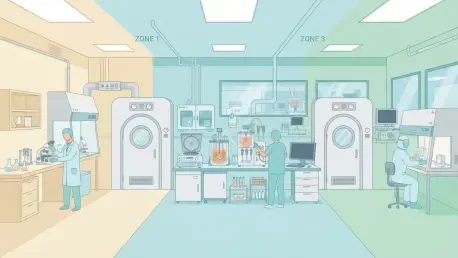
Containment requirements are structured into four distinct Biosafety Levels, which are assigned based on a combination of the agent’s pathogenicity, the nature of the research, and the physical design of the facility. BSL-1 is appropriate for work involving well-characterized agents that do not consistently cause disease in healthy adults, while BSL-2 is the standard for the majority of diagnostic and healthcare laboratories handling moderate-hazard agents like HIV or Hepatitis B. High-containment environments, categorized as BSL-3 and BSL-4, are reserved for the most dangerous pathogens, including those transmitted through aerosols or those with high mortality rates and no available treatments. BSL-4 laboratories represent the pinnacle of engineering control, requiring a full clothing change before entry, a chemical shower upon exit, and the use of positive-pressure suits. These facilities are often housed in isolated zones with dedicated air supply and exhaust systems, ensuring that even the most lethal viruses, such as Ebola or Lassa, can be studied with a minimum risk of environmental escape or worker exposure.
Institutional Governance: Leadership and International Coordination
Biorisk management is a top-down responsibility that begins with the Director or the Head of the Institute, who carries the ultimate legal and ethical accountability for the facility’s operations and safety culture. While the director provides the vision and necessary resources, the daily implementation of safety policies is typically delegated to a highly competent Biosafety Officer who possesses the technical expertise to approve procedures and ensure compliance. This officer acts as a bridge between the research staff and the administration, translating complex regulatory requirements into actionable laboratory protocols that maintain safety without stifling innovation. In recent years, the role of the Biosafety Officer has expanded to include a heavier emphasis on risk communication and the cultivation of a safety-first mindset, ensuring that every researcher understands the logic behind the rules. This leadership structure is essential for maintaining institutional integrity and ensuring that safety remains a core value across all levels of the organization.
On the international stage, the harmonization of biorisk standards is facilitated by key organizations that work to synchronize safety and security protocols across national borders to prevent global health crises. The World Health Organization leads these efforts through its Biosafety and Laboratory Biosecurity Programme, which provides member states with the technical guidance and strategic frameworks needed to minimize infection risks during laboratory work and transport. This global oversight is complemented by the Food and Agriculture Organization and the World Organization for Animal Health, which address biorisks in the context of food safety and veterinary health. These organizations recognize that biological threats do not respect species boundaries, and a comprehensive strategy must encompass the health of humans, animals, and the environment. By aligning these diverse sectors under a unified set of international standards, the global community is better equipped to detect, respond to, and mitigate the impact of biological threats wherever they may emerge.
Strategic Resilience: Building an Actionable Culture of Safety
The ultimate objective of a modern biorisk management system is not the total elimination of risk, which is a mathematical impossibility, but rather the creation of a resilient and informed institutional culture. Success in this field is measured by the ability of an organization to identify, assess, and mitigate hazards to an acceptable level while maintaining high levels of scientific productivity and transparency. This resilience is built through continuous training, the clear definition of professional roles, and the implementation of robust emergency response plans that are regularly tested through realistic simulations and drills. By prioritizing open communication, laboratories encourage researchers to report errors and near-miss incidents without fear of retribution, allowing the institution to learn and adapt its protocols in real-time. This focus on culture over mere compliance ensures that safety and security become ingrained behaviors rather than administrative burdens, ultimately protecting the long-term viability of the research enterprise.
The transition toward an integrated biorisk framework represented a significant milestone in the evolution of laboratory science, as institutions successfully bridged the gap between theoretical policies and operational safety. Successful laboratories recognized that the protection of personnel and the environment required more than just physical barriers; it demanded a sustained commitment to ethical responsibility and professional integrity. The adoption of these global trends provided a clear roadmap for balancing the rapid pace of biotechnological innovation with the necessary safeguards to prevent accidental or intentional harm. Moving forward, the lessons learned from this transition served as the foundation for future developments in laboratory governance, ensuring that the scientific community remained prepared for new and emerging biological challenges. By fostering a culture of continuous improvement and global cooperation, research facilities demonstrated that high-consequence science could be conducted safely and for the benefit of all humanity.