
The ability to reprogram living organisms to produce high-value chemicals and materials has transitioned from a niche academic pursuit to the cornerstone of a new economic paradigm. Instead of relying on the extraction of finite fossil fuels, industries are increasingly looking toward the microscopic world of yeast, bacteria, and algae to synthesize everything from jet fuel to spider silk. This shift represents a departure from the “heat, beat, and treat” methods of the twentieth century toward a more elegant, bottom-up approach to construction. The current trajectory suggests that by 2028, the bioeconomy will influence nearly a third of all global manufacturing output. This transformation is driven by the convergence of advanced CRISPR gene-editing tools and high-throughput automation, allowing scientists to design genetic circuits with the same precision as electrical engineers. The implications for global supply chains are profound, as the production of essential goods could shift to decentralized biological refineries that operate with significantly lower energy requirements and waste.
The Biological Foundry: Redefining Manufacturing Processes
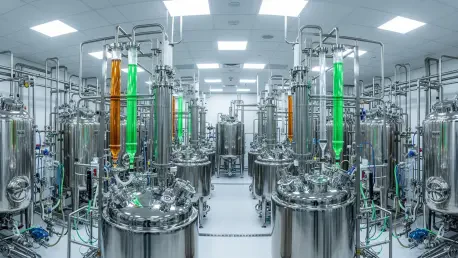
Precision fermentation has already begun to disrupt the traditional agriculture and chemical sectors by offering a more efficient alternative to conventional land-intensive practices. Companies like Amyris and Solugen have demonstrated that engineered microbes can produce specialized molecules, such as squalane or gluconic acid, with higher purity and lower costs than traditional extraction methods. This biological manufacturing model utilizes standard steel tanks rather than vast tracts of farmland, which dramatically reduces the geographic footprint of production. Moreover, the integration of artificial intelligence into the design-build-test-learn cycle has accelerated the development of novel strains, cutting the time required to bring a new bio-product to market from years to months. As these platforms continue to mature, the cost-competitiveness of bio-based materials is expected to reach parity with petroleum-derived counterparts across several key industries. The focus remains on optimizing metabolic pathways to maximize yield while minimizing the consumption of sugar-based feedstocks.
Beyond mere production efficiency, the environmental benefits of a mature synthetic biology ecosystem offer a compelling solution to the ongoing climate crisis facing the planet today. By utilizing carbon capture technologies to feed microbes direct atmospheric CO2, researchers are creating a closed-loop system that effectively turns pollution into a resource. For instance, LanzaTech has successfully deployed carbon-recycling technology that intercepts industrial waste gases and converts them into ethanol and other chemical precursors used in consumer goods. This approach not only mitigates the greenhouse gas emissions of heavy industry but also provides a sustainable alternative to the extraction of new hydrocarbons. Building on this momentum, the development of biodegradable plastics and self-repairing materials is set to revolutionize the construction and textile industries by 2029. These innovations demonstrate that the biological revolution is not just about making the same products more efficiently, but about creating entirely new classes of materials that possess properties unattainable through traditional chemistry.
Scaling these biological breakthroughs from laboratory proof-of-concepts to industrial-sized operations presents a complex set of engineering and logistical challenges that require immediate attention. The transition necessitates significant investment in specialized infrastructure, including large-scale bioreactors and advanced purification systems capable of handling high volumes of delicate biological material. Furthermore, the global regulatory landscape must evolve to provide clear pathways for the approval of novel bio-products without stifling the pace of innovation that characterizes this fast-moving field. Collaborative frameworks between government agencies and private sector leaders are essential to establish standardized safety protocols and intellectual property protections that encourage long-term research and development. This cooperative environment facilitates the creation of regional “bio-hubs” where startups can access shared equipment and expertise, thereby lowering the barrier to entry for new players. By focusing on modular biorefinery designs, the industry can ensure that production is both scalable and resilient.
The path toward a fully realized biological industrial revolution required a fundamental shift in how organizations approached research, investment, and public engagement. Strategic players focused on cross-disciplinary education to bridge the gap between computer science and molecular biology, ensuring that the next generation of engineers was equipped to navigate both digital and genetic code. It became clear that prioritizing transparent communication regarding the safety and benefits of synthetic organisms was vital for securing public trust and widespread adoption. Policy leaders took decisive action by implementing tax incentives for companies that replaced carbon-intensive processes with bio-based alternatives, which accelerated the transition across the private sector. By fostering an ecosystem that valued open-source genetic parts alongside proprietary innovations, the industry avoided the pitfalls of extreme fragmentation. This comprehensive strategy ultimately enabled a shift toward a regenerative economy where biological systems served as the primary engine for growth.