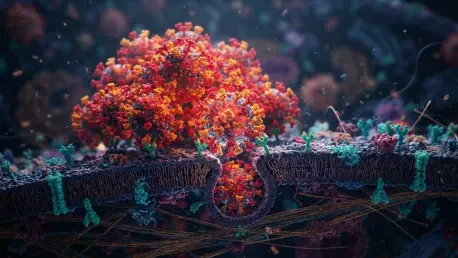

The landscape of influenza infection is characterized by extreme heterogeneity, where many cells fail to produce a complete set of viral genes due to packaging errors. This fundamental challenge means that the survival of a specific viral lineage often depends more on the logistical circumstances of its entry than on any inherent genetic superiority. Historically, the scientific community operated under the assumption that viral dominance was the result of positive selection, where specific mutations granted a strain an edge in replication or immune evasion. However, as we observe the viral landscape in 2026, research spearheaded by teams at major institutes has pivoted toward a more nuanced understanding. By utilizing high-resolution single-cell analysis and innovative tracking methods, investigators have demonstrated that the “winners” in the evolutionary race are often those that simply arrive at the right time and in sufficient numbers to cooperate with other viral particles. This paradigm shift suggests that the sheer stochasticity of the infection process—the luck of the draw in cellular entry—is a primary driver of which influenza lineages eventually achieve population-level dominance.
Understanding the Constraints of Viral Replication
Biological Tension: Heterogeneity in Influenza
The biological architecture of the influenza A virus presents a fascinating paradox that scientists are only now fully beginning to untangle through advanced longitudinal studies. The virus possesses a segmented genome, which is its greatest evolutionary strength, allowing for the rapid shuffling of genetic material known as reassortment. However, this same segmentation imposes a severe bottleneck during the replication cycle. For a single cell to produce infectious progeny, it must successfully package all eight distinct segments into a single virion. The reality of the infection process is that this packaging is often inefficient. In a significant majority of cases, cells become infected with incomplete sets of genetic information, leading to “abortive” or dead-end infections. These cells may express some viral proteins, but they cannot contribute to the spread of the virus unless they are “rescued” by a second, complementary viral particle that provides the missing genetic instructions. This inherent instability means that the viral population exists in a state of constant fragility at the cellular level.
This tension is further exacerbated by the host’s innate immune response, which acts as a formidable barrier to the spread of these incomplete lineages. When a virus enters a cell, it triggers sensors that can lead to the production of interferon, a signaling protein that warns neighboring cells of an impending threat. These neighboring cells then enter an “antiviral state,” making them refractory to subsequent infection. This creates a race against time where the virus must not only complete its replication cycle but also do so before the surrounding tissue becomes an impenetrable fortress. Because so many initial infections are genetically incomplete, the virus relies heavily on the probability of multiple particles entering the same cell simultaneously. This cooperative requirement, known as complementation, suggests that the success of a lineage is not just about its own fitness, but about its ability to find a partner within the narrow window of opportunity provided by the host environment.
Mapping Inconsistency: Single-Cell Sequencing Insights
To gain a clearer picture of these dynamics, researchers in 2026 have increasingly turned to single-cell RNA sequencing (scRNA-seq) to observe the infection process in real-time within human lung alveolar cells. This technology allows for the granular examination of thousands of individual cells, distinguishing between those that are successfully replicating the virus and those that have fallen victim to defective interfering particles or incomplete packaging. One of the most striking findings from these high-resolution maps is the extreme level of transcriptomic noise and heterogeneity. By analyzing the distribution of viral transcripts across ten major open reading frames, scientists can now separate genuine viral replication from simple “RNA carryover” in the medium. The data reveals that even when a high concentration of virus is present, the actual number of cells that successfully navigate the entire replication cycle remains surprisingly low, indicating that the initial wave of infection sets hard boundaries on the future of that viral population.
Furthermore, these single-cell maps have provided unexpected insights into the timing of host defenses. Early in the infection cycle, within the first eight hours, the activation of interferon-related genes is remarkably rare. This suggests that the virus is initially quite successful at staying under the cellular radar, likely through the action of its non-structural proteins that antagonize the host’s detection systems. However, once the 24-hour mark is reached, the landscape shifts dramatically as the antiviral state spreads throughout the culture. This progression highlights a critical “golden hour” for the virus. If a lineage does not establish itself and begin producing progeny within these first few hours, it is essentially locked out of the remaining healthy cells. The success of a lineage is therefore tied to its ability to exploit this brief period of host vulnerability, a factor that depends more on the physical logistics of the infection than on any specific mutation in the viral polymerase or surface proteins.
The Role of Stochasticity and Cooperation
Implementing Neutral Barcoding: Lineage Tracking
The challenge in studying viral evolution has always been distinguishing between a lineage that wins because it is “better” and one that wins because it got lucky. To solve this, researchers developed a neutral barcoding system that allows for the tracking of thousands of unique viral clones without altering their biological behavior. By inserting a randomized nine-nucleotide sequence into a permissive site in the M2 coding region, scientists can create a library of viruses that are genetically identical in every way except for their “name tag.” In studies conducted throughout 2026, these barcoded libraries have been used to infect cell populations at specific multiplicities, ensuring that each cell receives a known average number of viral particles. Because the barcode is part of a late-stage transcript, its presence in the final output serves as definitive proof that a specific lineage was able to complete the entire journey from entry to exit.
The use of these neutral markers has effectively stripped away the bias of traditional evolutionary studies. In previous years, researchers might have seen a specific mutation become dominant and assumed it was due to a fitness advantage. However, with neutral barcodes, there is no fitness advantage to analyze; every virus in the library replicates at the same rate and possesses the same entry mechanics. This allows investigators to isolate the impact of pure stochasticity—the random events that occur during an infection. The validation of these barcodes is rigorous, ensuring that the inserted sequences do not change the physicochemical properties of the viral proteins. This level of precision has confirmed that the vast majority of viral “winners” in a population are not the result of a superior genome, but rather the result of being in the right cell at the right time, often accompanied by other viral partners.
Stochastic Success: The Power of Multiplicity
When these barcoded libraries are put into competition, the results are consistently unpredictable, which is a hallmark of stochastic systems. In repeated experiments, different barcodes emerge as the dominant strains in every trial. If one lineage were truly superior, it would consistently appear at the top of the pile across multiple replicates. Instead, researchers found that 62% of the enriched barcodes appeared in only a single replicate, while only a tiny fraction—around 2%—appeared in all trials. This lack of reproducibility strongly suggests that the “success” of a viral lineage is a random event. The researchers then looked for a common thread among the winners and found a significant correlation with multiplicity of infection (MOI). Lineages that were successful were almost always those that originated from cells that had been coinfected by two or more distinct viral particles.
This finding points to a mechanism of cooperation known as complementation. Because so many influenza particles are defective or missing a segment, a single virus entering a cell is often doomed to failure. However, when multiple viruses enter the same cell, they can “pool” their genetic segments. If one virus is missing segment three but has segment five, and its partner has segment three but is missing segment five, they can together produce a full set of proteins and generate a massive burst of new, infectious progeny. This “power in numbers” means that the success of a lineage is tied to its ability to be part of a high-multiplicity infection event. A lineage that finds itself alone in a cell is likely a dead end, whereas a lineage that lands in a cell with several partners is vastly more likely to contribute to the next generation. This reliance on cooperation effectively overrides individual genetic fitness in many scenarios.
Timing and the Competitive Advantage
The Cooperative Window: Superinfection Exclusion
A critical discovery in the study of viral dynamics is the existence of a very narrow “cooperative window” during which a cell can be coinfected. Research has shown that once a virus successfully enters a cell and begins its replication cycle, it quickly initiates a process called superinfection exclusion. This is a cellular state where the cell becomes resistant to the entry of any additional viral particles. Data from 2026 indicates that if two viruses arrive at a cell at the same time, or within about two hours of each other, they can both enter and begin the process of complementation. However, as the interval between the first and second virus increases, the probability of the second virus entering drops off a cliff. By four hours post-infection, the likelihood of a successful second entry is reduced by more than half, and by ten hours, it is virtually impossible for a second lineage to join the first.
This temporal gatekeeper creates a massive “priority effect” that dictates the genetic makeup of the resulting viral population. The first virus to arrive not only claims the cellular resources for itself but also prevents its competitors from ever getting a foothold. This advantage is compounded by the fact that cells with higher initial multiplicities—those that were lucky enough to be coinfected within that two-hour window—produce significantly more virus than those infected by a single particle. In some trials, these coinfected “super-producer” cells generated ten times more infectious virions than their single-infection counterparts. Consequently, a lineage that starts even a few hours ahead of the pack can quickly overwhelm the population through sheer volume, effectively drowning out any late-arriving lineages, even if those latecomers possessed mutations that might have made them slightly more efficient replicators in a vacuum.
Rethinking Selection: Evolutionary Logistics
The implications of this research are forcing a major rethink of how we approach viral evolution and the development of future medical interventions. If the success of an influenza lineage is driven by timing and the logistics of infection rather than just genomic fitness, then our focus for vaccines and antivirals might need to shift. Instead of only targeting the proteins involved in replication speed, there is a growing interest in disrupting the “logistics” of the virus. This includes looking at traits that promote virion aggregation or clumping, which might increase the chances of synchronous coinfection, or studying how the virus navigates the mucus layer of the respiratory tract to reach the target cells as quickly as possible. The most successful viruses in a natural setting may be those that are best at “traveling in groups” or those that can initiate the entry process just a few minutes faster than their peers.
The study concluded that the inherent stochasticity and the narrow window of superinfection exclusion are the primary filters through which viral diversity must pass. Scientists observed that the traits driving long-term survival in the wild likely involve a combination of rapid dispersal and the ability to maintain a high local concentration of particles to ensure cooperation. Moving forward, the focus of influenza research was directed toward understanding these spatial and temporal dynamics in more complex tissues. There is now a clear path toward developing therapies that aim to extend the period of superinfection exclusion or disrupt the cooperative mechanisms that allow defective viruses to persist. By recognizing that the “race” is often won at the starting line, the scientific community has moved closer to predicting and potentially mitigating the spread of dominant seasonal and pandemic strains through a better understanding of infection logistics.