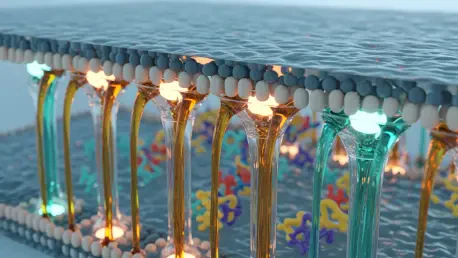

The quest to replicate the intricate machinery of biological life has moved beyond mere observation into the realm of precision engineering with the development of synthetic cell microreactors. Researchers at the University of Stuttgart have successfully demonstrated a “double-necked” platform that mirrors the complex, life-sustaining behaviors of biological cells through a sophisticated artificial membrane system. By integrating advanced DNA nanotechnology into a lipid bilayer, this breakthrough enables a dynamic environment capable of governing molecular traffic and biochemical reactions with accuracy. The core objective of this engineering feat is to replicate the selective permeability and communicative nature of natural cells, which have traditionally been difficult to mimic in laboratory settings. Unlike static containers that merely hold substances, these microreactors utilize interacting, DNA-based nanopores that function as an integrated network rather than isolated components. This architecture allows for real-time regulation of membrane permeability, enabling the system to orchestrate sequential biochemical reactions in a controlled, artificial space.
Engineering the Foundation of Synthetic Life
The transition from viewing synthetic cells as simple vessels to understanding them as active, programmable microreactors marks a significant shift in the field of synthetic biology. To achieve this, researchers have focused on the lipid bilayer, which serves as the protective skin of the cell, and the specialized channels that allow for the controlled passage of molecules. By engineering these membranes to be more than just barriers, the team at Stuttgart has created a system where the physical properties of the container are inextricably linked to the chemical processes occurring within. This integration is essential for creating a “smart” environment where the timing and location of reactions can be managed with the same level of precision found in a semiconductor factory. The ability to program the movement of molecules through these membranes provides the foundation for building more complex artificial systems that can mimic the adaptive and self-sustaining qualities of living organisms. This development represents a milestone in the bottom-up assembly of synthetic life forms.
Utilizing DNA as a Structural Program
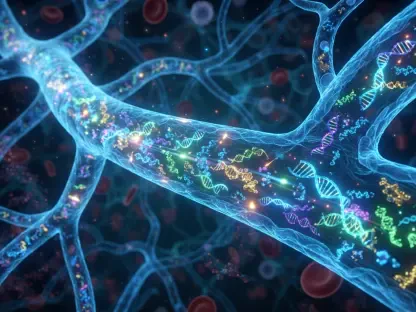
At the center of this innovation is the strategic use of DNA nanotechnology to build functional machinery that operates at the molecular level with high fidelity. While DNA is commonly associated with genetic storage in living organisms, this research treats the molecule as a versatile material for fabricating nanoscale devices that can be programmed to change shape in response to stimuli. These dynamic nanopores are embedded within the synthetic membrane, serving as the primary gates for molecular exchange and internal chemical regulation. The transition from static structural biology to dynamic nanomachinery allows researchers to dictate exactly when and how a synthetic cell interacts with its environment. By carefully designing the nucleotide sequences, the scientists have ensured that these pores respond to specific chemical triggers, effectively turning the lipid bilayer into a programmable interface. This level of control is essential for creating synthetic systems that can perform complex tasks autonomously without constant manual intervention or external power.
Double-Necked Design: A New Gating Mechanism
The “double-necked” design relies on the coupling of two distinct types of DNA-based nanopores within a single lipid bilayer to create a sophisticated communication channel. These pores communicate through the physical medium of the membrane; the activation of the first pore triggers conformational changes that facilitate the opening or formation of the second. This reciprocal interaction allows the microreactor to transition between functional states, effectively turning molecular transport on or off according to a predefined sequence. Such a mechanism ensures that reactants are introduced into the microreactor at the precise moment they are needed, preventing premature reactions or degradation of sensitive components. This structural programming represents a significant leap forward in our ability to design artificial systems that exhibit logical behavior. Furthermore, the integration of these dual pores allows for the synchronization of multiple metabolic pathways within a single synthetic entity, bringing us closer to life.
Biological Logic: Implementing Feedback Loops
A fundamental theme of this research is the shift toward “collective organization,” where complexity emerges from the interactions within a network of individual components. This system mirrors the regulatory feedback loops found in living organisms, allowing artificial pores to respond to one another’s status via the membrane milieu in real time. Such coordination ensures that the synthetic cell does not merely exist as a passive structure but operates as a functional unit through temporal and spatial management of its internal chemistry. The ability of the nanopores to influence each other’s behavior through the lipid environment creates a primitive form of cellular intelligence, where the system can adapt its permeability based on internal or external signals. This collective behavior is the cornerstone of complex life, enabling organisms to maintain homeostasis despite changing environmental conditions. By replicating this logic in a synthetic platform, the team has provided a new framework for building resilient and adaptive artificial cells.
Self-Regulating Modules: The Path to Autonomy
Professor Laura Na Liu and her team emphasize that this represents a new paradigm in the bottom-up design of synthetic life through the coordination of modular parts. By engineering systems that function through the collective effort of their components, researchers can create self-regulating modules capable of managing complex tasks autonomously. This approach allows the microreactor to maintain internal stability and deliver reactants in a specific order, even when external conditions fluctuate during the experiment. The modular nature of the DNA nanopores means that they can be swapped or modified to suit different applications, from energy production to molecular sensing. As these systems become more sophisticated, they will likely incorporate additional layers of feedback, such as light-responsive elements or pH-sensitive switches, to further enhance their regulatory capabilities. This move toward self-regulation is critical for the development of “smart” materials and therapeutics that can operate independently within the human body.
Experimental Validation and Future Perspectives
The theoretical promise of programmable microreactors has been met with rigorous experimental validation, proving that these synthetic systems can handle the complexities of real-world biochemical tasks. By testing the platform against a variety of biological challenges, the research team demonstrated that the double-necked design is both robust and flexible. These experiments were designed to push the limits of the system, verifying whether it could sustain multi-step reactions and organize internal structural components without external intervention. The success of these trials highlights the potential for these microreactors to serve as specialized tools for both basic scientific research and industrial biotechnology. As we move closer to the practical implementation of these systems, the focus shifts toward optimizing their stability and expanding the range of molecules they can manipulate. The validation process has not only confirmed the current capabilities of the platform but has also provided a clear roadmap for the next generation of synthetic cell engineering.
Enzyme Cascades: Mimicking Metabolic Complexity
The versatility of the double-necked microreactor was demonstrated through various experiments, including the successful mediation of multi-step enzyme cascades. By controlling membrane permeability with high precision, the team introduced substrates in a specific sequence to mimic the metabolic pathways observed in natural cells. This sequential delivery is vital for reactions where the product of one enzyme serves as the substrate for the next, requiring a strictly ordered environment to prevent unwanted side reactions. Additionally, the system facilitated cytoskeletal mimicry by enabling the polymerization of actin, which is a crucial step in building synthetic cells with internal structural complexity and mechanical integrity. This ability to organize proteins within a confined space mimics the structural dynamics of the eukaryotic cytoskeleton, allowing for the potential development of synthetic cells that can change shape or move. These milestones prove that the platform is a practical tool for re-creating the essential processes of biological life.
Genetic Synthesis: Advancing Cell-Free Transcription
Further testing confirmed the system’s ability to handle delicate genetic processes, such as cell-free RNA transcription and the growth of three-dimensional DNA crystals within the microreactor. These findings prove that the microreactor is a functional tool for executing sophisticated biochemical tasks without manual intervention or the need for complex laboratory equipment. The ability to manage spatial confinement and molecular sensing highlights its potential as a robust platform for advanced bioengineering in various sectors. For instance, the successful growth of DNA crystals suggests that these microreactors could be used to manufacture high-purity biological materials for research or industrial use. The containment provided by the lipid bilayer also protects sensitive genetic material from external degradation, ensuring higher yields and more consistent results. This robust functionality demonstrates that the University of Stuttgart’s platform has moved beyond a proof-of-concept and is now ready for demanding applications.
Future Horizons: Scaling Synthetic Life for Practical Use
The successful creation of programmable synthetic microreactors established a clear blueprint for understanding molecular communication and creating the next generation of synthetic life. This research demonstrated that complex cellular behaviors could be distilled into manageable, engineered components using DNA nanotechnology and lipid membranes. To move this technology into clinical and industrial settings, the next steps involved scaling production and ensuring the long-term stability of the lipid-DNA interface under various thermal and chemical stresses. Researchers identified the need for more robust membrane compositions that could withstand the rigors of the human circulatory system or industrial waste streams. Furthermore, the integration of more complex genetic circuits became a priority, allowing for even higher levels of autonomous decision-making within the synthetic units. By stripping away the complexity of living organisms, this platform provided scientists with the tools needed to design life-like systems from the ground up.