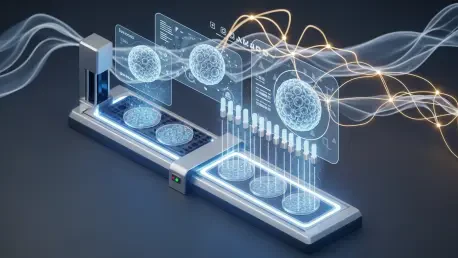

The pharmaceutical industry has long grappled with the sobering reality that nine out of ten drug candidates fail during clinical trials, often because the simplistic biological models used in early development do not reflect the staggering complexity of human physiology. For decades, researchers relied on two-dimensional cell cultures that, while easy to maintain, lacked the three-dimensional architecture and multicellular communication found in living patients. The resulting gap between laboratory success and clinical efficacy has cost the industry billions of dollars and delayed the arrival of life-saving treatments for countless individuals. However, the emergence of automated 3D biology is now offering a transformative bridge, allowing for the cultivation of complex organoids that mirror human tissue behavior with unprecedented accuracy.
Moving from traditional 2D cultures to complex 3D organoids allows researchers to replicate human tissue behavior, significantly improving the accuracy of drug testing. These models represent a paradigm shift in how biological responses are measured, as they provide a heterotypic environment where different cell types interact just as they would in a human organ. By capturing these intricate cell-to-cell signaling pathways and physiological processes, scientists can identify potential toxicity or lack of efficacy much earlier in the pipeline. This improvement in translational success is essential for modern drug discovery, ensuring that only the most viable candidates progress to human trials.
This article explores the shift toward human-relevant models, the role of automation and AI in solving scalability issues, expert insights from industry leaders, and the future of data-driven drug discovery. By examining the current landscape, it becomes clear that the marriage of robotic precision and machine learning is no longer a luxury but a necessity for organizations seeking to navigate the complexities of 3D biology. The following sections detail how these technologies address the logistical bottlenecks of organoid research and how they are setting a new standard for reproducibility and clinical prediction.
The Evolution of Human-Relevant Models in Drug Research
Market Trends and the Shift Toward 3D Physiological Accuracy
The pharmaceutical landscape is currently undergoing a significant transition as the adoption of 3D organoids outpaces traditional 2D monolayers to improve translational success. Market data indicates a growing preference for these complex models, driven by the realization that 2D environments fail to simulate the mechanical and chemical gradients present in the human body. As a result, research institutions are reallocating resources toward 3D modeling to ensure that the biology being studied is as human-relevant as possible. This movement is not merely a scientific trend but a strategic response to the high attrition rates that have historically plagued drug development.
Furthermore, the industry is moving toward “fail fast” strategies, where more predictive biological models are used earlier in the discovery process to save time and capital. By implementing 3D organoids during the initial screening phases, companies can identify ineffective compounds before they reach expensive animal testing or clinical stages. This proactive approach allows for a more efficient allocation of research budgets, focusing on molecules that demonstrate a high probability of success in human tissues. Consequently, the ability to predict clinical outcomes through advanced physiological modeling has become a cornerstone of competitive pharmaceutical development.
Real-World Application of Automated Discovery Platforms
Concrete examples of automated systems, such as the CellXpress.ai platform, demonstrate how technology is being used to handle sensitive induced pluripotent stem cells and patient-derived tissues. These automated platforms manage the entire lifecycle of a cell culture, from the initial plating and media exchange to continuous monitoring and final analysis. By automating these delicate tasks, laboratories can maintain thousands of organoids simultaneously, a feat that would be impossible to achieve through manual labor alone. The integration of environmental controls and robotic handling ensures that the biological integrity of the samples is preserved throughout the weeks or months required for organoid maturation.
In addition to handling the growth process, the use of “assay-ready” organoids has emerged as a standardized solution for reducing inter-laboratory variability and streamlining high-throughput screening. These organoids are produced at scale under controlled conditions, characterized for quality, and then preserved in a format that allows researchers to use them immediately upon thawing. This innovation removes the complex and time-consuming burden of upstream cell culture from the end user, allowing scientists to focus entirely on the drug assay itself. By providing a consistent biological starting point, assay-ready formats significantly enhance the reliability of data collected across different research sites.
Expert Perspectives on Overcoming Scalability and Reproducibility Hurdles
Insights from industry leaders, including Dr. Vicky Marsh Durban, emphasize the logistical challenges of maintaining hypersensitive cell cultures for extended periods. Organoids derived from stem cells or patient biopsies are notoriously temperamental, requiring precise nutrient delivery and environmental stability to develop correctly. Manual intervention often introduces fluctuations in temperature or handling that can inadvertently alter the phenotype of the cells, leading to inconsistent results. Dr. Durban notes that the physical demands of managing these cultures around the clock often result in human fatigue, which further compounds the risk of experimental failure in high-stakes research environments.
Automation serves to capture human expertise and standardize it, effectively removing the variable of operator-dependent performance to ensure every sample is treated identically. When a skilled scientist perfects a protocol, that process can be programmed into an automated system that replicates the exact timing, angle, and speed of pipetting across every well in a high-density plate. This level of precision eliminates the “art” of cell culture and replaces it with a rigorous, reproducible methodology. Consequently, the data generated is no longer subject to the subtle differences in technique that naturally exist between different researchers, creating a more objective foundation for drug evaluation.
The role of artificial intelligence is equally critical, as it provides objective quality control by using machine learning to detect subtle abnormalities in organoid morphology that the human eye might overlook. AI-driven imaging systems can analyze thousands of organoids in real time, identifying those that are failing to differentiate or those that exhibit signs of distress long before a human operator would notice. By flagging these issues early, the software allows researchers to exclude outliers and focus their analysis on healthy, representative models. This automated oversight ensures that the final data set is of the highest possible quality, reducing the noise that often complicates 3D biological research.
Future Outlook: The Convergence of AI and Biological Modeling
The future of drug discovery is centered on a “complementary cycle” where automation generates high-quality data and artificial intelligence extracts deeper insights into disease mechanisms. This synergy creates a feedback loop where the robotic systems provide the physical scale necessary for large datasets, while the AI identifies patterns and correlations that inform the next round of experimental design. As these systems become more integrated, the boundary between the digital and biological worlds will continue to blur, leading to a more holistic understanding of how drugs interact with complex human systems. This convergence is expected to unlock new therapeutic targets that remained hidden under traditional research methods.
Furthermore, there is immense potential for using historical biological data to predict outcomes, potentially reducing the need for physical “wet-lab” experiments in the long term. As automated platforms continue to populate vast databases with high-quality 3D screening results, AI models will eventually reach a level of sophistication where they can simulate the effects of certain compounds on specific organoids. This shift toward “in silico” biological modeling would allow for the rapid testing of millions of virtual molecules, narrowing down the field to only a handful of candidates that require physical validation. Such a transition would drastically reduce the time and cost associated with the initial stages of drug synthesis.
However, the success of this data-driven future depends heavily on the integration of complex datasets and the importance of full traceability in meeting the rigorous standards of modern drug development. Every step of the organoid’s journey, from the donor tissue to the final imaging result, must be meticulously documented to satisfy regulatory requirements. Platforms that link workflow logs with biological outcomes enable researchers to trace any unexpected result back to its origin, whether it was a specific media batch or a slight deviation in incubation time. This level of transparency is essential for building trust in automated systems and for ensuring that the resulting therapies are safe for human use.
Conclusion: Securing Clinical Success Through Innovation
The pharmaceutical landscape eventually accepted that the transition to automated 3D biology was no longer an optional upgrade but a fundamental requirement for clinical survival. Research institutions across the globe prioritized the installation of integrated robotic platforms that standardized the entire lifecycle of an organoid, from differentiation to high-content screening. This movement highlighted the necessity for universal data standards to allow for seamless collaboration between biotech firms and regulatory bodies. Leaders in the field moved beyond simple automation and began implementing decentralized discovery hubs that utilized cloud-based artificial intelligence to analyze results in real time.
Organizations that invested early in these traceable, automated workflows experienced a measurable reduction in late-stage attrition, effectively turning the “fail fast” philosophy into a tangible financial advantage. These strategic actions paved the way for a more ethical research environment that relied less on animal models and more on human-centric data, ensuring that the next generation of life-saving treatments reached patients with unprecedented speed and reliability. Moving forward, the focus shifted toward the creation of even more complex “organ-on-a-chip” systems that integrated multiple organoids into a single vascularized circuit. This next step in bioengineering sought to replicate the systemic interactions between the liver, heart, and kidneys, further narrowing the gap between the laboratory and the living human body.
Ultimately, the successful integration of robotic precision and deep learning insights transformed drug discovery from a process of trial and error into a highly predictable engineering discipline. The future of medicine was built on the foundation of these standardized, automated systems, which provided the high-resolution data needed to tailor treatments to individual patient profiles. By embracing these technological advancements, the industry finally overcame the reproducibility crisis and secured a path toward a more efficient, patient-centered model of healthcare. The journey from 2D monolayers to automated 3D systems demonstrated that when biology and technology align, the possibilities for innovation are virtually limitless.