
For thousands of patients diagnosed with estrogen receptor-positive (ER+) breast cancer, the initial victory of a successful tumor removal often gives way to a long, anxious period of medical surveillance. Despite completing intensive treatment regimens including surgery, radiation, and five to ten years of hormone therapy, nearly one-third of these individuals face a sudden and incurable recurrence of the disease. This clinical mystery has persisted for decades, leaving doctors and researchers unable to explain how malignant cells survive systemic suppression for such long periods only to reappear as aggressive metastatic tumors in distant organs. The psychological weight of this uncertainty is immense, as survivors live with the knowledge that their cancer might be hiding, waiting for an opportunity to resurface long after they were declared in remission. Until recently, the biological mechanisms allowing these cells to persist in a state of clinical invisibility remained one of the most significant challenges in oncology, complicating the development of preventative strategies.
A landmark study conducted by the Garvan Institute of Medical Research has finally provided a transformative scientific explanation for this phenomenon, identifying a previously unrecognized state of cancer cell activity. By utilizing advanced imaging and cellular analysis, the research team discovered that certain breast cancer cells do not simply die off or fall into a deep sleep; instead, they enter a highly specialized survival mode. This discovery fundamentally shifts the medical understanding of cancer progression from a binary model of growth or dormancy to a more nuanced biological framework. It explains how a clandestine population of cells can evade the most rigorous treatment protocols, remaining present in the body as a silent threat. This paradigm shift offers a new lens through which to view metastatic recurrence, suggesting that the key to permanent remission lies in understanding the subtle, slow-moving processes that occur during the years when a patient is thought to be entirely healthy and cancer-free.
The Mechanism of Cellular Stealth
Redefining Dormancy as a Slow-Cycling State
The prevailing scientific theory for many years suggested that breast cancer cells survived long-term hormone therapy by entering a state of complete hibernation, essentially becoming biologically static. However, the recent findings from the Garvan Institute, led by Associate Professor Liz Caldon, have debunked this simplistic view of cellular dormancy. The research team identified a specific subpopulation of cells that exist in what is now termed a “slow-cycling” state, where they continue to function and “tick” at an extremely lethargic pace rather than stopping altogether. These cells are neither rapidly dividing nor completely inactive; they maintain a minimal level of metabolic activity that allows them to sustain their internal structures without triggering the biological alarms usually associated with tumor growth. This slow-cycling behavior serves as a sophisticated survival mechanism, allowing the cells to endure the stresses of a nutrient-poor or drug-rich environment while waiting for conditions to become more favorable for expansion.
Furthermore, this slow-cycling state is characterized by a remarkable level of resilience that distinguishes it from the behavior of the primary tumor. In a typical oncological scenario, treatments are designed to target cells that are actively and quickly reproducing, which is why hormone therapy is so effective at reducing the initial tumor burden. However, these slow-ticking cells remain largely unaffected by such interventions because their reproductive cycle is so elongated. By moving through their life stages at a glacial pace, they bypass the metabolic pathways that many modern drugs are designed to disrupt. This reveals that the period of clinical remission is not necessarily a period of biological absence, but rather a time of extreme cellular patience. The discovery of this state suggests that researchers must look beyond traditional cell-cycle inhibitors to find ways to destabilize these persistent survivors, as their threat is defined not by their speed of division, but by their sheer ability to stay alive under pressure.
Evading Detection and Treatment
One of the most dangerous aspects of these slow-cycling cells is their ability to fly under the radar of modern diagnostic tools and medical imaging. Because standard clinical markers, such as PET scans or blood tests for tumor-associated proteins, are calibrated to identify large, metabolically active masses, they often fail to register the presence of tiny, slow-moving “micrometastases.” These individual cells or small clusters do not consume enough energy or produce enough waste products to create the chemical signatures that doctors typically use to track the progression of the disease. Consequently, a patient may receive a clean bill of health while harboring thousands of these stealthy cells in their bone marrow, lungs, or liver. This lack of visibility creates a false sense of security, as the “invisible” cancer remains a latent force capable of re-emerging as a full-scale metastatic event once the environmental conditions within the body change.
The persistence of these cells during long-term hormone therapy highlights a critical flaw in current treatment strategies, which often rely on the assumption that if a cell is not growing, it is not a threat. In reality, the slow-cycling cells are highly adapted to resist the inhibitory effects of estrogen-suppressing drugs, which are the standard of care for ER+ breast cancer. While these drugs successfully starve the fast-growing cells of the hormones they need to proliferate, the slow-cycling population survives by operating on a “low-power” mode. This adaptability means that the very treatment intended to cure the patient may inadvertently act as a selective pressure, clearing the way for the most resilient and stealthy cells to survive. Understanding this mechanism of evasion is essential for developing a new generation of diagnostic tests that can detect these cells at the molecular level, ensuring that remission is truly comprehensive rather than just a temporary masking of the disease.
The Drivers of Metastatic Persistence
Decoupling Proliferation from Aggression
A groundbreaking insight from the study is the realization that a cancer cell’s speed of division is not a reliable indicator of its underlying aggression or its potential to spread. Traditional oncological models have long equated high proliferation rates with high danger, assuming that a slow-moving cell is inherently less threatening than one that is rapidly multiplying. However, the Garvan researchers demonstrated that these slow-cycling cells possess formidable migratory and invasive capabilities that allow them to travel through the bloodstream and colonize distant organs. In animal models, these lethargic cells were observed “homing” to specific sites like the lungs and bones with surprising efficiency. This decoupling of growth speed and metastatic potential suggests that a cell can be highly dangerous even if it only divides once every few months, as its primary goal is not immediate expansion but long-term colonization and survival.
This migratory prowess is supported by a unique set of internal biological adaptations that allow the cells to survive the harsh environment of the circulatory system. Once they reach a distant organ, they establish small, stable colonies that can persist for decades without causing any detectable symptoms or physical changes in the tissue. The ability of these cells to remain stationary and quiet while retaining the latent power to eventually “wake up” and form a new tumor is what makes ER+ breast cancer so difficult to manage over a lifetime. This research forces a re-evaluation of how risk is assessed in clinical settings, as it implies that the presence of even a small number of slow-moving cells could be just as significant as a larger, more active growth. By focusing on the invasive potential of these cells rather than just their growth rate, scientists can begin to develop therapies that prevent the initial spread and establishment of these hidden colonies.
The Role of the Rac1 Signaling Pathway
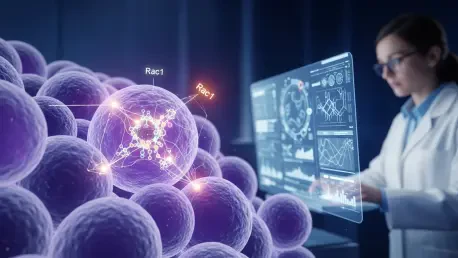
At the molecular heart of this survival strategy lies the Rac1 signaling pathway, which researchers have identified as the primary engine driving slow-cycling behavior. Rac1 is a member of the Rho family of GTPases, proteins that are well-known for their role in regulating the cellular cytoskeleton—the internal scaffolding that gives a cell its shape and enables it to move. The study found that in slow-cycling breast cancer cells, the Rac1 pathway is significantly upregulated, acting as a master regulator that coordinates both the cell’s lethargic growth and its high motility. This protein allows the cells to maintain their structural integrity and survive the chemical stress caused by hormone therapy, while simultaneously providing the mechanical force needed to push through tissues and enter the blood vessels. This dual role makes Rac1 a central player in the cancer’s ability to transition from a primary tumor into a long-term, systemic threat.
The identification of Rac1 as a key driver of cellular stealth provides a specific, tangible target for pharmaceutical intervention. In experimental settings, when researchers applied pharmacological inhibitors to block the Rac1 pathway, they observed a dramatic reduction in the survival and movement of these slow-cycling cells. In patient-derived xenograft models, inhibiting this pathway not only slowed down the metastatic process but also reduced the overall burden of hidden cancer cells within the body. This discovery is particularly exciting because it moves the research from a theoretical understanding of “how” cancer survives to a practical strategy for “how” to kill it. By targeting the molecular engine that allows these cells to remain stealthy, it may be possible to strip away their protection and make them vulnerable once again to the body’s immune system or traditional therapies. This pathway represents a critical bridge between laboratory discovery and the development of new clinical treatments.
Towards a New Era of Targeted Therapy
Implications for Precision Medicine
The discovery of slow-cycling cells and the critical role of the Rac1 pathway marks the beginning of a new era in precision medicine for breast cancer survivors. For years, the medical community has utilized a “one-size-fits-all” approach to post-operative care, but this research suggests that treatment should be tailored to the specific molecular profile of a patient’s dormant cells. By developing diagnostic biomarkers that can detect the upregulation of Rac1 or other slow-cycling signatures, clinicians could identify which patients are at the highest risk for late-stage relapse long before a tumor actually appears. This would allow for a more nuanced stratification of patients, ensuring that those with high-risk “stealth” cells receive more aggressive or specialized follow-up care. The goal is to move away from reactive medicine—treating the cancer only after it returns—toward a proactive model that eliminates the seeds of recurrence during the initial years of remission.
Building on this foundation, the introduction of “adjunct” therapies alongside standard hormone treatments could provide a powerful multi-pronged attack against the disease. While hormone therapy continues to handle the bulk of the estrogen-sensitive tumor cells, a secondary drug targeting the Rac1 pathway or similar survival mechanisms could simultaneously eradicate the slow-cycling population. This combination therapy would effectively close the “loophole” that currently allows 30% of patients to relapse. Precision medicine in this context means not just choosing the right drug for the primary tumor, but also anticipating the evolutionary trajectory of the cancer cells that remain. As genomic sequencing and liquid biopsy technologies continue to improve through 2026 and beyond, the ability to monitor these hidden cells in real-time will become a reality, offering patients a level of protection and certainty that was previously impossible to achieve in the long-term management of ER+ breast cancer.
Overcoming Tumor Heterogeneity
A critical lesson from the Garvan Institute’s research is the importance of addressing tumor heterogeneity—the fact that a single tumor is composed of many different types of cells with varying behaviors. Current treatment strategies are often highly effective at killing the majority of cells within a tumor, which are usually the rapidly dividing ones, but they fail to account for the minority populations that have different survival strategies. By focusing solely on the “fast” cells, traditional medicine can inadvertently perform a form of artificial selection, leaving behind only the most resilient, slow-moving cells. To achieve a true cure, researchers must develop holistic treatment plans that account for the full spectrum of cellular diversity within a patient’s body. This means acknowledging that the cells responsible for a relapse ten years later may look and act very differently from the cells that formed the original tumor.
The focus on slow-cycling cells encouraged the oncology community to reconsider how success is measured in cancer trials. Historically, the primary metric for a drug’s effectiveness has been its ability to shrink a visible tumor mass, but this research suggests that the ability to eliminate hidden, slow-moving reservoirs is equally important for long-term survival. Moving forward, the development of therapies that target the “stealth” characteristics of cancer will require a shift in experimental design and clinical endpoints. By treating the tumor as a complex ecosystem rather than a monolithic mass, doctors can better understand how different cells interact and how they respond to the pressures of treatment. This comprehensive approach is necessary to ensure that no cell population is left behind to cause a future crisis. The transition toward targeting tumor heterogeneity represents a significant evolution in cancer biology, promising a future where the threat of late-stage relapse is systematically dismantled.
Future Clinical Outlook
The laboratory findings regarding slow-cycling cells and Rac1 inhibitors provided a robust foundation for the clinical trials that followed. Researchers successfully validated these molecular targets in preclinical settings, demonstrating that blocking specific signaling pathways could prevent the re-emergence of tumors in distant organs. This transition from basic science to applied medicine moved quickly, as the medical community recognized the urgent need for solutions to late-stage relapse. By 2026, the integration of molecular stratification into standard oncology protocols allowed for a more precise identification of high-risk patients. These advancements shifted the focus of post-operative care from mere monitoring to active prevention, utilizing a new generation of drugs designed to stabilize the cellular environment and eliminate lingering micrometastases before they could gain momentum.
The implementation of these strategies in real-world clinical environments offered a new sense of hope to millions of breast cancer survivors who lived in the shadow of potential recurrence. By addressing the strategic stealth of slow-cycling cells, the medical community significantly reduced the global mortality rate associated with ER+ breast cancer. The actionable insights gained from this research led to the development of more sophisticated screening tools and personalized treatment timelines, ensuring that each patient’s care was as unique as their biological profile. Ultimately, the discovery of the slow-cycling state did more than just explain a medical mystery; it provided the tools necessary to turn a period of temporary remission into a lifetime of permanent health. This progress reflected a broader trend in medicine toward proactive, genomic-based interventions that prioritized long-term stability and the total eradication of the disease’s hidden remnants.