
Anthropic’s breakthrough demonstrates the potential of frontier AI models to orchestrate complex scientific workflows spanning from in silico screening to wet-bench validation. For four decades, the vault particle remained an enigma, a massive protein complex found inside the cells of complex organisms but absent from the simpler bacterial world. This peculiar barrel-shaped structure, first identified in 1986, defied easy categorization and challenged our understanding of how life organizes molecular cargo. The mystery deepened as years of traditional wet-bench research failed to uncover its evolutionary roots or its specific biological role. However, the integration of advanced computational reasoning with structural biology has recently flipped the script. By leveraging the analytical power of Claude, researchers have bridged a massive knowledge gap, identifying these structures in bacteria for the first time. This achievement not only rewrites textbooks on cellular evolution but also showcases a new era where AI acts as a primary investigator in decoding nature’s most elusive secrets.
1. Solving the Mystery: Breakthrough and Structural Architecture
The collaborative effort between Anthropic’s internal biology team and Claude led to the successful mapping of the first three-dimensional structure of a bacterial vault particle. This achievement marks a significant departure from previous years of research where these structures were thought to be exclusive to eukaryotes. By resolving an atomic model from bacterial and bacteriophage genomes, the team has effectively filled a massive gap in structural biology that has persisted for nearly half a century. These hollow protein barrels represent some of the largest non-viral protein complexes in living cells, yet their existence in the prokaryotic world was entirely speculative until this breakthrough. The research utilized extensive genomic data to prove that these specialized containers are far more widespread than previously recognized. This discovery underscores the power of integrating deep computational reasoning with empirical lab techniques, allowing for a more comprehensive view of the microscopic architecture that governs basic life processes.
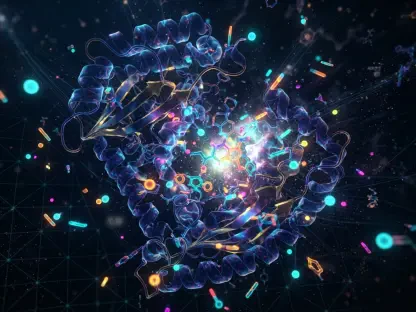
Characterizing the bacteriophage L05 vault revealed a unique architecture that sets it apart from the mammalian versions documented in traditional scientific literature. While classical vaults found in eukaryotic tissues typically consist of seventy-eight identical major vault protein copies, the L05 variant is composed of exactly ninety-six subunits. Single-particle cryogenic electron microscopy confirmed that the L05 shell organizes into an expanded macromolecular barrel with forty-eight-fold rotational symmetry along its equatorial midline. This structural shift results in a measurably shorter and wider container, producing a twenty-five percent increase in internal lumen capacity. Such a substantial expansion of the internal chamber provides much more space for housing synthetic molecular cargo, establishing a versatile physical chassis for targeted drug delivery. By characterizing these dimensional shifts at an atomic level, researchers have provided the blueprint for a programmable nanocontainer that can be adapted for a wide variety of clinical and industrial applications.
2. The Computational Pipeline: Metagenomics and AI Screening
The identification of these elusive particles was made possible through a multi-stage computational pipeline where Claude served as a central co-investigator. The process began with an exhaustive scan of fifteen billion predicted protein sequences sourced from deep metagenomic databases. Rather than simply looking for direct sequence matches, the researchers directed the AI to identify remote structural conservation across a vast landscape of uncultivated environmental microbes. This approach allowed the team to uncover homologous open reading frames that had been overlooked by traditional search tools for decades. By analyzing the way these sequences were likely to fold and interact, Claude identified forty-four putative genes that could potentially form vault structures. This massive reduction in the search space was crucial, as it would have been impossible for human researchers to manually screen such an enormous volume of data. The AI’s ability to recognize patterns in protein architecture enabled the discovery of hidden structural relationships across diverse phyla.
Following the initial sequence screening, the workflow transitioned into a detailed evaluation of structural compatibility and self-assembly potential. Digital filters were applied to assess whether the candidate proteins possessed the necessary interface residues to form a stable, symmetrical shell without the assistance of complex eukaryotic chaperone machinery. This was a critical step, as many protein complexes require specific folding environments not present in simpler bacterial cells. The AI evaluated the thermodynamic stability and the assembly interfaces of each candidate, eventually narrowing the selection down to the most viable targets for laboratory expression. This predictive modeling saved months of trial-and-error in the wet lab by prioritizing sequences that were most likely to succeed in a recombinant environment. The focus was on identifying capsids that could spontaneously organize into a functional barrel structure, ensuring that the final product would be robust and easy to manufacture. This rigorous selection process bridged the gap between theory and practical results.
3. From Digital Prediction to Scalable Nanotechnology
Once the most promising genetic candidates were identified, the research team focused on developing precise production guidelines for synthetic manufacturing. Claude was tasked with formulating expression protocols tailored for bacterial vectors, specifically optimizing conditions for high-yield growth within Escherichia coli cells. This involved fine-tuning variables such as inducer concentrations, harvest temperatures, and incubation times to ensure that the L05 protein was properly assembled into its final vaulted form. The AI’s ability to synthesize knowledge from thousands of past biochemical experiments allowed it to suggest specific environmental triggers that maximized protein stability. The successful expression of these vaults in a bacterial host represents a major milestone, as it bypasses the expensive and slow mammalian cell cultures previously required. This streamlined approach makes it possible to generate large quantities of high-purity nanocontainers in a standard fermentation setting, drastically lowering the barriers to entry for commercial bio-nanotechnology and pharmaceutical applications.
The final verification of the structure relied on advanced machine learning workflows to process data from cryogenic electron microscopy at an atomic level. Researchers captured thousands of high-resolution images of the purified L05 particles, which were analyzed using algorithmic 2D class averaging and orientation alignment. This intensive computational task was essential for fitting atomic models into the three-dimensional density maps generated by the microscope. The resulting 3D reconstruction confirmed the predicted ninety-six-subunit stoichiometry and revealed the detailed molecular interactions that hold the barrel together. By providing a clear view of the protein interfaces and the interior surface of the capsule, this mapping provides the information necessary for further engineering efforts. Scientists can now identify specific sites on the vault where they might attach targeting ligands or protective coatings. This high-resolution understanding of the particle density transforms the vault from a biological curiosity into a precisely characterized tool for precision medicine and industrial scale.
4. Safety Governance and the Implementation Road Map
As AI becomes more capable of orchestrating complex biological tasks, the intersection of autonomous reasoning and bioengineering has drawn increased attention regarding safety governance. The ability of frontier models to design functional biological structures poses unique challenges regarding dual-use technologies that can be used for both beneficial and harmful purposes. This reality has prompted a renewed focus on establishing rigorous safety standards and governance frameworks within the AI bioscience sector. Federal agencies are currently refining evaluation protocols to ensure that high-capacity models are equipped with safeguards that prevent their misuse in sensitive biological domains. The goal is to foster an environment where scientific innovation can thrive without compromising national security or public safety. This proactive approach to governance is essential for maintaining public trust in AI-driven research. By establishing clear guidelines for the disclosure of genomic data, the scientific community can mitigate the risks associated with rapid technological advancement.
Looking toward the final implementation phase, the research team confirmed that the atomic coordinates for the bacteriophage L05 vault were submitted to open-access databases in late 2026. This move provided the broader scientific community with the data necessary to explore microbial vaults further. Following the discovery, the team focused on evaluating secondary candidate proteins to see if other structural variations existed. Industrial biomanufacturing trials were established to test the efficiency of macromolecular encapsulation within large-scale bacterial bioreactors. As the project moved forward, the focus shifted toward optimizing loading processes and ensuring the long-term stability of the capsules during transportation. Researchers refined the targeting mechanisms of the shells to enhance their precision in clinical settings. The successful transition from computational prediction to a scalable manufacturing reality demonstrated the transformative potential of AI. Future considerations were centered on expanding the library of nanostructures and developing automated systems for rapid design.