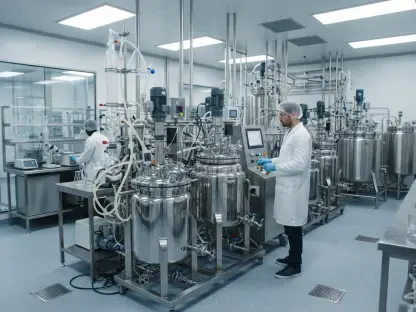

The global pharmaceutical landscape is currently navigating a profound transformation as researchers attempt to reconcile the astronomical promises of artificial intelligence with the uncompromising demands of laboratory validation. While the allure of accelerated data analysis remains a powerful motivator for investment, the industry has reached a stage where computational potential must translate into repeatable, high-fidelity scientific outcomes within living systems. Moving beyond the initial cycle of excitement requires a fundamental shift in how digital tools are integrated into the complex biological environments that define drug development. Experts emphasize that the true value of these technologies lies not in their ability to generate massive amounts of raw data, but in their capacity to refine hypotheses and reduce the failure rate of clinical candidates. This necessitates a rigorous validation process that prioritizes biological relevance over algorithmic speed, ensuring that every digital insight is grounded in the physical realities of human physiology and cellular interaction.
Historical Evolution and Cultural Barriers
From Genomics to Generative Intelligence
Looking back at the trajectory of the industry, the current enthusiasm follows a previous cycle of high expectations that emerged approximately fifteen years ago during the rise of genomics and cloud computing. During that era, advanced mathematical models were frequently rebranded as early forms of artificial intelligence, leading many stakeholders to believe that the simple accumulation of genomic data would solve the persistent bottleneck of target identification. However, the sector eventually encountered a significant barrier when these initial models failed to deliver successful outcomes in human clinical trials, highlighting a critical disconnect between digital correlations and biological causality. This period served as a valuable, if costly, lesson regarding the inherent resistance of biological systems to simplified data-driven fixes. It underscored the fact that identifying a potential drug target through computational means is only the beginning of a long and hazardous journey toward a viable therapeutic solution.
A fundamental pivot occurred around 2022 with the emergence of generative artificial intelligence and large language models, which redirected the industry’s focus from numerical analysis toward natural language processing. This breakthrough addressed a significant pain point for bench scientists: the staggering volume of scientific literature and experimental documentation that has become impossible for any human researcher to digest effectively. By enabling professionals to extract nuanced insights from tens of thousands of research papers through conversational queries, these systems have reignited a sense of possibility across research and development departments. However, a substantial gap still exists between identifying a promising insight in a research paper and implementing that discovery in a controlled laboratory setting. The current challenge involves moving beyond these text-based summaries to create tools that can actively assist in the design of experiments, rather than just reporting on existing knowledge that was produced by others.
Navigating Behavioral Shifts and Fiscal Challenges
The adoption of these technologies is often hindered by what many observers describe as a “TikTok mentality,” where an internal culture of instant gratification creates immense pressure for immediate results in a field defined by rigor. Scientific discovery is fundamentally distinct from consumer-facing technology; it requires a level of structural discipline and reproducibility that autonomous agents are not yet capable of providing without constant human intervention. Without stringent oversight and the implementation of carefully designed operational workflows, the outputs generated by these models risk appearing highly convincing to the untrained eye while simultaneously lacking the scientific integrity required for pharmaceutical development. Researchers are finding that the desire for speed must be balanced with the slow, methodical verification processes that have always been the backbone of medicine. Successful integration therefore requires a cultural shift where AI is viewed as an extension of the scientific method rather than a shortcut.
Beyond the cultural adjustments, the economic architecture of modern computational intelligence presents a practical barrier for large-scale pharmaceutical organizations. Most high-performing reasoning engines currently operate on a token-based pricing structure, which means that every individual computational “thought” or inference carries a direct financial cost. These expenses can quickly escalate to unsustainable levels when tools are deployed across global research teams tasked with processing petabytes of proprietary data. Organizations must carefully evaluate the cost of these reasoning engines against the actual return on investment observed within their drug discovery pipelines. This fiscal reality is forcing companies to be more selective about where and how they apply advanced models, prioritizing tasks where the complexity of the problem justifies the high cost of the computation. Consequently, the industry is seeing a move toward smaller, more specialized models that offer a more favorable balance between performance and operational expenditure for specific tasks.
Scientific Frameworks and the Simulation Frontier
Ensuring Reproducibility in Computational Workflows
Success in this modern era of drug development depends less on the raw processing power of the technology itself and more on the discipline utilized to construct the surrounding research workflows. Effective drug discovery necessitates a precise chain of events, starting from initial data acquisition and moving through to final clinical interpretation, a process that digital tools can support but never entirely replace. Organizations that fail to establish these highly structured environments will likely find themselves in possession of impressive computational tools that do not translate into tangible scientific progress or regulatory approval. The focus is shifting toward “human-in-the-loop” systems where the AI handles the heavy lifting of data organization while human scientists apply their intuition to the most critical decision points. This collaborative approach ensures that the nuances of biology are not lost in a sea of algorithmic optimization, maintaining a clear path from the digital laboratory to the patient.
One of the most persistent technical hurdles involves the non-deterministic nature of modern language models, which can provide different answers to the identical question based on slight variations in phrasing. This probabilistic behavior is fundamentally incompatible with the scientific requirement for reproducibility, where experimental results must remain consistent across different trials and environments. To manage this inherent variability, research teams are implementing sophisticated “guardrails” and validation frameworks designed to harness creative potential without sacrificing the accuracy needed for safety. These frameworks involve the use of secondary verification models and automated testing suites that check every AI-generated hypothesis against known biological laws. By creating a system of checks and balances, scientists can utilize the broad reasoning capabilities of AI while ensuring that the final data used for regulatory filings meets the highest standards of evidence. This transition from exploratory use to regulated application is the current priority for the industry.
Advancing Toward Simulation and Practical Mastery
The next significant frontier in the field involves moving beyond simple language processing toward what experts describe as “World Models,” which are designed to simulate entire biological systems in a digital space. These advanced models aim to represent complex physical and chemical processes, such as protein folding or cellular signaling pathways, within a comprehensive virtual environment. This allows researchers to test various therapeutic hypotheses through large-scale simulations before they ever commit to the significant expense of physical laboratory work. If fully realized, this technology would shift the paradigm of drug discovery from a traditional trial-and-error process to a predictive science rooted in deep computational insights. Such a shift would potentially reduce the time required to move a drug candidate from the initial design phase to clinical testing by several years. The goal is to reach a point where biological outcomes can be predicted with the same precision that engineers use when designing complex aerospace components.
The most successful researchers were those who treated these advanced models as collaborative partners rather than static tools, integrating them into the daily rhythms of the laboratory to enhance their own expertise. They focused on mastering prompt engineering and data curation, recognizing that the quality of scientific output was directly proportional to the quality of the instructions provided to the reasoning engine. By automating the more mundane aspects of data synthesis, scientists reclaimed valuable time for high-level creative problem-solving and experimental design. Forward-thinking organizations also invested heavily in proprietary data sets, ensuring that their models were trained on high-fidelity, internal results rather than just public information. This approach created a competitive advantage, as it allowed for the development of custom algorithms that were uniquely tuned to specific therapeutic areas. Ultimately, the transition to AI-driven discovery required a commitment to lifelong learning and an openness to redefining the traditional roles within the scientific community.