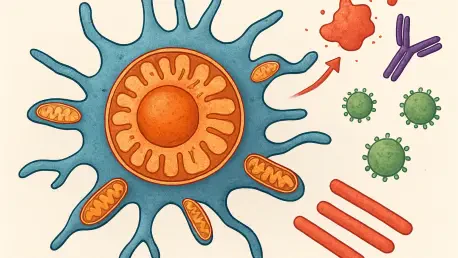

Within the microscopic theater of the human body, a relentless surveillance network operates with such precision that most pathogens are neutralized long before symptoms ever appear. At the heart of this defensive perimeter are dendritic cells, the primary “sentinels” that bridge the gap between innate detection and adaptive destruction. For decades, the scientific community focused on surface receptors to understand how these cells identify threats. However, recent breakthroughs have revealed that the true architect of immune defense resides much deeper within the cell. The mitochondria, long dismissed as simple power plants, are now recognized as the master regulators of whether an immune cell is prepared to stand its ground or remain in a state of ineffective dormancy.
Modern immunology has moved toward a sophisticated understanding of cellular preparedness. It is no longer enough to identify a pathogen; a dendritic cell must be metabolically “primed” to act. A groundbreaking discovery from collaborative research now confirms that a continuous flow of electrons within the mitochondria—rather than just the production of chemical energy—dictates the functional readiness of these first responders. This paradigm shift suggests that the metabolic health of these cells is the ultimate factor in determining the success of a vaccine or the failure of a tumor to evade detection.
The Invisible Engine: Powering the Body’s First Responders
Dendritic cells represent the high-stakes intelligence agency of the immune system, tasked with capturing foreign antigens and presenting them to T cells within the lymph nodes. This role requires immense agility and precision, as the timing of this interaction determines the vigor of the subsequent immune response. While the “powerhouse” metaphor for mitochondria remains popular, it fails to capture the complexity of how these organelles govern the life of a sentinel cell. Mitochondria do not just provide fuel; they act as a sensory hub that integrates internal chemistry with external defensive demands.
The functional status of these cells depends on a specific subset known as cDC1, which is critical for orchestrating responses against cancer and viral infections. When these cells are healthy, they maintain a high level of vigilance. However, research indicates that if their internal metabolic machinery falters, their ability to migrate and communicate with other immune components vanishes. This suggests that the invisible engine of the mitochondria is what truly powers the first line of defense, ensuring that dendritic cells remain ready to transition from quiet observation to active combat at a moment’s notice.
Deciphering the Connection: Metabolism and Immunity
The evolution of immunology has increasingly intersected with the study of cellular chemistry, shifting the focus from external signals to internal metabolic checkpoints. Historically, researchers believed that immune activation was a linear process triggered by external stimuli. Today, the focus has shifted toward how metabolic pathways provide the “permission” for these activations to occur. For dendritic cells, this means that their metabolic state serves as a linchpin for successful cancer immunotherapy and vaccine efficacy. If the internal chemistry is not optimal, even the most advanced medical treatments may fail to provoke a response.
Bridging the gap between basic biochemistry and clinical outcomes requires a deep dive into how cells manage their resources during a crisis. The cDC1 cells, in particular, must maintain a specific metabolic profile to remain effective. When this profile is disrupted, the body’s ability to stop pathogens and tumors is severely compromised. This metabolic governance explains why some individuals respond better to immunotherapies than others; it is not just about the presence of immune cells, but the internal “readiness” of those cells to execute their biological programming.
Redefining Mitochondrial Utility: Electron Flow over Energy
A significant paradigm shift has emerged, challenging the long-held belief that adenosine triphosphate (ATP) is the only vital contribution mitochondria make to immune activation. Evidence now suggests that the continuous flow of electrons through the mitochondrial respiratory chain is what actually maintains the internal chemical equilibrium, or “redox balance,” necessary for cell function. When this flow is interrupted, the dendritic cell does not just lose power; it loses its identity. The cell enters a state of dormancy, unable to process the signals required to initiate a defensive maneuver against a threat.
Insights from studies conducted at the CNIC and IRB Barcelona, using both mouse models and human samples, have proven that this electron flow is the primary governor of cell state. By manipulating the electron transport chain (ETC), researchers observed that dendritic cells became paralyzed despite having alternative energy sources. This discovery highlights that the flow itself is a signaling mechanism. It keeps the cell in a state of high alert, ensuring that all molecular systems are calibrated for an immediate response to a biological breach.
The Epigenetic Master Switch: How Mitochondria Talk to DNA
The intersection of metabolism and genetics has revealed a “metabolic checkpoint” that physically locks or unlocks immune genes. This process is mediated by the TET2 enzyme, a molecular gatekeeper that depends on mitochondrial health to function. When the electron flow is consistent, TET2 keeps the cell’s DNA in an “open” and accessible state. This allows the dendritic cell to quickly transcribe the genes needed for defense. In contrast, when mitochondrial health declines, DNA methylation patterns change, effectively “locking” the defensive genes behind a chemical barrier that prevents their activation.
Experimental breakthroughs have demonstrated that this process is surprisingly reversible. By using Vitamin C to stimulate TET2 or employing the AOX enzyme to bypass metabolic blocks, researchers were able to restore immune vigor in previously dormant cells. This suggests that the communication between the mitochondria and the nucleus is a two-way street. Maintaining mitochondrial electron flow ensures that the genetic blueprints for a powerful immune response remain ready for use, providing a clear target for future interventions designed to rejuvenate aging or exhausted immune systems.
Enhancing Immune Readiness: Strategies for Clinical Practice
The clinical application of these findings offers a transformative roadmap for the future of oncology and vaccine design. By prioritizing the metabolic health of dendritic cells, clinicians developed strategies to prevent cellular exhaustion in the immunosuppressive environment of a tumor. Optimizing dendritic cell vaccines now involves frameworks for metabolic priming, ensuring that cells are not only loaded with antigens but also equipped with the mitochondrial stamina to complete their mission. These pharmacological interventions, such as the use of TET2 activators, maintained the “open” state of immune DNA even under stress.
Furthermore, the potential for micronutrients to support mitochondrial electron flow became a focal point for preventative health. Dietary strategies that enhanced the internal chemical balance of sentinels offered a low-cost method to maintain high levels of immunological vigilance. As cell-based therapies were refined, the focus moved toward designing treatments that prioritized mitochondrial integrity. These advancements ensured that the body’s first responders remained active and capable, providing a robust defense against the most challenging diseases. This metabolic approach provided the foundation for a new era of precision medicine that empowered the immune system from the inside out.