
The survival of a breast cancer patient often hinges on a biological mystery that takes place at the jagged, microscopic frontier of a primary tumor. For years, the medical community viewed the spread of cancer as a chaotic series of unfortunate mutations or a simple failure of the immune system to police its own borders. However, recent evidence suggests that the blueprint for secondary tumors is drafted long before a single cell enters the lymphatic system, hidden within the genetic instructions of the very first malignant cluster.
This discovery moves away from the idea that metastasis is a late-stage roll of the dice. Instead, it posits that the potential for a tumor to colonize distant organs like the lungs or brain is a programmed trait. By identifying specific genetic markers at the invasive front of a tumor, researchers are beginning to decode which cells are destined to remain local and which are primed to become lethal travelers. This shift in perspective is not just academic; it represents a fundamental change in how clinicians might soon predict patient outcomes.
The Hidden Blueprints of Cancer Spread
Inside the chaotic environment of a primary breast tumor, a silent hierarchy determines which patients will remain in remission and which will face the threat of secondary tumors. Historically, oncology has treated the migration of cancer cells as a secondary event, often influenced by the welcoming nature of distant organs or “pre-metastatic niches.” Recent breakthroughs from the Institute for Neurosciences have challenged this assumption by demonstrating that the “seeds” of metastasis are identifiable at the tumor’s very edge before they ever reach the bloodstream.
These specialized cells exist in a state of high plasticity, allowing them to shift their identity to survive the journey through the body. Rather than being a random byproduct of tumor growth, this invasive potential is concentrated in specific zones. Understanding these zones allows scientists to map the geography of a tumor, distinguishing between the stagnant interior and the aggressive perimeter where the most dangerous cellular actors reside.
Understanding the EMT Paradox: The Master Regulator
To grasp the significance of the Prrx1 gene, one must understand the epithelial-to-mesenchymal transition, or EMT. This biological process is essential during embryonic development, acting as the engine that allows cells to travel and build the human body, but cancer cells hijack this mechanism to break free from their original site. The challenge for researchers has always been the “EMT paradox”: the observation that some highly mobile cancer cells successfully invade new organs while others simply vanish or fall into a permanent sleep upon arrival.
The discovery of Prrx1 as the master regulator of this transition provides the missing link between cellular mobility and the ability to grow in new environments. It turns out that simply having the ability to move is not enough to cause a secondary tumor. A cell must also possess the capacity to “re-specialize” once it reaches its destination. Prrx1 controls this toggle, determining whether a cell remains a wanderer or becomes a founder of a new colony.
The Hormetic Effect: How Prrx1 Concentration Determines Lethality
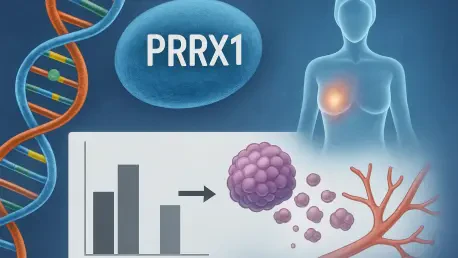
The most critical finding of recent studies is that the Prrx1 gene does not act as a simple “on/off” switch for cancer spread; instead, it operates on a sliding scale where the dosage dictates the clinical outcome. This hormetic effect means that both too little and too much of the gene’s activity can lead to less aggressive outcomes, albeit for different reasons.
- The Stationary State: Cells with low or absent Prrx1 expression remain tightly packed within the primary tumor, lacking the machinery required to invade surrounding tissues.
- The Dormant Travelers: Cells with high Prrx1 expression are masters of escape, flooding the body in massive quantities; however, their high intensity prevents them from “rooting,” often leaving them in a harmless, dormant state for years.
- The “Sweet Spot” of Metastasis: Cells with intermediate Prrx1 expression represent the highest clinical risk, as they possess the perfect balance of mobility to travel and the proliferative power to immediately form new, life-threatening tumors upon arrival.
Validating Genetic Markers: Spatial Transcriptomics
By utilizing advanced spatial transcriptomics and single-cell analysis, researchers were able to map the exact location of these dangerous “intermediate” cells at the invasive front of the tumor. This technology allows scientists to see not just which genes are active, but exactly where that activity is happening in relation to the tumor’s structure. To bridge the gap between laboratory models and clinical reality, teams analyzed human patient samples in collaboration with the MD Anderson Cancer Center Spain Foundation.
This cross-species consistency confirmed that the Prrx1 signature is not just a laboratory phenomenon but a tangible biological marker. By comparing the genetic maps of human tumors with patient survival rates, the data showed a clear correlation between the presence of “intermediate” Prrx1 cells and a higher likelihood of relapse. This validation provides a robust foundation for moving genetic profiling from the research bench to the diagnostic clinic.
Strategies for Integrating Prrx1: Clinical Diagnostics
The identification of Prrx1 levels offers a practical framework for changing how clinicians assess and treat breast cancer patients. Moving forward, the focus will likely shift toward enhanced patient stratification, using Prrx1 expression as a biomarker to categorize individuals into low, medium, or high risk of metastasis based on the primary tumor’s architecture. This would allow for more personalized treatment plans, sparing low-risk patients from aggressive systemic therapies while prioritizing high-risk individuals for intensive intervention.
Refining preventative therapies also became a tangible goal, as researchers looked for ways to prevent cells from reaching that dangerous “intermediate” state. If a drug could push cells toward the “high” expression state, it might effectively force them into dormancy, rendering them unable to form active metastases. Predictive mapping at the tumor’s invasive front promised a future where early-stage dissemination was identified long before systemic symptoms appeared, fundamentally altering the timeline of cancer care. Integrated diagnostic tools eventually provided a clearer roadmap for surgeons and oncologists to follow.