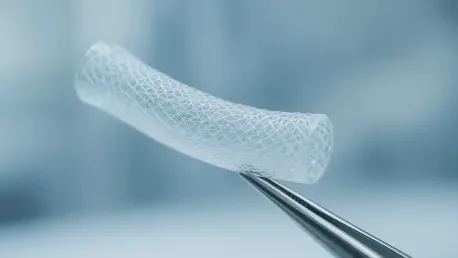

A major hurdle in cardiac surgery is the compliance mismatch between stiff artificial tubes and flexible arteries, which creates turbulent blood flow and eventual graft blockage. This fundamental discrepancy has long prevented the widespread adoption of synthetic bypass grafts, as the sudden change in vessel elasticity triggers localized stress at the junction. In contrast to native vessels that pulse with each heartbeat, traditional plastic conduits remain rigid, leading to the development of scar tissue that inevitably narrows the passage. The emergence of acellular regenerative conduits represents a paradigm shift, utilizing a bioengineered framework that actively encourages the host’s own cellular structure to populate the graft. This approach aims to provide a reliable ‘off-the-shelf’ alternative to the patient’s own veins, which are often compromised by age or disease. By focusing on biological compatibility rather than mere mechanical substitution, researchers have created a solution that adapts to the body’s needs, promising a new era in cardiovascular intervention and long-term recovery.
Addressing the Limitations of Traditional Grafting
The Constraints: Autologous Graft Harvesting
The current landscape of bypass procedures relies heavily on autologous grafts, which require the surgical removal of veins or arteries from another part of the patient’s body, such as the leg or arm. While this method uses the patient’s own biological material, it introduces significant secondary risks, including donor-site infections, persistent pain, and extended recovery periods. For many high-risk patients, especially those suffering from advanced diabetes or peripheral vascular disease, the available donor tissue is often of poor quality or entirely insufficient due to previous interventions. This scarcity of viable tissue forces surgeons to seek alternatives, yet the historical performance of synthetic materials in small-diameter vessels—those less than six millimeters—has been consistently disappointing. These narrow pathways are particularly sensitive to the clotting and wall thickening that occur when blood interacts with non-biological surfaces, making the search for a durable and compatible small-scale vessel replacement a top priority for clinical researchers.
Engineering Challenges: Small-Diameter Vessels
Historical attempts to use expanded polytetrafluoroethylene or Dacron in coronary applications failed because these materials do not possess the innate ability to self-repair or respond to physiological signals. In the high-pressure environment of the heart’s circulation, these rigid tubes cannot expand or contract, leading to hemodynamic disturbances that encourage the formation of thrombi. The acellular conduit addresses these specific engineering failures by providing a structure that mimics the delicate architecture of a natural vessel while maintaining the strength required to endure pulsatile flow. Unlike permanent synthetic implants that remain foreign objects forever, these bioengineered scaffolds are designed to serve as a temporary bridge while the body performs its own restorative work. This transition from a physical placeholder to a living biological component is essential for long-term success, as it allows the graft to behave exactly like the surrounding native tissue, effectively neutralizing the body’s inflammatory response to foreign materials.
Engineering and Biological Integration
Structural Foundations: The Extracellular Matrix
At the core of this technological leap is the use of a decellularized extracellular matrix, a protein-rich scaffold derived from donor tissue that has been meticulously stripped of all cellular components. This process is critical because it removes the antigens that would otherwise trigger an immune rejection, leaving behind a pristine framework of collagen and elastin. This biological blueprint is far more than a simple tube; it is a complex environment filled with biochemical cues that guide the recipient’s own cells during the healing process. When the conduit is implanted, it does not act as a barrier but rather as an invitation for host cells to migrate, attach, and begin the work of vascular remodeling. This sophisticated design ensures that the body does not recognize the graft as an intruder but rather as a natural extension of the existing vascular network. The result is a structure that possesses the mechanical durability of a medical device combined with the regenerative potential of living tissue, facilitating a seamless integration into the patient’s anatomy.
Biological Remodeling: Endothelial Growth
As the recipient’s cells begin to populate the scaffold, they differentiate into specialized types required for a functional vessel, including smooth muscle cells and a healthy endothelial lining. The formation of this inner endothelium is particularly vital, as it serves as a natural defense against blood clotting and regulates the exchange of nutrients and gases between the blood and the vessel wall. Over time, the original donor-derived scaffold is gradually replaced by the patient’s own proteins, a process that effectively transforms the conduit into an autologous-like structure. This dynamic remodeling allows the graft to maintain its integrity while becoming a living part of the patient’s cardiovascular system, capable of responding to hormonal and physical changes. The ability of the conduit to transition from an ‘off-the-shelf’ product into a personalized biological vessel represents a major milestone in tissue engineering, offering a level of adaptability that was previously considered impossible for any surgical implant.
Performance Milestones and Biomechanics
Sustained Patency: Long-Term Durability
Recent data evaluating the longevity of these bioengineered grafts have shown an impressive 18-month patency rate, a benchmark that indicates a high degree of long-term stability and function. In the world of vascular surgery, the first year is often the most critical period, as this is when most synthetic or poorly integrated grafts fail due to aggressive scarring or the accumulation of plaque. The fact that these acellular conduits remain open and functional beyond this window suggests that the remodeling process is successful and sustainable. This sustained performance is a direct result of the material’s ability to avoid the chronic inflammation that typically leads to intimal hyperplasia. By providing a smooth, biocompatible surface from the moment of implantation, the conduit minimizes the turbulence that often precedes graft failure. This clinical success provides a strong foundation for the transition to broader human trials, where the goal is to demonstrate that these bioengineered solutions can provide a lifetime of reliability without the need for additional revision surgeries.
Mechanical Harmony: Compliance Matching
Achieving mechanical harmony between the graft and the native artery is a multifaceted challenge that requires a precise balance of strength and elasticity. The bioengineered scaffold is specifically engineered to handle the high-pressure environment of the coronary arteries, ensuring it does not rupture or dilate under the constant stress of the cardiac cycle. However, it must also remain flexible enough to bend and twist with the natural movements of the heart, a property known as compliance. By matching the elasticity of the surrounding vessels, these conduits prevent the energy loss and wall stress that occur at the anastomosis points where the graft is stitched to the heart. This mechanical synchronization is crucial for maintaining laminar blood flow, which in turn prevents the activation of platelets and the subsequent formation of clots. The success of these conduits in mimicking the biomechanical profile of human arteries represents a significant technical achievement, bridging the gap between mechanical engineering and biological reality to ensure the long-term health of the bypass.
Clinical Applications and Future Directions
Streamlining Surgery: Off-the-Shelf Solutions
The availability of ‘off-the-shelf’ regenerative conduits could fundamentally change the workflow of cardiac surgery by removing the time-consuming and often traumatic step of vein harvesting. Surgeons would have access to a standardized, high-quality inventory of vascular grafts in various sizes, allowing for more precise matching to each patient’s specific anatomical needs. This efficiency would not only reduce the overall duration of the operation—thereby decreasing the time the patient spent under anesthesia—but also significantly lower the risk of complications associated with secondary surgical sites. For the aging population and those with complex medical histories, this means a faster return to daily activities and a reduced burden on the healthcare system. Furthermore, the standardization of these bioengineered vessels ensures that every patient receives a graft with consistent mechanical properties, regardless of their own health status or native vein quality, making advanced bypass procedures safer and more accessible.
Future Innovations: Regenerative Success
The clinical introduction of acellular matrices successfully expanded beyond the initial scope of coronary bypass to address other critical needs, such as peripheral artery disease and vascular access for dialysis. These bioengineered structures demonstrated a remarkable resistance to infection and calcification, making them a preferred choice for complex reconstructions following trauma or limb-salvage procedures. In the field of pediatric surgery, the potential for these grafts to grow alongside the child represented a transformative breakthrough, as it eliminated the recurring need for risky re-interventions as the patient matured. Researchers prioritized the refinement of these cellular interaction models to ensure that the transition to a fully living vessel remained predictable across diverse patient populations. By harnessing the body’s innate regenerative capacity, the medical community took a decisive step toward a time when vascular replacements were no longer just temporary fixes but lifelong biological solutions.