
For the past ten years, the Northwestern University Center for Synthetic Biology has fundamentally altered how researchers perceive the inherent capabilities of living systems by treating genetic code as a programmable substrate for engineering solutions. Since its establishment, the center has championed a paradigm shift that moves biological science away from the traditional, often unpredictable, discovery-based methods toward a more rigorous, engineering-focused discipline. This evolution has allowed scientists to repurpose cellular mechanisms for highly specific functions, such as environmental toxin detection and the precision delivery of therapeutic agents. While the field was once characterized by expensive, manual processes that yielded results slowly, the persistent innovation at this institution has streamlined these workflows. By focusing on the modularity of biological parts, the center has successfully demonstrated that life can be engineered with the same predictability found in electrical circuits or mechanical systems, providing a foundation for a future where biological design is accessible and efficient.
The Technological Leap: The Integration of Automation and Intelligence
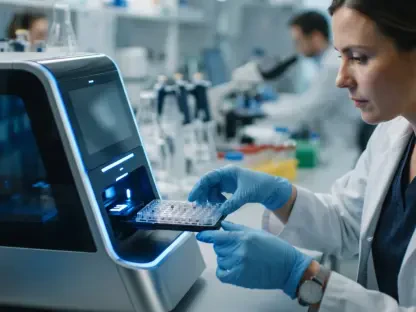
At the center of this transformation lies the automated laboratory facility known as the Foundry, which represents a significant departure from the manual bench work of previous decades. This facility integrates sophisticated high-throughput hardware with advanced computational tools, including artificial intelligence models like AlphaFold, to navigate the immense complexity of protein folding and genetic interactions. By utilizing these tools, researchers can now design, build, and test thousands of distinct biological prototypes within a single twenty-four-hour cycle, a feat that would have taken months to complete in the recent past. This closed-loop system creates a rapid iteration process where AI-driven predictions are immediately validated by robotic assembly, allowing for an unprecedented level of experimental precision. Such a technological leap has effectively removed the bottleneck of human physical labor, enabling the exploration of massive datasets that reveal how subtle genetic variations influence the behavior of entire biological networks.
Expanding the boundaries of what is possible within a laboratory setting, this transition to an automated environment allows for the investigation of intricate biological pathways that were previously deemed too complex for standard research. By standardizing the physical construction of genetic circuits, the center has drastically reduced the variability that often plagues biological experiments. This ensures results are reproducible. The synergy between mathematical modeling and physical hardware ensures that every design choice is informed by data, rather than trial and error, which accelerates the development of novel enzymes and metabolic routes. This systematic approach has not only increased the volume of research output but has also refined the quality of the insights generated, positioning the institution at the absolute cutting edge of global biotechnology. As these automated systems continue to evolve, they provide a scalable model for how scientific research can be conducted in an era where data density and speed are paramount.
Building a Regional Hub: The Rise of the Third Coast
Beyond the walls of the laboratory, the center has acted as a primary catalyst for the development of the Chicago metropolitan area into a prominent biotechnology epicenter, often referred to as the Third Coast. This growth has successfully challenged the historical dominance of coastal hubs by fostering an environment where academic research and commercial application coexist seamlessly. By focusing on practical solutions for global challenges such as food security and sustainable manufacturing, the center has attracted significant investment and talent to the Midwest, creating a robust ecosystem of startups and established industry partners. The regional impact is measured not just in economic terms, but also in the collaborative spirit that characterizes the local scientific community. This intentional cultivation of a biotechnology hub has ensured that the benefits of synthetic biology are not concentrated in a few geographic locations, but are instead distributed to drive innovation and infrastructure development throughout the central United States.
A cornerstone of this institutional success is a deeply collaborative philosophy that deliberately integrates diverse perspectives from engineers, social scientists, lawyers, and anthropologists. This multidisciplinary strategy acknowledges that biological engineering does not occur in a vacuum and that new technologies must be both technically functional and ethically sound to be accepted by the public. For instance, the development of low-cost water sensors required a combination of high-level molecular engineering and a nuanced understanding of the sociological contexts in which these tools would be deployed. By engaging with experts from the humanities and social sciences early in the design process, the center ensures that its innovations address real-world needs without causing unintended social or ecological harm. This holistic approach to technology development has set a new standard for how scientific institutions can operate, proving that the most effective solutions emerge when technical expertise is balanced with a deep commitment to societal responsibility and ethical integrity.
Pioneering Research: Applications in Medicine and Sustainability
The research portfolio managed by the center spans a wide array of applications, most notably in the creation of living pharmacies that are designed to produce and secrete medicinal compounds directly within the human body. These engineered systems represent a leap forward in personalized medicine, as they can be programmed to sense specific disease biomarkers and respond with a targeted therapeutic dose, minimizing the systemic side effects associated with traditional treatments. In addition to living systems, researchers have made significant strides in developing artificial cells that function as diagnostic tools without the inherent risks of using self-replicating organisms. These non-living platforms are capable of detecting pathogens or chemical signatures in a variety of environments, from clinical settings to remote field locations. By bridging the gap between theoretical synthetic biology and practical healthcare applications, these projects demonstrate how the manipulation of biological matter can lead to a more resilient and responsive medical infrastructure that improves patient outcomes worldwide.
In the realm of environmental sustainability, the center has focused on the creation of robust biomanufacturing platforms that utilize engineered microbes to convert renewable resources into high-value chemicals and fuels. These platforms offer a cleaner alternative to traditional petrochemical processes, potentially reducing the carbon footprint of diverse industries ranging from plastics production to aviation. By redesigning metabolic pathways, scientists have successfully enabled organisms to consume agricultural waste and produce complex molecules that were previously difficult to synthesize at scale. This research extends to the development of alternative proteins and nutritional supplements, addressing the growing global demand for food sources that do not rely on intensive land or water use. These innovations emphasize the dual role of synthetic biology as both a medical frontier and a fundamental tool for ecological preservation. The ability to engineer biology for industrial utility represents a critical step toward a circular economy, where biological systems are the primary engines of production and waste recycling.
Responsible Innovation: Educational and Ethical Foundations
As the institution moves forward, it maintains a steadfast commitment to training the next generation of scientists who will be tasked with managing the immense power of biological design. Beyond the mastery of technical skills like CRISPR-based editing or DNA synthesis, the graduate programs at the center emphasize the ethical weight of manipulating living systems. Foundational textbooks and curricula developed by the faculty encourage students to engage with the long-term implications of their work, focusing on safety, equity, and the preservation of biodiversity. By fostering a culture of biocontainment by design and ethical foresight, the center ensures that its graduates are not only skilled engineers but also responsible stewards of technology. This educational mission is vital for maintaining public trust, as the transparency of scientific processes and the proactive consideration of potential risks are essential for the continued expansion of the field. The focus remains on asking critical questions about who benefits from these technologies and how they can be distributed fairly across the global population.
The initial decade of research culminated in the establishment of actionable frameworks that prioritized the integration of safety protocols directly into the engineering lifecycle. Researchers mandated that all developments in genetic manipulation remained within clearly defined ecological and ethical boundaries to ensure long-term viability. This period proved that the successful implementation of biological technologies required a balance between rapid innovation and careful public engagement to maintain trust. The center formalized a structure where interdisciplinary collaboration was the primary vehicle for addressing the complexities of global health and environmental stability. These past initiatives provided the necessary groundwork for a future where biological engineering became synonymous with sustainability and human well-being. The institution solidified its global leadership by demonstrating that scientific excellence and societal accountability were reinforcing priorities. Ultimately, the lessons that were learned from these early successes provided a blueprint for the next phase of biotechnology.