
Ivan Kairatov is a leading biopharma expert with a profound understanding of how nanotechnology and materials science intersect to revolutionize medical diagnostics and hardware. With extensive experience in research and development, Kairatov has focused on the shift from rigid silicon-based systems to flexible, bio-integrated electronics. His work explores the frontier of neuromorphic computing, where the goal is to bridge the gap between artificial intelligence and biological neural networks. In this conversation, we explore the mechanics of printable semiconductors, the challenges of interfacing with living tissue, and the urgent need for energy-efficient hardware in an era of data-intensive AI.
The following discussion delves into the sophisticated chemical engineering behind aerosol jet printing and the role of molybdenum disulfide in creating functional semiconductors. We examine the specific biological requirements for neural communication, the importance of signal diversity in computing efficiency, and the environmental implications of moving away from traditional data center architectures.
How do molybdenum disulfide and graphene interact during the aerosol jet printing process to form a functional semiconductor, and how does the intentional, partial decomposition of polymers create the localized conductive filaments necessary for neuron-like signaling?
The synergy between these materials is a masterclass in nanoscale engineering, where we use molybdenum disulfide (MoS2) flakes as our active semiconductor and graphene as the high-speed electrical conductor. During the aerosol jet printing process, these electronic inks are layered onto a flexible polymer substrate with extreme precision, creating a complex, heterogeneous network. Traditionally, engineers viewed the stabilizing polymers in these inks as a hindrance and would burn them away entirely, but we discovered that keeping them allows for a more dynamic behavior. By partially decomposing these polymers rather than removing them, we create a landscape where electrical current drives further, localized decomposition. This process forms narrow, conductive filaments that constrict the current into specific pathways, effectively mimicking the sudden, all-or-nothing electrical response we see in biological neurons.
When interfacing artificial signals with living mouse cerebellum tissue, what specific temporal ranges and spike shapes are required to trigger a biological response, and how do you verify that the real neurons are communicating naturally rather than just reacting to electrical noise?
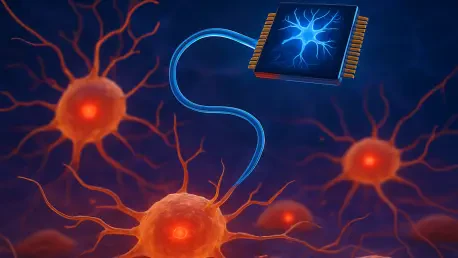
Achieving biological realism requires moving away from the extreme speeds of metal oxides and the sluggishness of traditional organic materials to find a very specific “Goldilocks” zone. Our artificial neurons operate within a temporal range that matches the timing and duration of living voltage spikes, ensuring the signal is recognizable to the mouse cerebellum tissue. We verify the natural communication by observing how the real neurons respond to the specific shape of the artificial spike; if the shape is correct, it triggers a predictable cascade of activity within the neural circuit rather than a random, chaotic reaction. This alignment in spike duration and amplitude proves that the biological system is processing our artificial signal as legitimate data. It is a profound moment when you see the living tissue respond to a printed device with the same fluidity it would show to a neighboring biological cell.
Biological neurons are capable of complex behaviors like bursting and continuous firing, unlike the simplified pulses of most digital systems. What mechanisms allow these printed devices to encode diverse signaling patterns, and how does this diversity translate into higher energy efficiency for computing hardware?
The secret to this complexity lies in the memristive properties of the MoS2 nanosheet networks, which don’t just turn on and off but can modulate their conductive states. This flexibility allows a single printed device to produce a rich variety of signaling patterns, including single spikes, continuous firing, and even the rhythmic “bursting” seen in the human brain. Because each artificial neuron can encode significantly more information through these diverse patterns, we can perform sophisticated functions with fewer individual components. This reduction in hardware complexity is the key to energy efficiency, moving us closer to the biological model where the brain remains the most power-frugal computer in existence. In a traditional digital setup, achieving this level of nuance would require a massive, power-hungry network, but here, the material itself does the heavy lifting.
As AI training demands more power and water for data center cooling, how can heterogeneous, three-dimensional architectures move us away from rigid silicon chips, and what specific metrics suggest that brain-inspired hardware can bridge the current five-order-of-magnitude gap in energy efficiency?
Current AI infrastructure is hitting a physical and environmental wall, with data centers consuming gigawatts of power and massive amounts of water for cooling, which is simply not sustainable. We are looking at a future where we move away from 2D silicon chips packed with billions of identical transistors toward 3D, heterogeneous architectures that mimic the brain’s dynamic structure. The brain is five orders of magnitude more energy efficient than a digital computer, a metric that serves as our “North Star” for hardware development. By using additive manufacturing to place material only where it is needed and creating devices that learn and adapt, we can drastically cut down on heat dissipation and power consumption. This shift isn’t just about speed; it’s about creating a sustainable foundation for intelligence that doesn’t require a dedicated nuclear power plant to function.
Flexible, printable electronics offer a unique path for neuroprosthetics involving vision, hearing, and movement. What is the step-by-step process for integrating these soft materials with biological nervous systems, and what are the long-term durability trade-offs when using polymer-based substrates instead of traditional metal oxides?
The integration process begins with the formulation of biocompatible inks, followed by the precise printing of the neural circuits onto flexible, soft polymer substrates that can contour to the irregular shapes of biological tissue. Once printed, these devices are interfaced with the nervous system, where their mechanical flexibility reduces the risk of scarring or inflammation that rigid metal oxides often cause. However, we do face a trade-off: while polymers offer superior biocompatibility and “softness,” they must be engineered to withstand the saline, corrosive environment of the human body over many years. We are constantly balancing the need for long-term structural durability with the desire for a material that feels “natural” to the body. Using an additive process also minimizes waste during production, making these neuroprosthetics not only better for the patient but also more efficient to manufacture on a large scale.
What is your forecast for brain-like computing?
I believe we are entering an era where the distinction between “hardware” and “wetware” will become increasingly blurred, leading to a complete overhaul of how we build and power artificial intelligence. Within the next decade, I expect to see neuromorphic chips that no longer rely on rigid silicon but are instead “grown” or printed using 2D materials to create low-power, localized intelligence. This will enable a new generation of medical implants that can seamlessly repair neural pathways for vision or movement, and it will save our global infrastructure from the looming energy crisis caused by traditional data centers. Ultimately, we are moving toward a future where our computers will finally begin to think and breathe with the same elegant efficiency as the biological minds that created them.