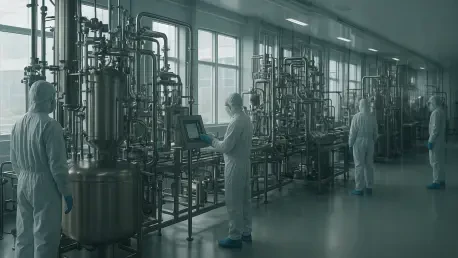

Personalized medicine is emerging as a primary catalyst for manufacturing innovation, requiring flexible platforms that can efficiently produce high-yield therapies for smaller patient populations. This fundamental shift marks the end of the traditional era where massive, stainless-steel vats dominated the landscape, often sitting idle between time-consuming cleaning cycles. Today, the global biopharmaceutical industry is pivotally moving toward continuous bioprocessing, an integrated approach that maintains an unbroken flow of materials from initial cell cultivation through to final purification. By merging upstream and downstream operations into a single, streamlined workflow, manufacturers are achieving significantly higher efficiency and more consistent product quality. This transformation is not merely operational but financial, as the market value is projected to climb from approximately $0.38 billion to an estimated $1.01 billion by 2030, representing a growth rate of over 21 percent from 2026 to 2030.
The Strategic Transition to Precision Healthcare Systems
The necessity for agile manufacturing systems is becoming more evident as regulatory bodies, such as the FDA, increase approvals for specialized treatments targeting rare diseases. As the pipeline for precision healthcare expands, the traditional batch-based infrastructure is proving less viable for companies that need to switch between different products rapidly. Continuous bioprocessing is uniquely suited for this environment, offering the flexibility and shorter lead times necessary to bring targeted oncology treatments to market. These systems allow companies to maintain rigorous quality control standards while scaling operations to meet specific patient requirements without the need for massive scale-up projects. By utilizing smaller, more efficient production units, pharmaceutical firms can manage the economic risks associated with developing niche therapies. This shift ensures that the industry can respond to the unique needs of patients while maintaining the high throughput required for global distribution and commercial viability.
Geographically, the distribution of this technology highlights a significant shift in global manufacturing power, with North America currently maintaining a lead due to its mature biotechnology ecosystem. The region’s regulatory environment has been particularly supportive of innovation, providing clear pathways for firms to implement more efficient production models. However, the Asia-Pacific region is quickly becoming the fastest-growing market, driven by heavy government investment in healthcare infrastructure and the rapid expansion of contract development organizations in countries like China and India. These nations are leveraging continuous bioprocessing to establish themselves as primary hubs for the global supply of affordable biologics. Meanwhile, Europe remains a dominant force, utilizing its established pharmaceutical base to pioneer new methods of process integration. This global competition is accelerating the adoption of advanced manufacturing, ensuring that the benefits of continuous processing are realized across diverse markets.
Advancing Production Through Single-Use and Automated Tools
The technological foundation of this transition relies heavily on the integration of single-use systems and disposable components. These tools effectively eliminate the need for time-consuming cleaning and sterilization cycles that characterized previous generations of biomanufacturing. By utilizing disposable bioreactors and filtration units, companies can significantly reduce the risk of cross-contamination and ensure a sterile environment for each production run. This move away from permanent stainless-steel infrastructure also lowers the initial capital investment required to build new facilities, making it easier for smaller biotech firms to enter the market. Additionally, the reduction in water and chemical usage for cleaning aligns with broader industry goals for environmental sustainability. As these single-use technologies continue to mature, they are providing the necessary physical flexibility for manufacturers to pivot their production schedules in response to real-time market demand and evolving patient needs.
Furthermore, the move toward a holistic design that integrates automated process monitoring is fundamentally changing how quality is maintained in the laboratory and on the factory floor. Modern workflows link the harvest and purification phases both physically and digitally, allowing for constant adjustments to ensure product integrity through every step of the process. This transition from manual sampling to the use of automated sensors and real-time data analytics reduces the likelihood of human error and prevents costly batch failures. By employing Process Analytical Technology, manufacturers can monitor critical quality attributes continuously, ensuring that the biological products meet exacting standards for human therapeutic use. This digital oversight not only improves the safety of the drugs but also provides a wealth of data that can be used to optimize future production cycles. The result is a more resilient manufacturing process that can deliver high-quality therapies with a level of precision and consistency.
Reflecting on the Path Toward Resilient Manufacturing
Looking back at the transition period, it was clear that the successful adoption of continuous bioprocessing required a significant evolution in how organizations managed their technical talent. It was found that traditional engineering silos had to be dismantled in favor of multidisciplinary teams that combined expertise in molecular biology, mechanical engineering, and digital systems. This collaborative approach was essential for troubleshooting the complex interactions that occurred within a continuous flow environment. Furthermore, companies that invested in early-stage pilot programs discovered that the lessons learned during small-scale testing were invaluable when it came time to deploy full-scale production lines. These organizations also realized that the standardization of digital protocols was a critical factor in ensuring that various components from different vendors could communicate effectively. These efforts established a more unified manufacturing framework, which eventually allowed the industry to scale its operations.
It was also determined that the environmental footprint of manufacturing needed to be a primary consideration as the industry moved toward more disposable systems. Stakeholders worked to implement comprehensive recycling programs for single-use plastics, ensuring that the benefits of faster production did not come at the cost of long-term ecological health. Additionally, the development of more localized manufacturing hubs was identified as a key strategy for improving the resilience of the global supply chain. By placing production facilities closer to major patient centers, companies reduced their reliance on complex international shipping routes and minimized the risks associated with global logistics disruptions. These strategic decisions, made during the mid-to-late part of the decade, ensured that the biopharmaceutical sector remained capable of delivering life-saving therapies even during times of significant market volatility. The integration of sustainable practices and localized production ultimately provided a roadmap for a more equitable healthcare infrastructure.