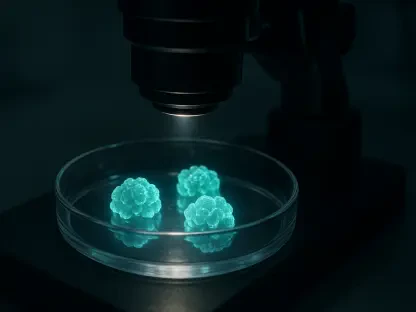

The ability to produce deciliter-scale volumes of organized synthetic tissue within minutes represents a major breakthrough in materials science scalability. This advancement is driven by the development of Jammed Interconnected Bilayer Emulsions, commonly known as JIBEs, which mark a significant departure from the static polymers of the past. Instead of merely providing a surface for biological growth, JIBEs act as active matter platforms that emulate the internal architecture and dynamic communication of living organisms. These materials represent a sophisticated bridge between the inanimate and the biological, offering a structural framework that can sense, process, and respond to its environment. In the current landscape of 2026, the demand for such versatile substances has accelerated across several industries, moving beyond the theoretical confines of laboratory research into tangible engineering applications that require both precision and volume. By integrating the principles of fluid dynamics with molecular biology, this technology addresses the long-standing challenge of creating artificial systems that possess the complexity of human tissue while remaining robust enough for industrial manufacturing and widespread medical distribution.
The Microscopic Architecture of Jammed Emulsions
At a macroscopic level, a JIBE presents as a thick, opaque substance with a consistency similar to toothpaste or a high-viscosity gel, yet its internal reality is far more intricate and organized. Beneath the surface, the material contains billions of individual water-filled compartments per milliliter, each isolated by a microscopic membrane. These droplets are not merely suspended in a medium; they are packed so tightly that they undergo physical deformation, pressing against one another to reach a “jammed” state. This physical phenomenon prevents the droplets from merging or floating freely, resulting in a stable, foam-like configuration that maintains its shape even under moderate mechanical stress. The density of these compartments is comparable to the cellular packing observed in natural human organs, providing a high surface-area-to-volume ratio that is essential for the complex biochemical reactions and signaling processes that define living matter. This architectural foundation ensures that the material is not a hollow shell but a dense, functional network of microscopic units.
The defining characteristic of these jammed emulsions is the way adjacent droplets interact at their points of contact. Where the membranes of two droplets meet, they adhere to form shared bilayers, creating a continuous and interconnected network that spans the entire volume of the material. This structural motif effectively replicates the interface of natural cells, where shared boundaries facilitate the exchange of information and nutrients. Unlike conventional emulsions that might break down or coalesce over time, the connectivity of JIBEs provides them with the structural integrity of a solid while preserving the internal compartmentalization necessary for advanced biological functions. This dual nature allows the material to behave as a single cohesive unit, capable of supporting its own weight in a three-dimensional space without losing the distinct boundaries of its billions of internal compartments. Consequently, the material serves as an ideal platform for engineering synthetic tissues that require specific spatial orientations and localized chemical environments to function correctly.
Breakthroughs in 3D Printing and Scalability
One of the most persistent bottlenecks in the field of synthetic biology has been the inability to move from microscopic samples to usable bulk materials. Until recently, the assembly of droplet-based tissues relied on microfluidic techniques that were painstakingly slow, producing only microliter-scale volumes that were insufficient for practical applications like large-scale implants or industrial filters. JIBEs circumvent this limitation through a self-assembly process that allows for the rapid production of deciliter-scale volumes within minutes. This shift in scale is transformative, as it enables the transition from fundamental research to the mass production of tissue-like substances. The process relies on the spontaneous organization of molecules rather than the mechanical placement of individual droplets, allowing for a level of efficiency that was previously unattainable. This development is particularly relevant in 2026 as the medical field seeks more immediate solutions for tissue replacement and organ modeling that can be deployed at the point of care.
The success of JIBEs in large-scale manufacturing is largely attributed to their unique rheological properties, specifically their possession of a yield stress. In practical terms, this means the material acts as a solid when at rest but flows like a liquid when a specific amount of force is applied, such as the pressure from a 3D-printing nozzle. This characteristic allows for high-fidelity extrusion directly into aqueous environments, where the printed filaments retain their geometric configuration layer by layer without dissipating or collapsing. Unlike other bio-inks that may require secondary support structures or chemical cross-linking after printing, JIBEs are inherently stable upon deposition. This allows researchers to construct complex, multi-layered 3D structures that possess the internal complexity of natural tissue but the structural durability required for long-term engineering use. The ability to print these materials in water is especially significant, as it mirrors the natural environment of biological cells and ensures that the internal components of the JIBE remain hydrated and functional throughout the fabrication process.
Programmable Chemistry and Adaptable Materials
The chemical versatility of JIBEs is rooted in the fundamental physics of amphiphilic molecules, which are compounds possessing both water-loving and water-fearing components. By precisely controlling the mixing conditions of oil and water phases, engineers can encourage these molecules to spontaneously organize into the bilayer-connected networks that define the material. This approach avoids the need for specialized or highly expensive custom chemistry, making the technology accessible for a wide range of research and industrial settings. The underlying physics of self-assembly ensures that the process is consistent and repeatable, regardless of the specific chemicals used, provided they follow the basic principles of amphiphilicity. This robustness allows for a high degree of experimental freedom, enabling scientists to test different molecular combinations to achieve the desired physical characteristics, such as specific membrane thickness or varied internal droplet sizes, which can influence the final properties of the printed tissue.
Because the assembly process is so adaptable, the material can be “programmed” using a variety of different building blocks to suit specific application requirements. For example, using biological lipids as the primary membrane component results in a soft, biocompatible material that is ideal for medical implants and drug delivery systems, as it mimics the natural softness and chemical composition of human cell membranes. In contrast, utilizing synthetic block copolymers provides the mechanical strength and chemical resistance needed for more demanding environments, such as industrial chemical separation or electronic components. This flexibility allows for the creation of hybrid materials where the mechanical stiffness, permeability, and chemical reactivity are all tuned to match a specific biological or technical target. This capability is vital for the development of organ-on-a-chip technologies, where different parts of the device must mimic the varying textures and functions of different human tissues, from the rigidity of bone to the elasticity of skin.
Functionalization and the Future of Active Matter
The true potential of JIBEs is realized when they are functionalized with membrane proteins, such as ion channels, which transform the passive structure into a dynamic, active system. In nature, these proteins act as gatekeepers that control the movement of charged particles across cell membranes, facilitating everything from the transmission of nerve impulses to the contraction of muscles. By embedding these biological components into the shared bilayers of a JIBE, researchers have successfully demonstrated tunable electrical conductance and selective molecular transport. This means the material can be engineered to act as a sophisticated biological filter that only allows certain ions to pass through while blocking others, mimicking the complex sorting functions of the human kidneys. This level of control effectively turns a synthetic gel into an electrically addressable system, capable of responding to external signals in a manner that closely resembles the behavior of living tissue.
Furthermore, the discovery of memristive behavior within these functionalized emulsions has opened new doors for the field of neuromorphic computing. A memristor is a component that retains a memory of the electrical charge that has passed through it, altering its resistance based on its history. Observing this behavior in a soft, water-based material suggests that JIBEs could serve as the foundation for biological-style computing systems that process and store information simultaneously. This development is particularly promising for the field of soft robotics, where machines require a “nervous system” that is as flexible and compliant as their bodies. By utilizing ionic signaling instead of traditional silicon-based electronics, JIBEs allow for the creation of robots that are more integrated with their environments and capable of autonomous sensory processing. This move toward active matter represents a paradigm shift where synthetic materials are no longer just structural components but are active participants in the function and intelligence of the systems they comprise.
Strategic Implementation: Moving Toward Biotic Integration
In the pursuit of standardizing these materials for clinical and industrial use, the focus of research has shifted toward ensuring long-term stability and environmental resilience. Studies conducted through the mid-2020s revealed that while the initial assembly of JIBEs is highly efficient, maintaining the integrity of billions of microscopic membranes over extended periods requires precise atmospheric control or the inclusion of stabilizing agents. To address this, engineers have begun developing protective coatings and specialized storage media that prevent the evaporation of the internal aqueous phase and the degradation of sensitive protein components. These efforts have been instrumental in transitioning the technology from a controlled laboratory setting to more variable field environments. Standardizing the manufacturing protocols has also allowed for more consistent results across different production batches, which is a critical requirement for any material intended for use in human medicine or high-stakes industrial filtration.
Moving forward, the integration of JIBEs with traditional electronic hardware remains a primary area of development for the engineering community. Creating seamless interfaces between the ionic signaling of synthetic tissues and the electron-based signaling of modern computers is essential for the realization of sophisticated bio-hybrid systems. Future work should prioritize the development of conductive hydrogel bridges and specialized sensor arrays that can translate biological responses into digital data. This synergy will likely lead to the creation of advanced prosthetic devices that can communicate directly with the user’s nervous system or intelligent environmental sensors that detect and neutralize toxins in real time. As these materials continue to evolve, the emphasis must remain on the hybridization of biological efficiency and synthetic durability. The path to widespread adoption lies in the ability to refine these interfaces and ensure that the functional benefits of JIBEs can be reliably harnessed across a diverse spectrum of technological applications.