
Traditional medical AI systems often operate in isolation, focusing on either computer vision or natural language processing rather than integrating both into a unified patient profile. In the specialized field of nephrology, this fragmentation often results in a disjointed diagnostic process where imaging data and clinical history remain separate. Researchers at the University of Central Florida are now bridging this gap with Kidney-VLM, an advanced AI platform designed to transform the assessment of renal masses and kidney stones. Led by Associate Professor Pegah Khosravi, the project utilizes a vision-language model architecture to synthesize complex medical data. Supported by a $974,681 grant from the Florida Department of Health’s Casey DeSantis Florida Cancer Innovation Fund, this initiative represents a critical investment in the state’s healthcare infrastructure. By 2026, the team has moved beyond basic algorithms, creating a tool that offers a cohesive understanding of a patient’s condition by combining diverse diagnostic streams into one.
Interdisciplinary Foundations and Collaborative Innovation
Technical Synergy: Advancing Computer Vision and Machine Learning
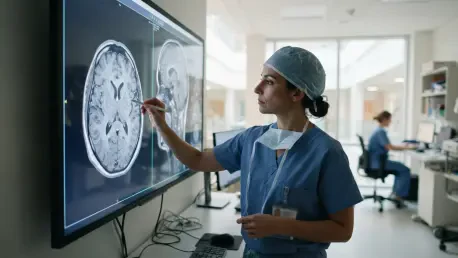
The technical foundation of Kidney-VLM relies on the expertise housed within the UCF Institute for Artificial Intelligence, a facility where computer vision and natural language processing converge. This multi-modal approach is a departure from traditional diagnostic software that merely identifies shapes in an image. Instead, the model is built to understand the context of what it sees. Faculty members like Mubarak Shah, a pioneer in visual reasoning, along with Yu Tian and Chen Chen from the College of Engineering and Computer Science, have engineered a framework capable of processing high-resolution CT scans alongside semantic data. By 2026, the integration of these technologies has enabled the AI to recognize subtle morphological features of a kidney tumor while simultaneously cross-referencing them with the patient’s biochemical markers. This convergence ensures that the AI does not just provide a statistical probability but rather a nuanced clinical assessment grounded in multi-dimensional data points.
Building on this technical framework, the researchers have ensured the model’s reliability by training it on vast, diverse datasets. The computational complexity required to synchronize image recognition with linguistic analysis necessitated a specialized architecture that can handle the high-dimensional space of medical records. This development phase focused on ensuring that the vision and language components were not merely running in parallel but were deeply integrated. Consequently, the system can pinpoint exactly which part of a radiology report corresponds to a specific visual anomaly in a scan. Such precision is vital for creating a tool that can survive the rigorous demands of a hospital environment. The collaboration within the AI MIND Lab has successfully translated these high-level engineering concepts into a functional platform that balances computational efficiency with clinical depth, providing a robust backbone for the next generation of digital health solutions across the Florida medical landscape.
Clinical Integration: Bridging the Gap Between Lab and Clinic
The transition from a laboratory prototype to a practical medical tool requires deep insights from frontline healthcare providers. To achieve this, the Kidney-VLM project incorporates clinical expertise from Abdo Asmar, a professor of internal medicine and nephrologist, and Michael McDonald, a urologic oncologist and surgeon at the AdventHealth Research Institute. These practitioners provide the necessary clinical grounding, ensuring that the AI outputs align with the actual needs of a physician during a patient consultation. By involving medical experts in the development process, the team has been able to tailor the user interface and the decision-support logic to match the reality of hospital workflows. This partnership ensures that the data processed by the AI—such as pathology findings and bloodwork results—is interpreted in a way that is medically relevant. It moves the project beyond academic research and into the realm of tangible clinical utility, where it can directly influence patient outcomes.
Furthermore, this collaboration highlights the importance of the Pegasus Partnership between UCF and AdventHealth, which serves as a conduit for moving innovation from the classroom to the operating room. Surgeons often face high-pressure decisions regarding whether to proceed with a nephrectomy or choose a more conservative observation path. Having an AI assistant that has been vetted by clinical experts like Dr. McDonald provides a layer of validation that is often missing from commercial AI products. The synergy between engineers and clinicians has resulted in a system that speaks the language of medicine while utilizing the power of advanced mathematics. This interdisciplinary approach ensures that the resulting platform addresses real-world challenges, such as the variability in how different radiologists might report a finding. By 2026, this bridge between engineering and medicine has proven essential for creating a tool that doctors can trust as a reliable second opinion during complex surgical planning.
Improving Clinical Outcomes and Patient Safety
Diagnostic Precision: Reducing the Burden of Invasive Procedures
One of the most persistent challenges in renal care is the difficulty of distinguishing between benign masses and malignant tumors through standard imaging alone. Currently, a significant number of patients undergo invasive surgeries to remove masses that are later found to be harmless upon pathological examination. Kidney-VLM addresses this clinical uncertainty by providing a higher degree of diagnostic confidence before any surgical intervention is scheduled. By analyzing the unique features of a mass in conjunction with the patient’s historical health data, the AI can help characterize the tumor with greater accuracy than traditional methods. This capability is designed to reduce the physical and emotional toll on patients who might otherwise undergo unnecessary procedures. For the healthcare system, this shift means a more efficient allocation of surgical resources and a reduction in the costs associated with post-operative care for non-cancerous conditions.
The impact of this increased precision extends beyond avoiding surgery; it also ensures that patients with aggressive cancers are identified and treated more rapidly. The AI’s ability to interpret complex CT scans and correlate them with lab results allows for a more comprehensive staging of the disease. This holistic view is crucial for determining the best course of action, whether it be immediate surgery, targeted therapy, or active surveillance. By 2026, the focus of the Kidney-VLM initiative has shifted toward optimizing these decision-making pathways to ensure that every patient receives a personalized treatment plan. The reduction in diagnostic ambiguity allows clinicians to communicate more clearly with their patients, providing them with evidence-based rationale for the recommended care path. This level of clarity is vital in oncology, where the stakes are high and the window for effective intervention can be narrow, making the AI an indispensable asset in the fight against renal cancer.
Ethical Innovation: Prioritizing Trustworthy and Calibrated AI
The researchers have placed a significant emphasis on creating a trustworthy system, which is a departure from the black box nature of many modern AI applications. Kidney-VLM is designed to be a calibrated model, meaning it does not just offer a diagnosis but also provides a measure of its own certainty. If the AI encounters a scan or a set of clinical data that is ambiguous or outside its training parameters, it explicitly signals this uncertainty to the physician. This feature is critical for maintaining safety in high-stakes medical environments, as it prompts the clinician to seek additional verification or a third opinion. The goal is to reinforce, rather than replace, human judgment. By offering transparent reasoning—where the AI links its suggestions back to specific data points in the patient’s medical record—the system fosters a collaborative relationship between the doctor and the technology, ensuring that the final decision remains in human hands.
In addition to addressing technical and regulatory hurdles, the broader adoption of this technology depended on the ongoing dialogue between AI developers, medical boards, and patient advocacy groups. Establishing clear guidelines for how AI-assisted diagnoses were documented and communicated became a critical priority for the development team. The Kidney-VLM project led these conversations by providing a model for ethical AI deployment that prioritized patient autonomy and physician oversight. As health systems continued to evolve, the integration of multi-modal AI tools became the standard of care in several pilot programs. By 2026, the groundwork laid by the researchers provided the necessary framework for this systemic shift, offering a clear path toward a future where medical technology was more proactive, precise, and patient-centered. Stakeholders focused on continuous improvement, ensuring that the system evolved alongside the latest discoveries to provide the best support for kidney health.