
The ability to dictate the behavior of meta-biomaterials rather than merely observing them represents a significant shift toward precision engineering in the field of tissue regeneration. This evolution marks a departure from traditional synthetic implants that often struggle to replicate the complex, multifaceted nature of human biology. Researchers at the Delft University of Technology have recently unlocked a method to navigate this complexity by addressing the internal architecture of materials at a microscopic level. By moving beyond the chemical makeup of substances and focusing on their structural geometry, scientists can now create scaffolds that behave more like living tissue than static plastic or metal. This progress, detailed in a major study, offers a specialized framework for decoupling material properties that were previously inseparable. This scientific advancement allows for a clearer observation of how specific physical traits influence the growth and repair of bone or cartilage in real-world clinical settings. By isolating factors, engineers can now ensure that every design choice leads to a predictable biological outcome.
The Challenge: Interconnected Material Traits
Limitations: The Problem of Property Coupling
Traditional meta-biomaterials are designed to act as scaffolds, mimicking the mechanical and morphological environment of natural human systems. However, a major hurdle known as property coupling has historically limited the efficacy of these structures. In a standard engineering context, modifying a single geometric parameter—such as the thickness of internal struts to increase overall stiffness—inevitably leads to unintended changes in other critical areas. Increasing stiffness might inadvertently shrink the pore size of the material or dramatically alter its surface area, which then changes how easily fluids and nutrients can circulate through the scaffold.
This interconnectedness makes it almost impossible for biological researchers to determine which specific change caused a cell to react in a certain way. If a bone cell grows faster, is it because the material is stiffer or because the pores are smaller? The lack of independent variables has kept design in a state of observation. Establishing a clear cause-and-effect relationship between material geometry and biological response is the only way to move from general-purpose scaffolds to truly optimized clinical solutions for complex injuries.
Transitioning: From Trial and Error to Precision
This historical scientific stalemate has relegated the development of next-generation medical implants to a process largely defined by trial and error. When multiple variables change simultaneously, the data collected from cell cultures remains ambiguous, preventing the creation of reliable design rules for regenerative medicine. By isolating individual variables like surface area, stiffness, or permeability, the research community can finally move toward a model of precision engineering. The objective is to ensure that every structural adjustment is intentional and its subsequent effect on the human body is fully documented and predictable.
This shift is critical as medical technology advances toward the decade of 2026 to 2036, where the demand for personalized implants will require absolute control over material behavior. By identifying the rare architectural configurations that allow for independent property adjustment, researchers are effectively decoding the mechanical language of cells. This methodology provides a much-needed tool to untangle the complexities of tissue engineering and removes a significant bottleneck in the development of sophisticated medical implants.
Computational Innovation: A Path to Precision
Simulation: Mapping the Vast Design Space
To resolve the puzzle of property coupling, the research team at Delft University of Technology developed a groundbreaking computational framework designed to navigate a massive array of potential material architectures. Led by PhD candidate Ebrahim Yarali and a group of senior experts, the team employed nearly 45,000 high-fidelity computer simulations to explore the vast design space of meta-biomaterials. This massive data set allowed the researchers to hunt for rare geometric configurations where properties that are usually linked could be manipulated independently.
By utilizing advanced computational optimization methods, they were able to sift through millions of possibilities that would be impossible to test manually in a laboratory setting. This digital exploration revealed that specific, unconventional lattice structures could maintain a constant density while significantly altering their mechanical response. Such findings suggest that the internal logic of material design is far more flexible than previously understood, provided one has the computational power to map the hidden relationships within geometric structures.
Optimization: Identifying Design Sweet Spots
The systematic exploration of these digital models allowed the researchers to identify specific “sweet spots” in design that effectively defy standard engineering rules. One of the most significant achievements involved the manipulation of the Poisson’s ratio, which describes how a material thins or thickens when it is stretched. In conventional materials, changing this ratio usually impacts the material’s density or how easily fluids pass through its internal channels. However, the new framework identified architectures where this mechanical trait could be tuned without any impact on nutrient permeability or structural weight.
This level of granular control represents a fundamental shift in the field, allowing engineers to actively dictate the mechanical “language” a material speaks to the surrounding cells. Instead of settling for a compromise between different properties, designers can now target specific mechanical cues that are known to trigger the regeneration of specific tissue types. This optimization ensures that synthetic scaffolds can be engineered with a level of specificity previously found only in natural biological systems.
Biological Integration: Validation and Future Use
Physical Testing: Bridging Digital and Reality
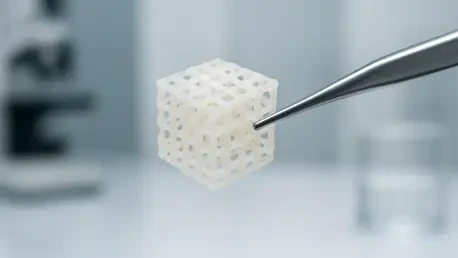
Moving beyond the realm of theoretical simulations, the research team focused on the physical validation of these optimized designs using high-precision 3D printing technologies. They manufactured several physical prototypes of the computationally identified scaffolds to determine if the decoupled properties would translate accurately into the real world. These physical samples were subjected to rigorous mechanical testing and morphological analysis to measure their stiffness, deformation behavior, and fluid flow characteristics.
The experimental results aligned with high accuracy to the computational predictions, confirming that the decoupling achieved in the digital environment remained intact in tangible, 3D-printed scaffolds. This validation is a vital milestone, as it proves that the theoretical framework is a reliable tool for manufacturing real-world medical devices. It ensures that the engineered materials will perform exactly as expected when they are eventually implanted into the dynamic and demanding environment of the human body, providing a safe transition from digital theory to clinical application.
Healing: Targeted Tissue Engineering Solutions
The ability to isolate individual material properties opened significant new doors for studying how human cells interacted with synthetic environments. Researchers conducted experiments where they changed only one variable at a time, such as mechanical resistance, while keeping every other factor—including surface chemistry and pore volume—completely identical. This degree of specificity allowed for the targeted design of scaffolds tailored to the unique requirements of various tissues, such as the high-load environment of a femur or the flexible requirements of cartilage.
As the industry moved forward, this precision led to significantly faster healing times and a higher success rate for long-term implants. Professionals recommended that future research should focus on implementing these decoupled structures in multi-material 3D printing to mimic the gradient properties of natural joints. This advancement established a new standard for biological research and clinical orthopedic engineering, providing the foundation for medical solutions that were as sophisticated as the biological systems they repaired.