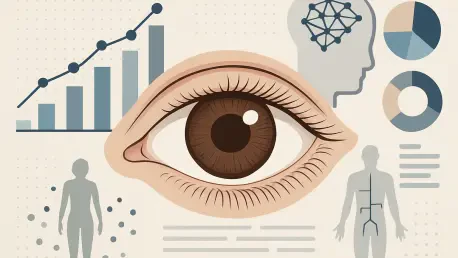

The biological complexity of the human retina offers a uniquely transparent gateway into the body’s cardiovascular and neurological systems through advanced imaging technology. This anatomical window allows clinicians and researchers to observe microvascular and neural health in real-time without the need for invasive surgical procedures. As the healthcare industry moves toward more data-driven and preventative models, the field of oculomics—the study of the eye as a reflection of systemic health—has emerged as a transformative frontier. By applying artificial intelligence to retinal photographs, medical professionals can now detect patterns associated with chronic conditions that were previously considered invisible to the naked eye.
The Rise of Oculomics in Digital Health
Market Evolution and Adoption Statistics
The field of oculomics has experienced a monumental surge in research interest and clinical focus following the widespread recognition of advanced frameworks like Reti-Pioneer. This shift reflects a desperate need to address the staggering global metabolic disease burden, where conditions like Type 2 Diabetes (T2DM) and hypertension continue to strain healthcare infrastructures. Traditional diagnostic methods often require invasive blood draws and expensive laboratory work, creating a significant barrier to frequent, large-scale population screening. In contrast, AI-powered retinal analysis offers a non-invasive, scalable solution that meets the rising demand for preventative medicine in an aging global population.
Statistical performance data from recent studies highlights why this technology is gaining rapid traction across the medical landscape. AI models have demonstrated impressive accuracy, achieving AUROC scores of 0.83 for conditions like gout and T2DM and reaching as high as 0.90 for osteoporosis in specific demographics. This precision is driven by a fundamental shift in technical architecture; the industry is moving away from narrow, single-task models toward sophisticated foundation-model ensembles. Systems like RETFound and the Swin Transformer allow for a deeper understanding of retinal morphology, enabling the detection of subtle systemic signatures that reflect the internal state of the patient.
Real-World Applications and Notable Frameworks
The Reti-Pioneer framework stands as a premier case study in the power of multimodal learning using Color Fundus Photographs (CFPs). By integrating high-resolution visual data with structured clinical metadata, this architecture contextualizes retinal patterns within a patient’s broader medical history. This approach has proven particularly effective in resource-limited settings, such as hospital registries in China and diverse multi-ethnic cohorts in Singapore. The success of these applications suggests that oculomics can function as a high-throughput triaging system, ensuring that patients in underserved regions receive critical health assessments without the need for specialized laboratory equipment.
Beyond autonomous detection, the integration of AI provides a significant “boost” to human clinical performance in diverse medical environments. Studies show that when retinal specialists use AI as a decision-support tool, their accuracy for detecting complex conditions like gout can jump from a baseline of 51% to a robust 79%. This synergy has led to the transition of these models from laboratory prototypes to “prospective silent trials” in primary care clinics around the world. These trials allow researchers to evaluate AI performance in real-time workflows, preparing the ground for full-scale integration into daily medical practice while ensuring that patient safety and diagnostic reliability remain the primary priorities.
Expert Perspectives on AI-Driven Diagnostics
Specialists in ophthalmology are increasingly viewing the eye not just as a sensory organ, but as a comprehensive systemic health indicator. The retina remains the only site in the body where microvasculature and neural tissue can be directly observed, making it a natural laboratory for studying chronic disease progression. Experts argue that the ability to visualize these structures provides a “living biopsy” of the patient’s internal state. Consequently, the role of the retinal specialist is expanding to encompass a broader scope of systemic health monitoring, bridging the gap between ophthalmology and internal medicine in a way that was never before possible.
Addressing the “black box” problem is a top priority for researchers seeking to gain long-term clinical trust in machine learning applications. To provide biological interpretability, experts are linking AI-detected retinal features to plasma protein signatures and using saliency maps to visualize exactly where the model is focusing its attention. This transparency helps clinicians understand the biological rationale behind an AI’s prediction, transforming a statistical output into a actionable clinical insight. Despite these advancements, medical professionals maintain a strong consensus that AI must serve as a decision-support tool rather than a replacement for human judgment and clinical experience.
There is also a palpable sense of caution regarding the logistical and regulatory hurdles that accompany such a disruptive technology in modern medicine. Integrating AI-driven oculomics into existing healthcare systems requires seamless data interoperability and rigorous adherence to evolving medical standards and privacy laws. Furthermore, specialists emphasize the necessity of maintaining “gold standard” laboratory backups to verify AI findings in critical cases. While the potential for improved clinical efficiency is high, the medical community remains committed to ensuring that technological speed does not compromise the accuracy and reliability of patient diagnoses or treatment plans.
Future Outlook and Industry Implications
The industry is currently witnessing a transition from reactive “sick care” to proactive, longitudinal health monitoring through the power of the retina. Advanced algorithms are now capable of providing five- and ten-year disease onset predictions, allowing for interventions long before physical symptoms manifest. This shift has profound implications for global health equity, as low-cost fundus cameras can be deployed in rural or low-income areas to provide high-quality screenings. By identifying at-risk individuals early, healthcare providers can focus resources on prevention, potentially saving billions in long-term treatment costs for chronic complications associated with heart and kidney disease.
Achieving perfect generalizability across diverse ethnic demographics remains one of the most significant challenges for the next phase of global development. AI models must be trained and validated on diverse datasets to ensure that predictive accuracy does not falter when applied to different populations with unique genetic backgrounds. This requirement will likely drive an increase in multicenter randomized controlled trials to establish the necessary evidence base for global regulatory approval. Additionally, the commercial potential of this technology is bolstered by high levels of user acceptance, with a majority of patients expressing a willingness to pay for non-invasive preventative screenings.
However, the widespread adoption of predictive oculomics also introduces complex ethical and management dilemmas for modern society. There is a risk of over-reliance on technology, where clinicians might defer to AI even when clinical signs suggest otherwise. Moreover, managing “at-risk” patients who are identified by AI before they are technically ill creates a new category of medical supervision and ethical responsibility. Developing protocols for how to handle these pre-symptomatic cases will be essential to ensure that AI insights lead to improved health outcomes rather than unnecessary anxiety or over-treatment for the general population.
Summary and Strategic Takeaways
The recalibration of the retina as a non-invasive window into the body’s microvasculature and neural tissue changed the trajectory of preventative diagnostics. By leveraging the eye’s unique anatomy, AI-powered frameworks bridged the gap between specialized ophthalmology and general systemic health. The technical milestones achieved through multimodal foundation models demonstrated that complex metabolic signatures were detectable through simple imaging. These advancements moved the needle from theoretical research toward a practical tool for population-scale health screening.
The successful transition of these technologies into clinical settings required a balance of innovation and rigorous validation. Strategic implementation focused on enhancing human expertise rather than replacing it, which smoothed the path for professional and patient acceptance. As the field matured, the focus shifted toward longitudinal prediction and global scalability, making healthcare more accessible and proactive. This evolution established oculomics not as a replacement for traditional methods, but as a foundational cornerstone of a modern, data-driven approach to maintaining human health.