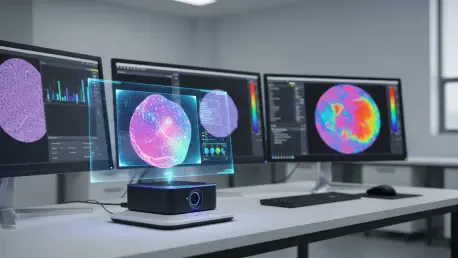

The rapid transformation of modern oncology is currently being defined by a sophisticated fusion of optical engineering and deep learning algorithms that are effectively replacing traditional microscopic evaluations. As the global cancer burden continues to rise, the necessity for diagnostic tools that are not only precise and objective but also highly scalable has pushed computational pathology to the absolute forefront of medical innovation. This evolution represents a fundamental shift from manual tissue analysis to integrated AI platforms, specifically highlighting how advancements like lensfree holography are systematically dismantling the barriers that once limited high-end diagnostic services to elite urban institutions. By merging affordable hardware with high-performance software, the medical field is entering a period where the democratization of pathology is no longer an aspiration but a functional reality for healthcare systems worldwide.
Market Evolution and Adoption Dynamics
Global Growth and Performance Statistics
The transition toward digital pathology has progressed from a niche luxury of well-funded research centers into a standard requirement for clinical consistency across the medical sector. Recent data suggests that AI-driven frameworks are now reaching levels of accuracy that rival or exceed those of human specialists, with specialized models demonstrating a 94.8% success rate in binary HER2 scoring. This specific metric is vital for breast cancer treatment, as it determines whether patients are eligible for life-saving targeted therapies. Adoption rates are also accelerating due to the sheer efficiency of these newer imaging methods; while traditional scanners often struggle with bulky components and slow processing times, emerging computational systems can now achieve a throughput of 84 mm² per minute across a massive field of view.
This surge in adoption is not merely a technological trend but a response to a critical global shortage of specialized medical personnel. By 2027 and throughout the following decade, the industry expects a significant increase in the integration of automated workflows to compensate for the growing volume of tissue samples. The standardization offered by digital platforms allows for a more fluid movement of diagnostic data between different healthcare providers, which in turn facilitates faster second opinions and more robust clinical trials. As the accuracy of these systems continues to improve, they are increasingly being viewed as the primary baseline for patient assessment rather than a secondary verification tool.
Transformative Real-World Applications: The Lensfree Breakthrough
A significant milestone in this trend is the emergence of lensfree holography platforms which utilize RGB laser lighting and ensemble deep learning instead of expensive objective lenses. Researchers have successfully managed to reduce the cost of such diagnostic hardware to less than $980, making it possible for smaller clinics to perform automated HER2 scoring without investing hundreds of thousands of dollars in traditional equipment. This shift is transformative because it removes the reliance on heavy, fragile mechanical stages that are difficult to maintain in decentralized environments. The resulting devices are portable, durable, and capable of high-resolution imaging that was previously restricted to centralized laboratory settings.
These systems incorporate advanced uncertainty quantification via Bayesian Monte Carlo dropout, which allows the software to recognize its own limitations by flagging ambiguous cases for human review. In recent large-scale trials, this mechanism effectively filtered out over 30% of high-complexity cases that might have otherwise resulted in misclassification, ensuring that the AI acts as a reliable partner to the pathologist. By prioritizing samples that require human expertise, these platforms optimize the diagnostic pipeline and ensure that limited medical resources are directed where they are most needed. This tiered approach to diagnosis balances the speed of automation with the nuance of human judgment, creating a more resilient healthcare infrastructure.
Expert Perspectives on Automated Diagnostics: The Objective Shift
Medical professionals increasingly view the primary value of these automated systems as their ability to eliminate the subjective variance that often plagues manual tissue scoring. Even highly experienced pathologists can differ in their interpretation of borderline samples, leading to potential inconsistencies in treatment plans that can negatively affect patient outcomes. Experts argue that AI-driven computational pathology establishes a consistent and objective baseline that remains stable across different labs and geographic locations. This standardization ensures that a patient in a rural setting receives the same diagnostic rigor as one in a metropolitan center, effectively closing the gap in care quality.
The consensus among industry leaders is that the most effective implementation of this technology involves a collaborative model where the AI functions as a first-line screening tool. The focus has shifted toward creating self-aware systems that proactively identify samples requiring secondary human validation. This approach allows the technology to handle the massive volume of routine screenings while reserving human expertise for the most nuanced and difficult cases. By streamlining the diagnostic workflow, these platforms are helping to solve the global shortage of trained pathologists, allowing current professionals to focus on complex decision-making and patient management rather than repetitive manual counting tasks.
Moreover, proponents of these digital shifts point out that the integration of AI allows for the discovery of sub-visual patterns in tissue samples that the human eye cannot detect. These “hidden” biomarkers can provide deeper insights into how a tumor might respond to specific immunotherapies or chemotherapy regimens. This level of granular detail was previously unattainable through traditional microscopy alone, marking a shift from descriptive pathology to predictive pathology. As experts continue to validate these findings, the role of the pathologist is evolving from a technician of the microscope to a curator of complex biological data.
The Future Landscape of Computational Pathology: Toward Decentralization
The diagnostic environment is moving toward a state of complete decentralization, where high-level diagnostic power is no longer confined to major hospitals. Portable and modular devices are expected to become commonplace, utilizing simplified light modes to reduce costs while maintaining clinical utility in remote and resource-limited regions. This shift promises to significantly reduce turnaround times for cancer diagnoses, which is often the most critical factor in successful patient outcomes. As these systems become more integrated into the standard medical infrastructure, the friction between traditional methods and digital workflows is expected to diminish entirely until they become a singular, unified standard of care.
Despite these advancements, the path forward requires addressing significant regulatory hurdles and ensuring that digital infrastructures are robust enough to handle the massive data loads generated by high-resolution imaging. The integration of these tools into existing hospital records systems must be seamless to avoid creating new bottlenecks in clinical environments. Furthermore, as the hardware becomes even more affordable, the focus will likely shift from the devices themselves to the sophistication of the global data networks that connect them. This connectivity will allow for real-time peer review and the constant refinement of AI models through a continuous influx of diverse, global diagnostic data, ensuring that the technology remains at the cutting edge of oncology.
The Road Toward Scalable Precision Medicine
The medical community successfully recognized that the structural bottleneck of expensive and centralized diagnostics required a radical technological departure from conventional manual microscopy. By combining lensfree holography with sophisticated ensemble neural networks, healthcare systems moved closer to a future where high-impact oncology tools were accessible to any clinic regardless of budget or size. The transition from subjective manual scoring to objective, automated analysis represented a pivotal moment in the history of precision medicine. It became clear that the democratization of pathology was not just about lowering costs but about ensuring equitable and timely cancer treatment for all patients globally. To fully capitalize on this progress, healthcare providers began prioritizing the integration of these digital platforms into daily workflows, ensuring that the benefits of AI-enhanced analysis were felt directly at the point of care. Moving forward, the focus must shift toward expanding these diagnostic capabilities to include a wider range of cancers and establishing international data standards to facilitate seamless global collaboration.