
The biological monopoly held by the standard twenty amino acids has finally met its match in a laboratory environment that prioritizes chemical versatility over the stubborn requirements of cellular survival. For decades, the progress of synthetic biology was tethered to the growth cycles and metabolic tolerances of living organisms, particularly E. coli. While these biological workhorses served the industry well, they acted as a restrictive bottleneck when scientists attempted to rewrite the genetic code. The emergence of the AGENTEX (Automated Genetic tRNA Expansion) platform signifies a departure from this living constraint, moving the theatre of operation from the crowded cytoplasm of a cell to the controlled precision of a test tube. This transition represents more than a technical upgrade; it is a fundamental shift in how humanity approaches the manufacture of functional matter.
Introduction to Synthetic Protein Engineering and the AGENTEX Platform
The core principle of synthetic protein engineering involves hijacking the translation machinery that converts genetic instructions into physical proteins. In nature, this process is remarkably conservative, relying on a fixed set of building blocks that has remained largely unchanged for billions of years. To move beyond this evolutionary plateau, researchers have spent years attempting to “recode” organisms to accept non-natural amino acids. However, the complexity of a living cell often rebels against such modifications, leading to decreased viability or total systemic failure. AGENTEX emerges as a sophisticated response to these hurdles, providing a platform where the genetic code can be expanded without the life-or-death stakes of traditional genetic engineering.
This technology arrived at a moment when the pharmaceutical and materials industries were desperate for molecular diversity. By decoupling protein synthesis from the biological imperative of reproduction, the system allows for the creation of “designer” proteins with properties previously considered impossible. It functions as a bridge between classical chemistry and molecular biology, utilizing the efficiency of ribosomes while shedding the baggage of the genome. In the broader technological landscape, this represents a move toward biological manufacturing that looks more like a predictable assembly line and less like an unpredictable agricultural process.
Core Components of the AGENTEX System
The Cell-Free Lysate Paradigm
One of the most significant features of this technology is its reliance on cell-free lysate solutions. These solutions consist of a concentrated mixture of enzymes, energy-generating molecules, and the protein-building machinery harvested from cells, but without the restrictive cell membranes. By removing the need to keep a cell “happy” or alive, the system can dedicate 100% of its resources to the specific task of synthesizing the desired protein. This creates a high-yield environment where toxicity, which often kills living bio-reactors, is no longer a primary concern for the operator.
The performance of these lysate systems is measured by their ability to maintain high rates of translation outside of a biological context. In practice, this means that proteins containing exotic, non-natural components can be produced at scales and speeds that were unattainable in live-cell cultures. The significance of this paradigm lies in its flexibility; researchers can fine-tune the chemical environment—adjusting pH, temperature, and reagent concentrations—with a level of granularity that would be lethal to a living organism. This precision allows for the robust production of proteins that are otherwise difficult to fold or assemble.
Automated Genetic tRNA Expansion (AGENTEX) Workflow
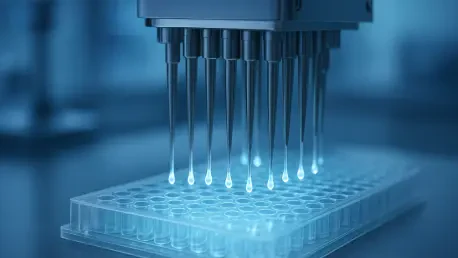
The workflow of the AGENTEX system integrates high-throughput robotics with sophisticated design software to manage the complexity of expanded genetic codes. Because the system can handle dozens of different amino acids simultaneously, the manual labor of traditional biology would be insufficient to manage the permutations. Instead, the process is automated using open-source liquid-handling robots that execute complex pipetting schedules with extreme accuracy. This automation ensures that each synthetic reaction is consistent, reproducible, and scalable across thousands of variants in a single run.
From a technical perspective, the workflow functions as a high-speed prototyping engine. It allows researchers to screen vast libraries of protein designs to identify which specific combinations of non-natural amino acids provide the best stability or therapeutic effect. Real-world usage has shown that this automated approach reduces the time required for protein optimization from months to days. By treating protein design as an iterative engineering task rather than a slow biological experiment, the platform accelerates the transition from a theoretical molecular design to a tangible product ready for testing.
Breakthrough Innovations in Genetic Code Expansion
Breaking Biological DogmThe tSCAN Discovery
The discovery of non-CCA tRNA tails represents a genuine disruption of biological dogma. For a century, the scientific consensus was that every transfer RNA molecule must end in the specific three-letter sequence CCA to be recognized by the ribosome. The development of the tSCAN tool allowed researchers to systematically challenge this rule, discovering that alternative sequences like CGA are not only functional but can be used to create “stealth” production lines. These custom tRNAs operate on a different frequency than natural ones, ensuring that the synthesis of synthetic proteins does not interfere with the essential functions of the remaining biological machinery.
This discovery enables the creation of orthogonal translation systems, where synthetic proteins are built on a dedicated track separate from the rest of the cell’s output. By utilizing these unique tail sequences, engineers can design “private” ribosomes that only interact with “private” tRNAs carrying non-standard amino acids. This level of exclusivity prevents cross-reactivity, which was a major source of error and inefficiency in earlier iterations of genetic code expansion. It provides a level of control over molecular assembly that was previously unimaginable, effectively allowing for the side-by-side existence of two different genetic codes in one reaction.
Expanding the Amino Acid Alphabet
The leap from a standard 20-amino-acid palette to a 34-amino-acid system is the crowning achievement of this technological evolution. By bypassing genomic constraints, the platform can utilize redundant codons—the “spare” sequences in the genetic code—to represent entirely new chemical entities. This expansion allows for the introduction of functional groups that nature never intended for proteins, such as fluorinated residues for increased stability or photo-reactive groups that allow proteins to be “switched” on and off with light.
This shift effectively doubles the chemical diversity available to protein engineers. The ability to incorporate 34 distinct building blocks means that proteins can now be engineered to possess the durability of synthetic plastics while maintaining the specific functional capabilities of biological enzymes. This is not merely an incremental improvement but a fundamental expansion of the building blocks of life. It allows for the creation of molecules that can survive the harsh conditions of the human stomach or the industrial heat of a chemical reactor, environments where natural proteins would typically unravel and fail.
Technological Trends and Industry Evolution
The current trajectory of the industry is defined by a clear move toward “software-defined” biology. As the AGENTEX platform matures, the focus is shifting from the wet-lab mechanics to the computational models that predict how these 34-amino-acid proteins will behave. This trend is driven by the convergence of massive biological datasets and the increasing availability of affordable laboratory automation. We are seeing a transition where the primary value in protein engineering is no longer the ability to perform the synthesis itself, but the proprietary knowledge of how to design the most effective synthetic sequences.
Moreover, there is a visible shift in industry behavior toward decentralized, small-scale manufacturing. Rather than relying on massive fermentation tanks that are prone to contamination, companies are looking toward modular, cell-free systems that can be deployed locally. This evolution is influenced by the need for personalized medicine, where a specific therapeutic protein might only be needed for a handful of patients. The ability to quickly and safely manufacture complex proteins on demand, without the biological risks associated with live genetically modified organisms, is becoming the gold standard for the next generation of biomanufacturing.
Real-World Applications and Sector Impact
Pharmaceutical and Therapeutic Development
In the pharmaceutical sector, this technology is being deployed to overcome the limitations of conventional monoclonal antibodies and peptide drugs. Standard proteins are often rapidly cleared by the human body or lack the necessary binding affinity to target elusive disease markers. By incorporating non-natural amino acids, developers can create “stapled” peptides that are locked into their active shapes, significantly increasing their potency and half-life. This enables the creation of oral versions of drugs that previously required injection, as the synthetic components can protect the molecule from digestive enzymes.
Furthermore, the technology allows for the design of targeted cancer therapies with unprecedented precision. Synthetic proteins can be engineered with “click-chemistry” handles, allowing toxic payloads to be attached only after the protein has reached the tumor site. This minimize collateral damage to healthy tissues, a perennial challenge in oncology. The impact on drug discovery is profound, as researchers can now explore a chemical space that was once considered the exclusive domain of small-molecule synthetic chemistry, but with the high specificity of biological proteins.
Advancements in Materials Science and Environmental Remediation
Beyond medicine, the implementation of expanded protein codes is revolutionizing materials science. Researchers are developing bio-fabricated materials that combine the self-assembling properties of proteins with the mechanical strength of industrial polymers. For example, spider silk proteins can be enhanced with synthetic cross-linkers to create fibers that are stronger than steel yet biodegradable. These materials offer a sustainable alternative to petroleum-based plastics, providing a path toward carbon-neutral manufacturing in industries ranging from aerospace to textiles.
In the realm of environmental remediation, unique use cases are emerging for custom enzymes designed to degrade persistent pollutants. Natural enzymes are often too fragile to function in contaminated soil or wastewater. However, by using the AGENTEX system to incorporate stabilizing non-natural amino acids, scientists have created rugged “extremophile” enzymes capable of breaking down complex microplastics and chemical toxins. This implementation demonstrates how synthetic protein engineering can address ecological challenges that natural evolution has not yet had the time to solve.
Technical Challenges and Operational Hurdles
Despite its potential, the technology faces significant technical hurdles, particularly regarding the folding of complex proteins containing multiple non-natural residues. While the AGENTEX system can successfully incorporate these building blocks, ensuring they settle into the correct three-dimensional structure remains a challenge. If a protein misfolds, it becomes non-functional or even toxic, negating the benefits of its expanded chemistry. Ongoing development efforts are focused on integrating chaperone proteins into the lysate mix to assist in the folding process, though this adds another layer of complexity to the reaction.
Regulatory and market obstacles also play a role in limiting widespread adoption. The cost of producing synthetic amino acids remains high, as they must be manufactured through traditional chemical synthesis before being fed into the AGENTEX workflow. Additionally, regulatory bodies like the FDA have not yet established a standardized framework for evaluating proteins with non-standard genetic codes. This lack of clear guidance creates uncertainty for companies looking to move these molecules into clinical trials, potentially slowing the commercialization of the most innovative synthetic therapies.
The Future Landscape of Protein Engineering
The direction of this field points toward a future where biology becomes a fully programmable medium. As the number of available amino acids continues to grow, the distinction between “natural” and “synthetic” will become increasingly blurred. We are likely to see the emergence of fully synthetic organisms that operate entirely on expanded codes, though these will likely remain confined to secure industrial environments. The long-term impact on society could be a complete reimagining of the supply chain, where everything from fuels to medicine is grown in a vat using digital blueprints.
Potential breakthroughs in the coming years will likely involve the integration of real-time sensor feedback into the AGENTEX system. This would allow the platform to self-optimize, adjusting the concentration of tRNAs and amino acids on the fly to maximize yield and purity. As the cost of these systems drops, we may see a democratization of protein engineering, where small research teams can design and build complex molecular machines that were once the exclusive domain of multi-billion-dollar corporations. The long-term trajectory is one of increasing complexity, decreasing cost, and limitless chemical possibility.
Summary and Final Assessment
The review of the AGENTEX platform revealed a technology that successfully bypassed the historical limitations of cell-based protein synthesis. By moving to a cell-free environment and utilizing automated workflows, the system expanded the functional amino acid alphabet to 34, a feat that defied biological conventions. The discovery of alternative tRNA tail sequences provided the necessary orthogonality to ensure that these synthetic processes remained distinct and efficient. While challenges related to protein folding and the cost of raw materials remained, the technological shift toward automated, high-throughput molecular design was undeniable.
The integration of AGENTEX redefined the boundaries of what was achievable in both pharmaceutical and materials engineering. The platform proved its value by accelerating the development of stable therapeutics and high-performance biopolymers that natural evolution could not produce. Moving forward, the industry must prioritize the standardization of these synthetic building blocks and the refinement of computational folding models. The transition from discovery to widespread implementation required a concerted effort to scale production and lower entry barriers for smaller laboratories. Ultimately, the shift toward a programmable, cell-free protein economy established a new foundation for the biotechnology sector.