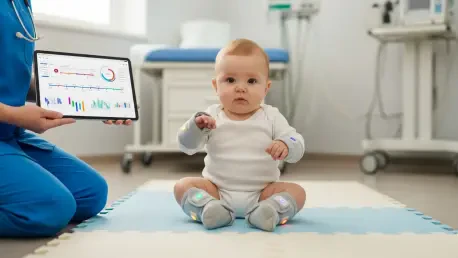

Tiny sensors wrapped around a baby’s wrists and ankles promise to turn fleeting clinic snapshots into a living record of early motor development, offering a clearer path to timely identification and support when every month of neuroplasticity still counts. These wearables, paired with analytics, aim to make subtle movement differences visible months before social-communication concerns crystallize. The UCLA Health research program led by pediatric neurologist Dr. Rujuta Wilson places this vision under rigorous test, asking whether fine-grained, home-based motion data can reliably forecast developmental outcomes and steer clinical workflows.
The stakes are high: pediatric checkups excel at tracking milestones but often miss nuanced kinematics that signal risk. By translating raw acceleration and rotation into interpretable patterns of variability, coordination, and smoothness, this approach reframes early surveillance as continuous, objective, and ecologically valid. Moreover, it seeks to balance sensitivity with clinical pragmatism—surfacing children who might benefit from closer observation while minimizing unnecessary alarms.
Core Concepts and Context of Infant Movement Sensing
Infant movement sensors are lightweight wearables built around inertial measurement units that capture acceleration and angular velocity across multiple axes. Worn during daily routines, they convert raw signals into quantifiable kinematics, revealing the tempo and texture of early motor control rather than only its milestones. The core principle is simple but powerful: measure more, in natural settings, to see earlier.
Behind the scenes, the system combines hardware, firmware, and secure logging or streaming with an analytics pipeline and clinician-facing dashboards. This stack elevates movement from a subjective impression to a structured dataset aligned with developmental constructs. Clinically, the appeal is clear; motor differences often precede social signs of autism and can constrain exploration, which in turn shapes language and social learning. In contrast to occasional clinic observations, longitudinal sensing captures day-to-day variability—the stuff that often hides in plain sight.
The UCLA Health Longitudinal Program: Study Design and Scope
The UCLA Health program, funded by NINDS for $3.1 million over five years, began in January and is slated to conclude in December 2030. It targets a high-likelihood cohort—about 120 infants with an older autistic sibling—to concentrate signal detection within a feasible sample. This study window, spanning ages 3 to 12 months with assessments every three months, brackets the period when foundational motor systems organize rapidly.
At each visit, sensors embedded in soft wrist and ankle warmers record naturalistic movement at home, while behavioral assessments provide standardized context. Outcome evaluations at 12 and 24 months tie early signatures to later diagnoses. The objectives are both scientific and translational: validate variability-based metrics, build an interpretable composite predictor, ensure reliability in diverse homes, and map a path for integration into primary and specialty care. Families receive regular feedback, with clear communication about what the data can and cannot infer.
Hardware, Data, and Analytics Pipeline
Wearable Form Factor and Sensing Modalities
The devices anchor to wrists and ankles with comfort-focused warmers that reduce slippage and skin irritation, a key factor for adherence across months. Safety features limit small parts and keep charging routines simple, while sealed enclosures protect sensors from drool, baths, and daily jostling.
Functionally, triaxial accelerometers and gyroscopes capture linear and rotational dynamics that inform movement variability, rhythm, and symmetry. The form factor matters: limb-mount placement preserves sensitivity to fine motor exploration and bilateral coordination, whereas torso-only devices often miss distal nuance. Battery life and onboard storage are tuned to cover extended home sessions without data gaps.
Sampling, Synchronization, and Data Quality
Sampling rates are set high enough to resolve infant micro-movements yet low enough to conserve power and storage, typically in the tens to low hundreds of hertz. Precise time synchronization across sensors is essential to assess interlimb coordination; drift correction and clock calibration prevent spurious asynchrony from masquerading as clinical signal.
Home environments introduce artifact—from swaddles to caregiver handling. The pipeline flags non-wear periods, saturations, and repetitive environmental vibrations. Missing data strategies prioritize transparency: segments are imputed only when statistical assumptions hold, and confidence intervals reflect uncertainty. Consistency checks across sessions ensure measurement comparability over the study’s timeline.
Feature Engineering and Movement Metrics
Feature engineering translates raw IMU streams into interpretable markers of neurodevelopment. Variability metrics quantify dispersion of movement amplitudes and intermovement intervals, which may index early neural control stability. Coordination features capture phase relationships between limbs, flagging asymmetries or delayed coupling.
Other indicators—periodicity, intensity profiles, smoothness, and proxies for object interaction—expand the lens from “how much” to “how well.” These features are anchored to clinical theory: smoother, well-timed actions often reflect maturing motor plans, while erratic patterns can indicate atypical circuitry. Importantly, the study tests whether composite patterns outperform any single metric.
Machine Learning Models and Validation Strategy
Modeling blends classification and regression to estimate individual risk and forecast developmental scores. Cross-timepoint approaches track trajectories, learning how early changes predict later outcomes. Training and validation splits guard against leakage across visits from the same infant, and calibration curves test clinical reliability, not just accuracy.
Interpretability is central. Techniques such as feature attribution and sparse modeling help clinicians see why a given risk estimate arises, preventing black-box recommendations. The bar is usefulness, not novelty: models must add value beyond milestone checks, maintain performance across homes, and flag actionable next steps rather than opaque scores.
Behavioral Assessments and Multimodal Integration
Standardized behavioral tools run alongside sensor collection to ground predictions in recognized developmental frameworks. By aligning sensor metrics with constructs like motor planning and attention, the study connects kinematic patterns to functions that clinicians already track.
Linking early signatures to 12- and 24-month outcomes tests not just correlation, but durability and clinical meaning. In the longer term, integration with video or caregiver-reported measures could clarify ambiguous cases and reduce false alarms, strengthening both sensitivity and specificity.
Data Security, Privacy, and Family-Centered Design
The program de-identifies data at ingestion, stores it securely, and limits access to authorized personnel. Consent processes emphasize what is collected, how it is used, and how results are communicated, reflecting the sensitivity of home-based monitoring.
Family-centered design keeps the system minimally intrusive and culturally responsive. Materials in multiple languages, flexible scheduling, and clear feedback reduce burden and enable participation from diverse households—crucial if the technology is to serve broad pediatric care.
Developments and Emerging Trends in the Field
The field is pivoting from episodic screenings to continuous home monitoring that captures real behavior. Early pilot studies suggest movement variability is a sensitive indicator, but standardized reporting and replication are tightening claims and curbing hype. Edge processing is gaining ground to protect privacy and cut bandwidth while enabling timely feedback.
Clinically, objective sensor data is shifting behavior from “wait and see” toward proactive surveillance, especially in infants with known risks. There is also a widening lens: features first explored for autism risk now inform broader neurodevelopmental profiles, recognizing overlapping motor phenotypes across conditions.
Real-World Applications and Notable Implementations
In primary care, these tools could augment well-child visits by surfacing subtle concerns earlier, without displacing clinician judgment. Specialty clinics and early intervention programs can use longitudinal movement profiles to focus resources where they matter most and to monitor response to therapy.
As a model implementation, the UCLA Health study demonstrates how home-based sensing, standardized assessments, and machine learning can be woven into a longitudinal platform geared for clinical translation. The program’s emphasis on interpretability, reliability, and family engagement positions it as a practical test bed rather than a lab-bound proof of concept.
Limitations, Risks, and Barriers to Adoption
Sensitivity and specificity pull in opposite directions: detect more at-risk infants, and false positives may rise. Since early motor differences occur across multiple developmental paths, models must communicate uncertainty and support staged follow-up rather than binary verdicts.
Generalizability is another hurdle. A high-likelihood cohort is ideal for signal discovery but may not reflect population-level prevalence or diversity. Regulatory standards, reimbursement, workflow integration, and training all shape adoption, while technical pitfalls—battery failures, data loss, interoperability—can erode trust if not addressed systematically.
Outlook and Future Directions
Key next steps include validation in larger, more diverse cohorts and pragmatic trials that measure outcomes, costs, and equity impacts. Multimodal fusion with video, audio, and caregiver input could improve specificity for complex cases, while on-device analytics may deliver real-time cues during natural play.
Explainable AI will remain pivotal for clinician trust and family understanding. Policy frameworks and standards will determine how data moves across systems, how models are monitored for drift, and how payers recognize value when improvements hinge on earlier, not just cheaper, care.
Summary and Overall Assessment
The evidence to date suggests that early motor signatures are meaningful, wearable sensing is feasible at home, and composite metrics can outpace milestone-only checks. The UCLA Health program charted a credible path from discovery to clinic by pairing rigorous methods with family-centered design and clear integration goals.
This technology distinguished itself by capturing continuous, ecologically valid motion, aligning features with clinical constructs, and insisting on interpretability and workflow fit. It also faced real constraints: balancing accuracy with generalizability, navigating regulation and reimbursement, and safeguarding privacy in home settings. The most actionable next steps were broader validation, multimodal integration, and edge analytics, with pragmatic trials to quantify impact on referrals and intervention timing. If those pieces came together, infant movement sensing would have moved from promising research to a reliable layer of pediatric surveillance—one that quietly extended clinicians’ reach into the moments that matter most.