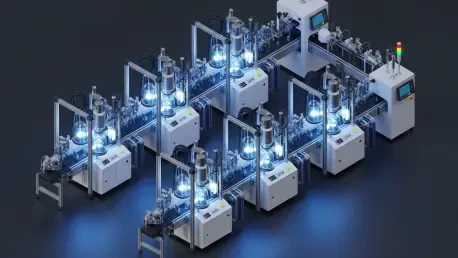

The traditional approach to developing soft materials like specialized polymers and healthcare-essential liquids has historically relied on manual, labor-intensive cycles that frequently stall progress for years at a time. To address these systemic bottlenecks, the University of Chicago and Argonne National Laboratory launched the Polymeric Liquidity and AI-Robotic Interactive System, known as PoLARIS, supported by a significant twenty-million-dollar investment from the National Science Foundation. This initiative established a remotely accessible, robotically operated laboratory ecosystem that allows researchers to orchestrate complex chemical experiments through cloud-based interfaces. By prioritizing digital orchestration over physical presence, the program modernizes the fundamental ways scientists synthesize the building blocks of future technologies. The system creates a pipeline where discovery occurs within a precision-controlled environment, bridging the gap between theoretical modeling and physical implementation.
Bridging Global Talent: Democratizing Scientific Tools
Central to this leap is the development of a distributed operating system for discovery that merges artificial intelligence with high-performance data infrastructure. One primary objective of this architecture is the democratization of high-end scientific tools, ensuring that researchers at smaller institutions or resource-constrained companies can utilize elite hardware. By eliminating the necessity for multi-million-dollar on-site equipment, the platform levels the playing field for innovation across the material sciences.
The practical application of this system means a scientist anywhere can program and monitor a sophisticated robot housed in a Chicago facility. This capability turns what was once a localized laboratory into a communal asset that functions continuously regardless of geographic location. Such an arrangement reduces the carbon footprint associated with scientific travel while maximizing the utility of every machine within the network. This fosters an environment where talent dictates the pace of progress.
Integrating Intelligence and Engineering: The Fusion of Disciplines
Achieving this level of autonomy required a profound collaboration between molecular engineering and computer science, bridging the gap between chemical structural expertise and advanced computational theory. This partnership ensures that the laboratory is an integrated system capable of understanding the nuances of material behavior. Molecular engineering experts provide insights into polymer characteristics, while computer scientists build the frameworks necessary for intelligent automation.
By applying data-transmission principles from global communication networks to physical laboratory instruments, the team created a seamless environment where physical science and high-speed computing operate in perfect tandem. This synthesis allows for the real-time adjustment of parameters based on immediate data feedback, which is a critical requirement for handling volatile materials. This foundation enables the platform to handle diverse material sets with unprecedented accuracy.
Strategic Campaign Planning: Speed and Efficiency
Unlike standard automation that merely repeats instructions, the AI driving this system is capable of long-term strategic reasoning and complex campaign planning. The AI functions as a seasoned researcher, evaluating each experiment based on its ability to provide high-value insights that inform future testing cycles. This foresight allows the network to manage multiple users while coordinating three hundred individual experiments daily across more than twenty distinct robotic stations, accelerating research.
This strategic approach also plays a vital role in strengthening domestic supply chains by ensuring that critical material innovations originate and scale efficiently. The ability to rapidly iterate on chemical formulations allows for the identification of domestic alternatives to rare raw materials. Moreover, the campaign-driven model ensures that the data generated is immediately useful for industrial scaling, bridging the gap between laboratory prototypes and commercial manufacturing sectors.
From Isolated Labs to a Unified Network: Strategic Outcomes
The infrastructure of this network integrated five distinct research facilities, including the Advanced Photon Source, into a single intelligent entity. This distributed architecture was designed for rapid deployment, with the goal of completing end-to-end autonomous experiments within eighteen months. By the end of its second year, the system moved toward opening its digital doors to external researchers. This shift moved away from the traditional model toward a highly integrated, AI-coordinated partnership.
Stakeholders prioritized the adoption of these standardized protocols to ensure that all participating laboratories maintained compatibility with the national network. Future strategies focused on expanding the library of chemical precursors and refining the AI’s ability to predict toxicity alongside material performance. This holistic approach ensured that new discoveries were functionally superior and sustainable. The implementation established a blueprint for other disciplines to prioritize robotic precision.